23 October 2026, 06:34
Loading...
Transit of Russian gas through Ukraine rose this year. Its future remains unclear

Eduard Majling
12 December 2024, 10:55
As this year draws to a close, so too does the possible end of Russian gas transit through Ukraine. Although only a fraction of the volumes that flowed through the country a few years ago currently transit Ukraine, volumes have edged up year on year this year. The future of Russian gas supplies to Europe remains uncertain, although Ukraine has long signaled that it is not interested in continuing cooperation with Russia’s Gazprom.
Despite the ongoing war, Ukraine continues to transport Russian natural gas to Europe. Just over 40 million cubic meters of gas a day have been steadily flowing across the Russian-Ukrainian border in recent months. According to S&P Global, Ukrainian transit has edged up this year. According to data published by the country’s gas producers’ association (AGPU), a total of 14.17 billion cubic meters of Russian gas passed through Ukraine from the beginning of the year through the end of November.
Although the volume of gas transported has edged up this year, it remains well below the contracted volume under the current five-year agreement. Under the deal, which expires at the end of this year, Gazprom is supposed to transport around 40 billion cubic meters of gas through Ukraine annually—more than twice the volume currently flowing. In 2008, as much as 117 billion cubic meters of gas a year still flowed to Europe through the country’s pipelines.
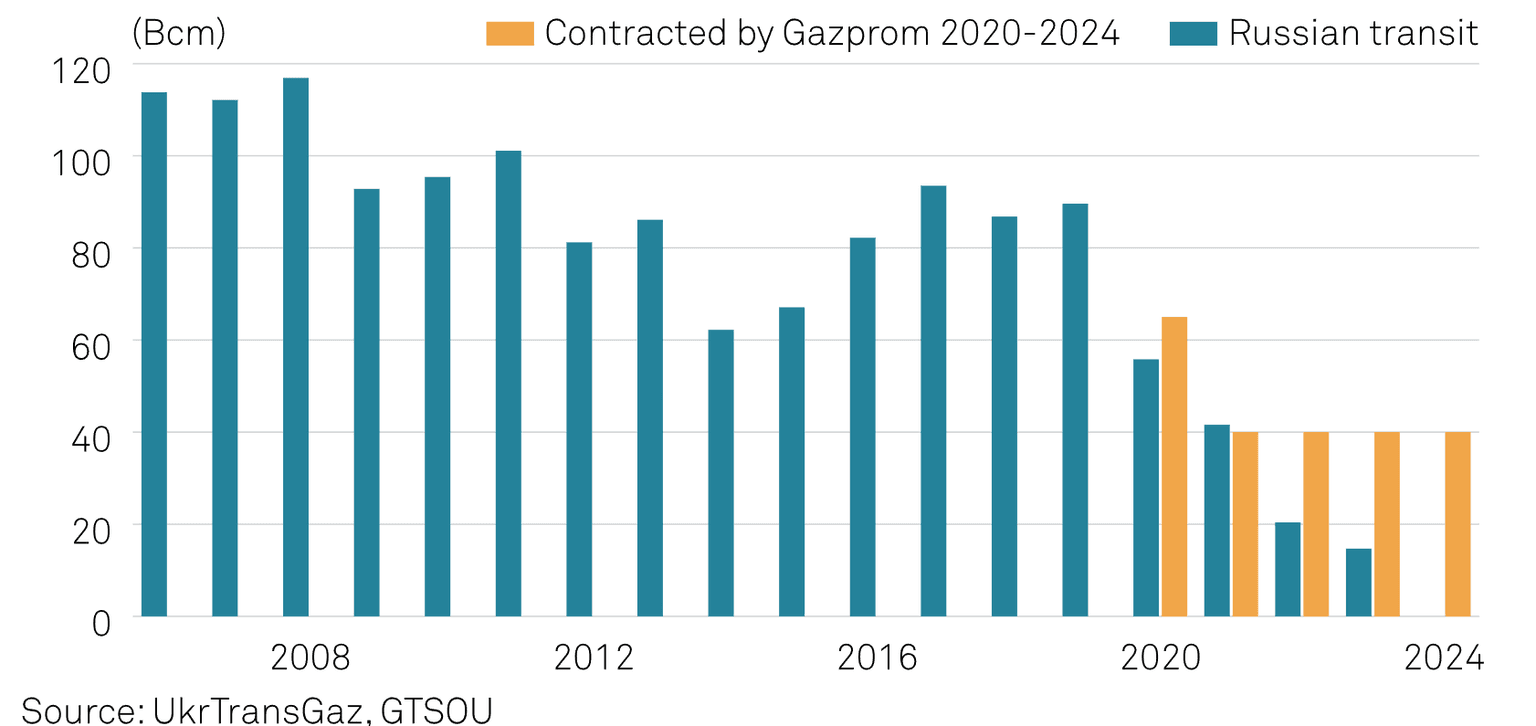
Russian gas transit through Ukraine between 2006 and 2023. Source: S&P Global
"In November, Gazprom transported 1.26 billion cubic meters of gas, or 38% of the contracted volume. This is 1% more than in 2023, but 59% less than in the same period of 2021," the AGPU said, according to the website.
The market is now waiting anxiously to see what will happen to Russian gas transit through Ukraine after the end of this year. Ukrainian officials have long said that they do not plan to extend the transit agreement with Russia. It is therefore highly likely that no Russian gas will flow through Ukrainian territory from the beginning of next year.
The uncertain future of natural gas supplies from Russia is also causing concern in Central and Eastern Europe. Although the Czech Republic has ended its dependence on Russian gas supplies in recent years, imports of Russian gas rose sharply in November.
In this case, however, the reason is not an inability to import gas from other sources, but the more favorable price once additional fees for transporting gas through Germany are taken into account. The German government has promised to abolish those fees from next year, but amid the country’s current political crisis, it is still not certain that this will happen on January 1. Representatives of Czechia, Slovakia and Austria again called on Germany this week to pass the necessary legislation as soon as possible.
Translation disclaimer
This article is a machine translation of the Czech original and has not yet been fully reviewed. In case of any doubt, please refer to the Czech version.
Sdílejte článek prostřednictvím:
You might also like

22 October 2026, 10:45