
23 October 2026, 14:38
Loading...
US election: Democrats split by hydraulic fracturing
Jan Žižka
13 June 2016, 18:49
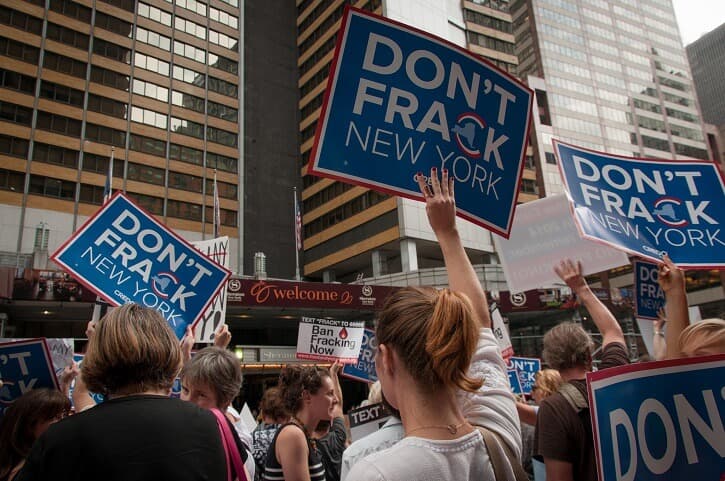
Will the era of “green” president Barack Obama be followed by another boom in renewables in America, or will the new head of state hit the brakes? And how will the United States’ new energy policy affect the whole world? We bring you another in our series of articles on “Energy and the US presidential election”.
Published so far:
- Energy and the US presidential election: America is divided by the “war on coal”
- Is Donald Trump a dinosaur? Voters’ verdict awaited
It was a meeting of two leading US Democrats – incumbent president Barack Obama and Bernie Sanders, until then a candidate to succeed him. On the second Thursday of June, Obama lavished praise on Sanders, intended to help ensure that the strongly left-wing candidate would no longer divide the party and would definitively make way for Democratic candidate Hillary Clinton.
However, anyone viewing the two men from a somewhat different energy perspective might be struck by the very different positions they effectively represent on one of the biggest phenomena in US energy and the economy in recent years – the so-called shale boom and the controversial method of “hydraulic fracturing” (known as fracking) used in oil and gas extraction.
America experienced its major shale boom under Barack Obama, who generally presented himself as a very “green” president. And fracking long helped sustain that image too – thanks to the more frequent use of shale gas at the expense of “dirtier” coal, and thus lower carbon dioxide emissions.
A green president?
“Hydraulic fracturing”, which is part of extracting resources from shale, will simply remain associated with the Obama era. For critics of shale extraction, Barack Obama was far from as green a president as he appeared at first glance. And Bernie Sanders would outright and uncompromisingly ban this extraction method involving water, sand and chemicals.
Hydraulic fracturing effectively split the Democrats during this year’s election campaign. Sanders certainly shifted the entire debate substantially to the left, and Clinton also adopted a highly cautious position, but she remained a target of criticism – in Sanders’s eyes (and above all according to his statements), she had not ceased to be a defender of the disputed method.

“She supported and continues to support fracking despite the fact that we are facing a clean water crisis,” Sanders said of Clinton during the Democratic primaries. Alongside methane leaks, given methane’s potency as a greenhouse gas, and the triggering of earthquakes, groundwater pollution is among the main criticised side effects of hydraulic fracturing. Experts disagree over whether these objections are justified and, if so, how severe these negative effects are.
Taking shale to the world
Clinton faces criticism connected with her tenure as secretary of state during Obama’s first term. Not only was America itself experiencing a shale boom at the time – US shale gas production increased sevenfold between 2008-2015 – but it decided to spread it around the world. Officials in Washington’s diplomatic service actively encouraged other countries to extract shale resources.
At the time, this was driven by “green” intentions – the fight against climate change. And, of course, by strengthening the US position relative to other resource-producing countries, including Russia. Incidentally, complete US energy independence is precisely the argument for continuing shale extraction now used by Republican candidate Donald Trump. For Trump’s supporters, both Clinton and Sanders threaten US interests as well as the prospects of the US economy, which benefits greatly from cheap shale gas and the ability to reduce oil imports from abroad.
Sanders, however, reproaches Clinton for the fact that her position at the time instead harmed America – specifically, its environment.
How Clinton changed course
It must be added that today’s Clinton is – clearly also under Sanders’s influence – made of rather different stuff. In her view, fracking is possible only if three conditions are met. First, the candidate rejects it where there is opposition at the local or individual state level.
Clinton also does not support hydraulic fracturing where it is linked to methane leaks or water contamination. Her third condition is that everyone who fracks must disclose the exact composition of the chemicals used.
The former first lady, secretary of state and leading presidential candidate even went so far as to express her conviction that, if all these conditions were met, there would not be many places left in the US where hydraulic fracturing could be used.
Opinions again differ sharply on whether this is really the case. For example, rules requiring the disclosure of chemicals already apply in most states. For critics, Clinton’s position may therefore be merely for show and in reality intended to preserve shale extraction for another term.
An economic boost
Of course, there is also an ironic assumption that hydraulic fracturing has contributed strongly in recent years to the relatively good state of the US economy, which might be more favourable to the Democrats as Barack Obama’s successors.
The sevenfold increase in shale extraction between 2008-2015 led to a threefold fall in gas prices. This was a major boost for an economy struggling with a crisis. Some sectors of US industry got a second wind – primarily petrochemicals, but also related sectors. New jobs for highly qualified workers were created in the US.
In oil and gas extraction, America rose to the very top of the world rankings. According to a recent BP statistical report in 2015, the United States ranked first in the world in both oil production (12,7 million barrels per day, narrowly ahead of Saudi Arabia) and gas production (767 billion cubic metres per year).
America attracted new foreign investors. Last but not least, terminals for exporting liquefied natural gas began to be built. It is also true that the shift from coal to gas has so far contributed substantially more to reducing US greenhouse gas emissions than the development of renewables. Europe’s now familiar lament is that America achieved both better economic results and more significant improvements in air protection.
Risks and limits to growth
Today, however, it is primarily Republicans who warn about the risks of banning hydraulic fracturing. A renewed rise in gas prices would at least weaken America’s advantage over Europe and the rest of the world in terms of the appeal of lower industrial energy costs. On the other hand, another of Donald Trump’s fossil-fuel plans – reviving coal mining – might work out better for him.
Not all such arguments are accurate. Much earlier, voices from America had already suggested that the shale boom also has limits to its growth. Easily accessible extraction areas will gradually become scarcer, making it harder for Americans to compete on price with the rest of the world. The effect of displacing coal will also be exhausted, and further emissions reductions in the energy sector will only be possible through the development of renewables, or nuclear energy.
On the other hand, it must be taken into account that Americans will use ever more sophisticated technologies in hydraulic fracturing, which may have both economic and environmental consequences. That is, both the ability to extract resources at ever lower costs and a more environmentally friendly approach thanks to a more suitable mix of water, sand and chemicals.
The author works as a consultant and energy projects specialist at the HATcom agency.
Lead photo: Flickr @ CREDO: Cuomo Policy Summit 8/22/2012
Translation disclaimer
This article is a machine translation of the Czech original and has not yet been fully reviewed. In case of any doubt, please refer to the Czech version.
Sdílejte článek prostřednictvím:
You might also like

23 October 2026, 11:01
23 October 2026, 06:34