23 October 2026, 06:34
Loading...
Whoever controls Sudzha, gas is still flowing through it
Klára Čeperová
16 August 2024, 08:42
Austria, Hungary and Slovakia have confirmed that gas is still flowing to them despite the unclear situation at the measuring station at the Sudzha border point. The countries have also agreed to continue reducing their dependence on Russian gas.
Intense fighting between Ukrainian and Russian forces near the pipeline through which Russia supplies gas to European countries has not disrupted deliveries, network operators and gas companies told Euractiv.
Russia’s Gazprom also said on Tuesday that it was still sending gas to Ukraine via Sudzha, which lies just across the border with Ukraine and is under Ukrainian control, as a video published by Seznam Zprávy appears to show. The point is used to transport gas from western Siberia through Ukraine to Slovakia and other European Union countries.
The smooth flow through Sudzha, in line with expectations, is also indicated by the ENTSOG Transparency Platform.
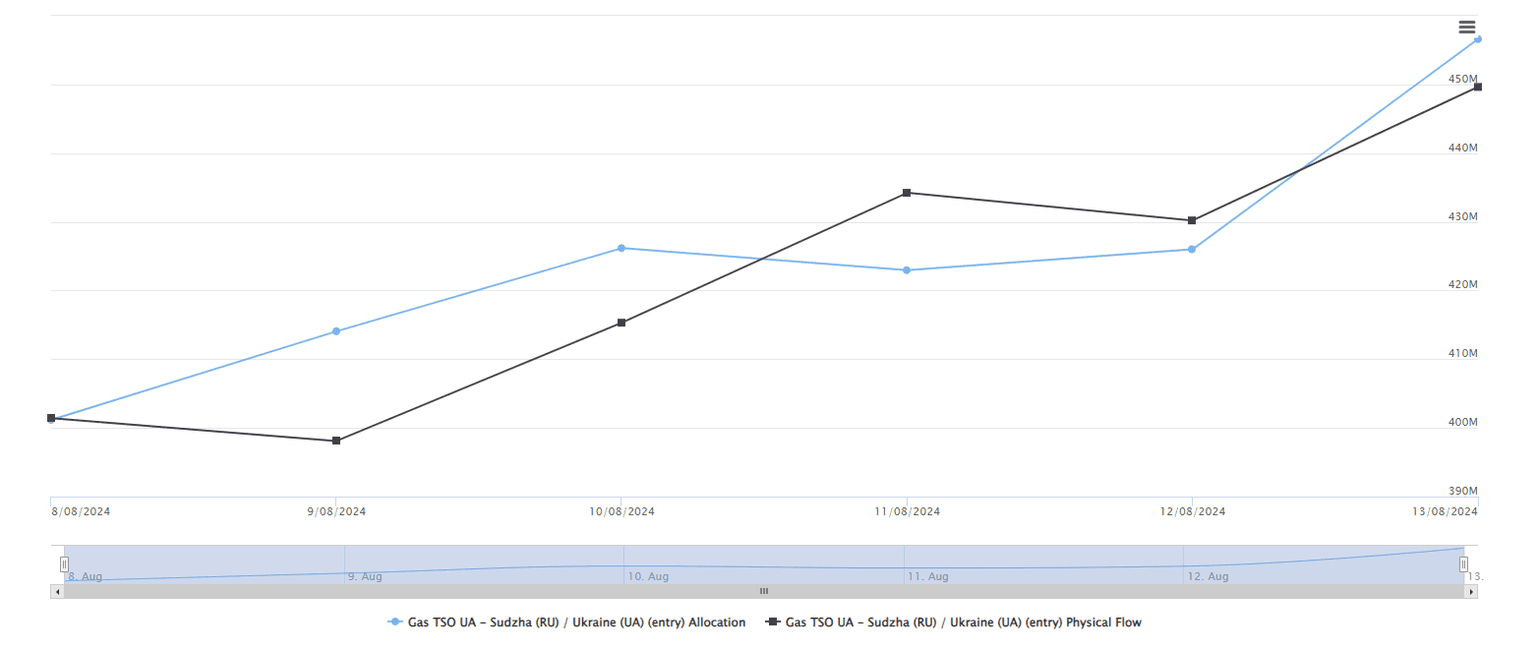
Transparency platform: Allocations and physical flows at the Sudzha IP
Importers’ perspective
Most countries importing gas via Ukraine said they were preparing for deliveries to stop at the end of this year, when the transit agreement between Ukraine and Russia is due to expire anyway, as Ukraine has said it does not want to extend it.
A source at Austria’s energy ministry told Reuters that Austria has been taking measures over the past two years to reduce its dependence on Russian gas over the long term.
“As things stand today, no supply problems are expected in Austria, because storage levels are high and Russian gas could be replaced via Germany or Italy. However, if supplies were to stop immediately, Austria would face an economic burden, particularly from Germany’s gas storage levy,” the Austrian energy regulator E-Control said in a statement.
Ukraine is connected to Slovakia, Poland, Romania and Hungary by eight points through which Russian gas can reach the EU. Two are currently in use—at the Polish and Slovak interconnection points—and volumes can then be transferred to other Central and Eastern European countries, according to analysts at Kpler Insight.
They estimate that Slovakia’s anticipated use of Ukrainian flows in 2023 would amount to almost 80%.
“This dependence could increase if inflows from Hungary fell and a cold winter set in, as Russian gas would not be available to replenish storage,” they said.
Ending dependence
Slovak gas company SPP said it had been preparing for the risk of Russian gas supplies being halted for several years and had signed commercial contracts with non-Russian suppliers.
Hungary receives approximately one billion cubic metres of Russian gas per year through a pipeline from Austria, and a spokesperson for the Hungarian gas pipeline operator said that gas was still flowing.
The European Union drastically reduced its dependence on Russian gas after the war in Ukraine began in 2022, leaving Austria as the EU country most dependent on Russian supplies.
“We are not aware of any pressure fluctuations, all nominations are proceeding as planned, and there is no indication of any irregularities,” said Armin Teichert, a spokesperson for Gas Connect Austria.
Translation disclaimer
This article is a machine translation of the Czech original and has not yet been fully reviewed. In case of any doubt, please refer to the Czech version.
Sdílejte článek prostřednictvím:
You might also like
22 October 2026, 10:45