
28 October 2026, 15:10
Loading...
Containment installation successfully completed on Haiyang 3 reactor

Jiří Puchnar
21 March 2024, 12:29
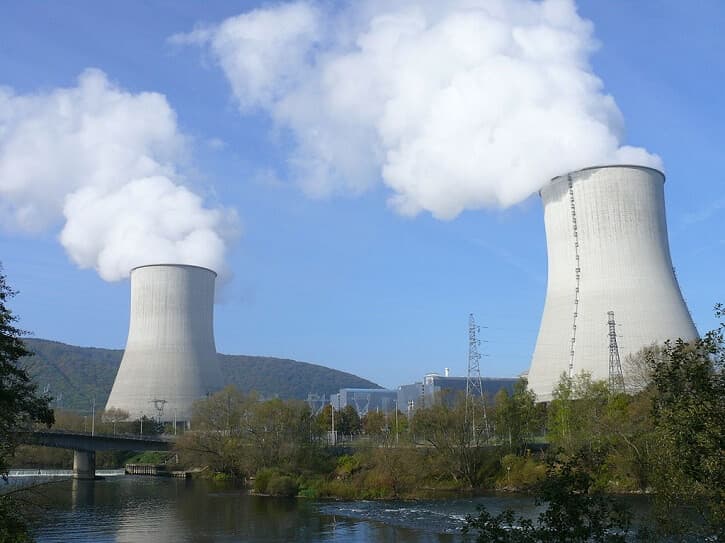
The third and final cylindrical containment ring has been installed on Unit 3 at the Haiyang Nuclear Power Plant in China’s Shandong Province. A nuclear reactor’s containment is a key component of a nuclear power plant’s safety barriers. Its primary function is to prevent radioactive materials from escaping into the environment in the event of an accident.
Containment design and composition
The containment for the CAP1000 reactor, China’s adaptation of the Westinghouse AP1000 design, is assembled from five main modules:
- lower section
- first cylindrical ring
- second cylindrical ring
- third cylindrical ring
- upper closure
The third cylindrical ring, which was installed on 16 March, has an inner diameter of nearly 40 metres, a height of 11.6 metres and a weight of approximately 660 tonnes. The operation took less than two hours and is considered a technical success.
Installing the third containment ring not only improves construction efficiency by making the ring crane available, but also reduces safety risks. This step lays the foundation for further construction milestones and ensures a stable structure for the future operation of the nuclear power plant.
Expansion of China’s nuclear programme
China’s nuclear programme continues to expand, with plans to build two CAP1000 reactors at each of the Haiyang, Sanmen and Lufeng nuclear power plant sites. The decision, approved by the State Council on 20 April 2022, includes the construction of Haiyang 3 and 4, Sanmen 3 and 4, and Lufeng 5 and 6.
The first unit at Haiyang entered commercial operation in October 2018, and the second unit followed in January 2019. The plant now supplies up to 20 TWh of electricity per year. This output meets the needs of almost one-third of households in Shandong Province. With Haiyang 3 and 4 scheduled for completion in 2027, the share of clean electricity generation in the region will increase further.
Completion of the containment on Haiyang 3 is not only a technical success, but also a step towards strengthening the region’s energy independence. The project is part of China’s efforts to reduce the carbon footprint of its energy sector, as well as the global effort to transition to more sustainable and safer forms of electricity generation. The construction and development of new nuclear power plants are therefore in the spotlight not only for experts, but also for the wider public, which is following the future direction of the energy sector.
Translation disclaimer
This article is a machine translation of the Czech original and has not yet been fully reviewed. In case of any doubt, please refer to the Czech version.
Sdílejte článek prostřednictvím:
You might also like

28 October 2026, 13:08

28 October 2026, 11:10

28 October 2026, 09:08
