Czech Dukovany and Temelín: Will the French return? Perhaps backed by Asians
You damaged our reputation. That was the response of France’s Areva when, just under four years ago, Czech energy leader ČEZ excluded it from the tender to expand the Temelín nuclear power plant in South Bohemia.
From today’s perspective, the episode is almost amusing. Since then, Areva has faced so many scandals, problems in building new reactors and financial difficulties that the Temelín incident seems like little more than a drop in the ocean.
On the other hand, none of Areva’s aforementioned difficulties changes the fact that France remains a country at the global forefront thanks to its know-how. Moreover, the French are the only possible supplier of new reactors from European Union countries. It is therefore logical that Prague will invite them to take part in a new tender to expand Dukovany or Temelín.
For now, let us set aside the question of whether Czechia will actually decide to build new nuclear power plant units. Even the new nuclear energy commissioner, Ján Štuller, is not entirely certain of it.
Waiting for now
Could the days return when many considered the French to be the leading favourite in the ultimately cancelled Temelín tender? Industry Minister Jan Mládek recently indicated that communication with French companies has not yet properly got under way. This is linked to the transformation and break-up of the entire Areva company. Another French company, Électricité de France (EDF), will take over construction of new reactors from it.
The entire operation will be made possible by the fact that the French state holds majority stakes in both Areva and EDF. It has decided to come to the aid of its companies. EDF is admittedly in a substantially better position than Areva, but even this company is not doing particularly well at a critical time, in terms of building new nuclear capacity in Europe and low electricity prices.
What is certain is that the French are not giving up and want to build more reactors not only in Europe but also elsewhere in the world. “France will continue investing in nuclear energy,” said Economy Minister Emmanuel Macron.
Dismal experience
However, the French now face a crucial decision on whether to invest in new EPR reactors (originally the European Pressurized Reactor) at the Hinkley Point power plant in England. EDF has confirmed that it will proceed with this project, which is crucial for its immediate future, but a final decision is still pending.
The fact is that the experience so far with building EPR reactors in Europe has been dismal. French newspaper Libération called the project at Finland’s Olkiluoto “an industrial and financial disaster” – it is around a decade behind schedule and its total budget has already been exceeded by nearly EUR 5 billion.
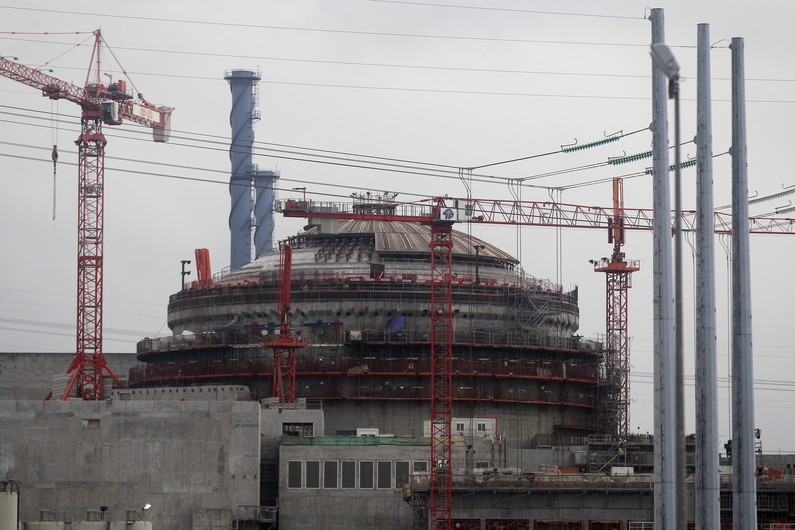
The project at Flamanville in France is not doing much better. It was there, moreover, that the scandal over a faulty reactor vessel emerged, raising British doubts about building reactors of the same type in the United Kingdom.
The same offer at Temelín
And let us recall that it was EPR reactors that Areva also offered in the Temelín tender. At the time, doubts arose, among other things, over whether such large 1,650-megawatt reactors were even suitable for South Bohemia. However, the French argued fairly credibly that two EPR reactors, which Areva would build at Temelín, would effectively provide the output of three with their 3,300 megawatts, eliminating the need to build another unit at Dukovany.
Yet another doubt became increasingly serious, one gradually shared by a number of nuclear experts: the sophisticated EPR reactor, with its many safety features, may have represented the absolute global state of the art, but it turned out that it was perhaps “too advanced”. Its complexity is precisely what drives up costs and causes delays.
On the other hand, the argument must also be considered that Flamanville and Olkiluoto represented the complete launch of a new technology. Thanks to the experience gained in France and Finland, further projects can now be delivered much better…
Too large for Dukovany?
Even so, it is debatable whether the Czechs would consider the EPR reactor the best “purchase”. The situation in Czechia has also changed rather fundamentally since the Temelín tender was cancelled. There is increasingly frequent talk that the next new reactor – if any – will be built at Dukovany rather than Temelín.
And while the “giant reactor” EPR might still be acceptable in South Bohemia, installing it at Dukovany would be much more complicated, including because of the site’s limited water-cooling options.
Perhaps even that would not be an insurmountable problem. Nevertheless, another “French solution” may appear more promising to many.
Given the Temelín tender, many Czechs have so far associated “French nuclear power” with Areva and the EPR reactor. They are slowly beginning to get used to the fact that future talks will be held with another company, EDF. But could another French reactor also be in play?
The fact is that the options under consideration include the smaller Atmea 1 reactor with an output of 1,100–1,200 megawatts. It is not purely French, as it is jointly developed by France’s Areva and Japan’s Mitsubishi Heavy Industries, combining the technological strengths of both companies.
EDF courts the Japanese
EDF is also becoming increasingly involved in the Atmea project. At the end of June, the company’s chief executive Jean-Bernard Lévy signed a memorandum of understanding with Mitsubishi president Shunichi Miyanaga. This is a broader partnership that also includes support for the construction of Atmea reactors, initially in Turkey and Vietnam.
The question, of course, is whether the French would agree to deploy Atmea in Europe – so far, they have targeted this reactor particularly at developing markets outside the old continent. Its defeat in 2009 in the United Arab Emirates by the Koreans, where the sophisticated but expensive EPR reactor lost out, probably also contributed to this.
More generally, however, the French have increasingly been betting on cooperation with Asians following problems in their own nuclear industry. While with the Japanese they are moving towards combining know-how, with the Chinese they are relying in particular on their financial strength. Chinese companies are expected to participate financially in the Hinkley Point project, and their possible equity entry into French companies is also under consideration.
A dance among Asians
In Mitsubishi’s case, too, there has been discussion that the Japanese company could acquire an equity stake in Areva’s existing reactor business, in which EDF is due to take a majority stake from next year.
These Asian courtships have nevertheless caused the French another headache. According to Japanese sources, their talks with the Chinese last year triggered considerable concern in Tokyo. All the more so because the original agreement on the Atmea joint venture between Areva and Mitsubishi dates back much further, to 2007. The Japanese feared that the three-way dance between Paris, Tokyo and Beijing might ultimately lead to the Chinese obtaining know-how from their partners on favourable terms.
Speculation also emerged in Czechia that the Chinese could ultimately arrive at Dukovany or Temelín with French technology.
Czechia and France: A new start?
Many such uncertainties may be clarified during forthcoming French-Czech talks, which could become more frequent given the two countries’ still similar “nuclear” interests in the European Union. Industry Minister Jan Mládek also indicated that, alongside foreign companies’ activities at Dukovany or Temelín, he expects them to involve Czech companies in projects abroad. Any conclusions in this respect would be premature at this point.
The author works as a consultant and energy projects specialist for the HATcom agency.
Translation disclaimer
This article is a machine translation of the Czech original and has not yet been fully reviewed. In case of any doubt, please refer to the Czech version.