Czech heating plant in České Budějovice to use heat from Temelín for first time this season

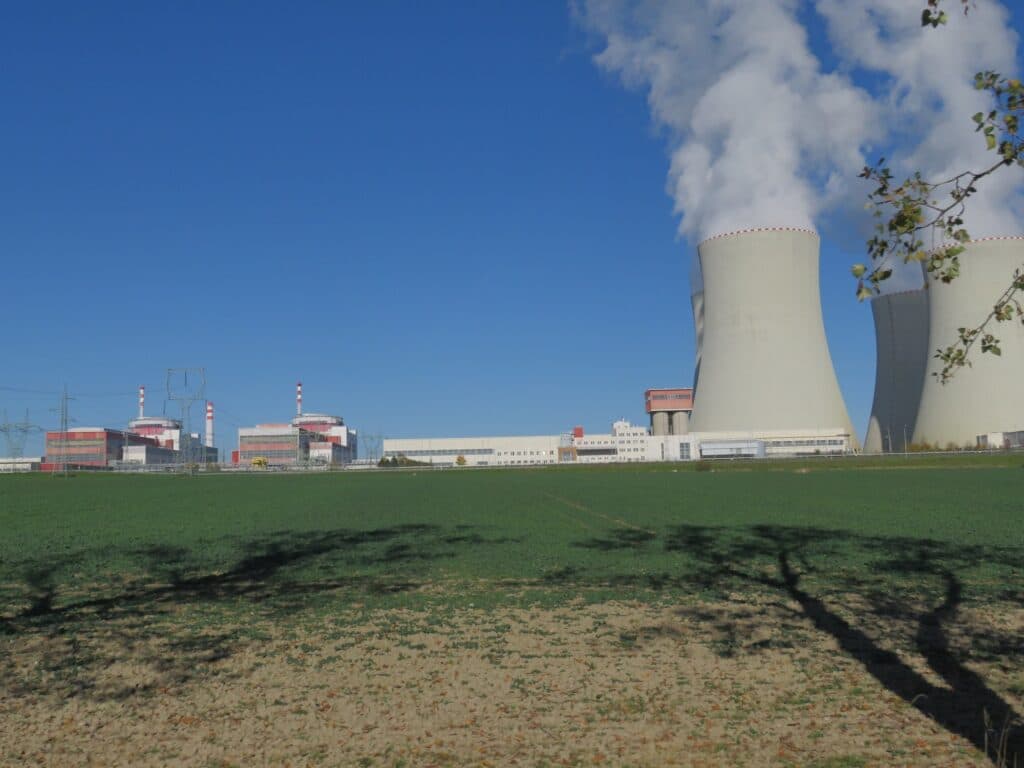
In the new heating season, the České Budějovice heating plant will change its fuel mix for the first time. Heat supplied through a pipeline from the Temelín nuclear power plant will replace some of the coal it burns. Emissions, including greenhouse gases released into the air, will fall by around a third. In the new heating season, the company will also start burning wood chips instead of coal in boiler K12. The municipal company said so in a press release.
The Temelín pipeline will cover 30 percent of Budějovice’s heat demand, supplying up to 800 terajoules a year, according to information in the heating plant’s newsletter. Temelín is expected to supply a third of the heating plant’s customers. The company will thus save more than 80.000 tonnes of carbon dioxide emissions a year by not burning coal, Temelín spokesperson Marek Sviták previously told ČTK. The hot-water pipeline is expected to supply 800 terajoules a year for at least 20 years. This will be the first step towards ending the plant’s use of coal. The pipeline is expected to cover the heat consumption of around a third of the plant’s customers; the company will supply the rest from its own sources.
“This is the first major investment in gradual decarbonisation, a decision made by city representatives back in 2017. Construction of the wood-chip boiler at the Novohradská site is also continuing, and we are systematically preparing the Vráto waste-to-energy plant,” said Václav Král, chairman of the board of the České Budějovice heating plant.
The biomass boiler will already be in trial operation during this heating season, said Martin Žahourek, a member of the heating plant’s board. The new wood-chip boiler will then cut coal consumption by approximately another third.
České Budějovice had relied on coal since 1908, when the municipal coal-fired steam power plant was established. In the 1960s, it was converted into a heating plant burning lignite.
Two 26-kilometre pipelines with an outer diameter of 80 centimetres connect Temelín with Budějovice. Both pipelines are buried at least 1.3 metres underground. “In winter, water at temperatures of up to 140 degrees Celsius will flow to České Budějovice; for the rest of the year, a temperature of 90 degrees Celsius will be sufficient,” Sviták said.
The hot-water pipeline was built by ČEZ, at a cost of 1.69 billion Kč. ČEZ originally announced that the pipeline would start supplying heat to Budějovice at the turn of 2020 and 2021. Construction began in spring 2019. The project was delayed by around two years. Work stopped for about a year from the end of 2020 after construction company Tenza went bankrupt. At the end of 2021, ČEZ selected the companies that would complete the pipeline: Elte and Energie – stavební a báňská.
Temelín is the country’s largest electricity producer, covering around one-fifth of domestic consumption. Last year it generated 16.29 terawatt-hours (TWh) of electricity. The plan to connect the nuclear power plant with the regional capital first emerged in the mid-1980s.
The České Budějovice heating plant supplies heat to around 30.000 apartments and more than 400 companies, institutions, schools, healthcare facilities and shops. Last year it sold 1463 terajoules of heat, recorded revenue of 1.3 billion Kč and posted an after-tax profit of 23.1 million Kč, according to its annual report.
Translation disclaimer
This article is a machine translation of the Czech original and has not yet been fully reviewed. In case of any doubt, please refer to the Czech version.