
23 October 2026, 14:38
Loading...
Framatome successfully verifies accident-tolerant nuclear fuel

Jiří Puchnar
23 November 2024, 13:52

Fuel assemblies using Framatome's PROtect Enhanced Accident Tolerant Fuel (E-ATF) technology have successfully completed four 12-month fuel campaigns at the Gösgen nuclear power plant in Switzerland. This type of accident-tolerant fuel is the first in the world to achieve successful operation with full-length fuel rods at a burnup of 60 GWd/tU.
E-ATF technology features chromium-coated M5Framatome fuel rods. The chromium layer on the cladding significantly increases resistance to oxidation, improves mechanical properties at high temperatures and minimises hydrogen production in the event of a loss of cooling. These improvements represent a major advance in the safety and resilience of fuel assemblies during accident conditions.
Operational success at Gösgen
Framatome's advanced fuel rods combine a chromium coating with the modern M5Framatome zirconium alloy and uranium dioxide (UO₂) fuel pellets, or a chromium-enriched version of the same. The fuel assemblies were manufactured at Framatome's plant near Lingen, Germany.
During the Gösgen reactor's scheduled spring outage, which included refuelling and routine maintenance, visual inspections and measurements of changes in fuel dimensions were carried out. The inspections confirmed the expected results and excellent performance observed during the three previous fuel campaigns. The fuel assemblies are now due to be reloaded into the reactor for operation during the fifth fuel cycle.
Close cooperation with the nuclear industry
“This success confirms our commitment to bringing innovative technologies to market,” said Lionel Gaiffe, executive vice president of Framatome's nuclear fuel division. “The project's results reflect the close cooperation between Framatome and our customers, which is key to the future of energy and meeting growing energy demand.”
PROtect Enhanced Accident Tolerant Fuel technology has been tested worldwide in six nuclear reactors (five different reactor types).
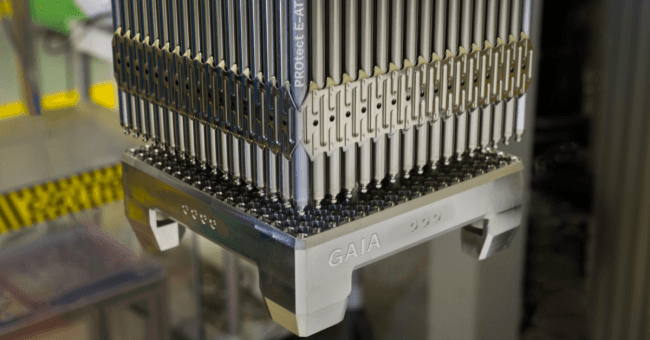
Detail of a Framatome E-ATF fuel assembly. Source: Framatome
Accident-tolerant nuclear fuel represents another step in the development of nuclear fuel design. This technology increases fuel resilience during severe accidents while also helping to improve reactor performance and economic efficiency. Development involves the use of new materials and innovative design approaches for cladding and fuel pellets.
The three main suppliers—Framatome, GE Hitachi with GNF, and Westinghouse—are working with the US Department of Energy to develop these advanced fuel types under the Accident Tolerant Fuel Program.
Translation disclaimer
This article is a machine translation of the Czech original and has not yet been fully reviewed. In case of any doubt, please refer to the Czech version.
Sdílejte článek prostřednictvím:
You might also like


23 October 2026, 11:01


23 October 2026, 06:34