
23 October 2026, 14:38
Loading...
New Paks II reactor receives key permit for first concrete pour

Jiří Puchnar
5 December 2024, 11:13
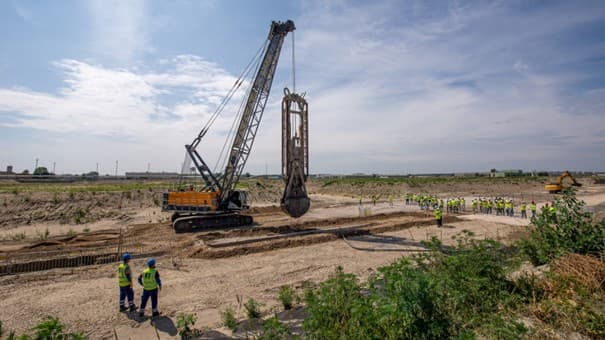
Hungarian Minister of Foreign Affairs and Trade Péter Szijjártó announced that the first concrete pour for the new Paks II nuclear unit will take place in early 2025. The step follows approval of the preliminary safety report by the National Atomic Energy Authority.
According to Szijjártó, approval of the report is one of the project’s most significant milestones. The document, which runs to half a million pages, meets the standards of the International Atomic Energy Agency (IAEA). Once the first concrete is poured, the construction site will officially be classified as a nuclear facility under construction.
Excavation is currently under way to a depth of 23 metres, and 39,000 of the 75,000 piles that will be drilled into the ground to stabilise the soil have already been completed. Szijjártó also said that thousands of people are now working at the construction site.
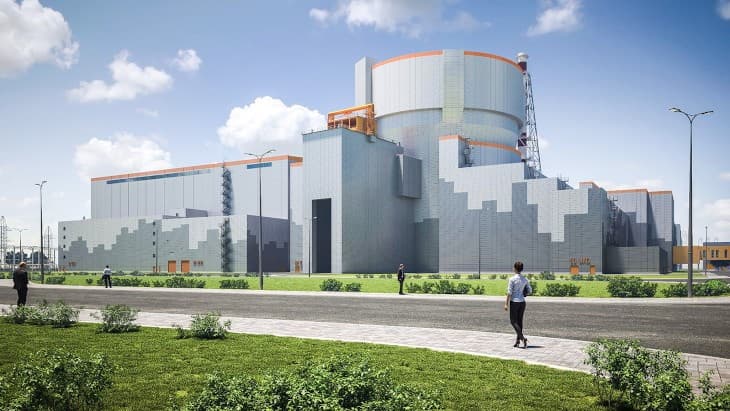
Rendering of the new VVER-1200 reactor at the Paks nuclear power plant. Source: Paks2
In August 2024, the first major piece of equipment for the nuclear power plant, a so-called core catcher, was delivered to the construction site. Also known as a “melt trap”, the device is cone-shaped and made of heat-resistant steel. In the event of an accident, it safely catches molten core material and prevents radioactive substances from escaping the reactor containment.
Permit for the first concrete pour
In an official announcement, the National Atomic Energy Authority (Országos Atomenergia Hivatal, OAH) said it had decided to lift the so-called hold point specified in the construction permit for the new units at the nuclear power plant. The decision allows key activities to begin, including the first concrete pour for the new unit’s nuclear island.
The OAH stressed that these activities can begin only once additional technical and administrative conditions have been met, such as obtaining a permit to use the stabilised ground. Throughout construction, the OAH will monitor compliance with legal requirements and permit conditions through both announced and unannounced inspections.
History and future of the Paks II project
The Paks II project was launched in early 2014 under an intergovernmental agreement between Hungary and Russia. Rosatom will supply two VVER-1200 reactors, with most of the project financed by a Russian state loan. The application for a construction permit was submitted in July 2020, and the permit was issued in August 2022. Under the schedule approved last year, the new units are expected to be connected to the grid in the early 2030s.
The four existing units at the Paks power plant are VVER-440 reactors, which began operating between 1982 and 1987 and cover approximately half of Hungary’s electricity consumption. Their originally planned service life was 30 years, but in 2005 it was extended by a further 20 years, to between 2032 and 2037. In 2022, the Hungarian parliament approved a further extension of their operation, allowing preparations for the plant to operate long-term into the 2050s.
Translation disclaimer
This article is a machine translation of the Czech original and has not yet been fully reviewed. In case of any doubt, please refer to the Czech version.
Sdílejte článek prostřednictvím:
You might also like


23 October 2026, 11:01


23 October 2026, 06:34