3 October 2026, 13:01
Loading...
OECD: Tripling nuclear capacity by mid-century requires fundamental changes

Jiří Puchnar
8 July 2026, 13:53
A new OECD NEA analysis shows that current political ambitions for nuclear energy far outstrip the actual pace of construction. Achieving the most ambitious development scenarios will depend not only on the choice of technology, but above all on the availability of skilled workers, supply chain capacity and access to financing.
The OECD Nuclear Energy Agency has published a report, Nuclear Energy Outlook: Global Installed Capacity to 2050 and Beyond, assessing the possible development of installed nuclear capacity through 2050 and beyond. According to the NEA, nuclear energy is returning to the centre of energy strategies after decades of decline in many OECD countries, particularly in connection with energy security, decarbonisation and industrial competitiveness.
The International Atomic Energy Agency (IAEA) also regularly publishes a similar analysis.
Four development scenarios to 2050
The report considers four scenarios. Under the low scenario, global installed nuclear capacity would reach just 347 GWe in 2050, as new projects would not be enough to offset the retirement of some existing power plants in OECD countries.
The ambitious scenario envisages reaching 883 GWe, with a greater contribution from new construction and small modular reactors. Only the transformative scenario envisages capacity of around 1324 GWe in 2050—more than three times the current level. According to the NEA, this is the only scenario that would actually achieve the goal of tripling global nuclear capacity by 2050.
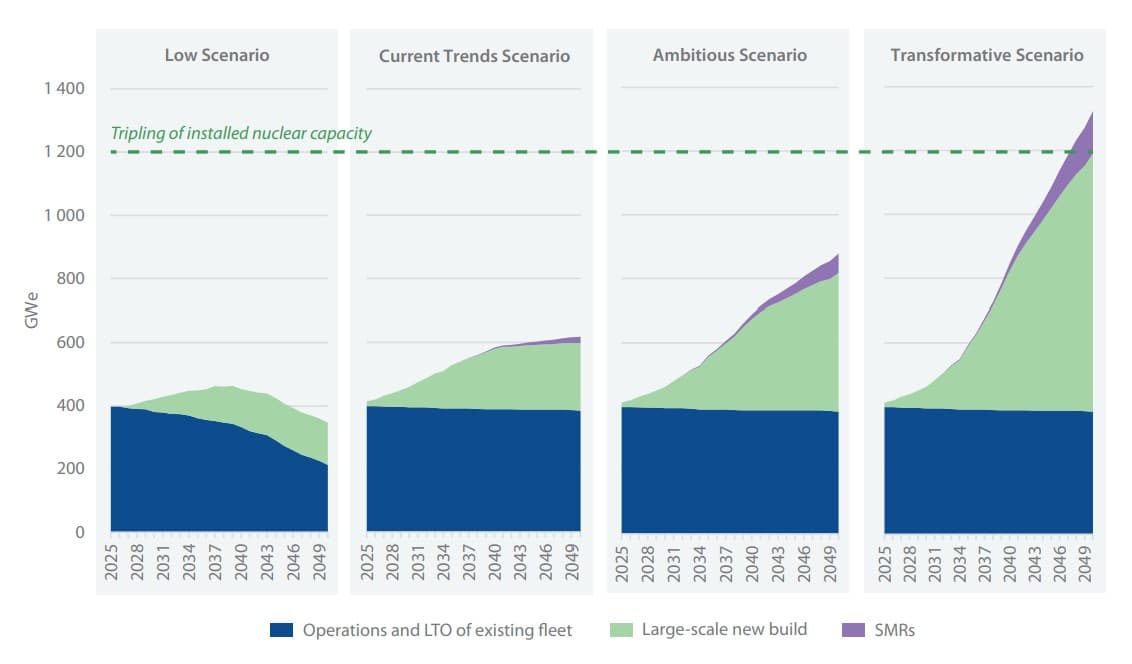
Scenarios for the development of global installed nuclear capacity to 2050, according to the OECD NEA. The analysis finds that global nuclear capacity is tripled only in the transformative scenario. Source: OECD NEA, Nuclear Energy Outlook: Global Installed Capacity to 2050 and Beyond.
The transformative scenario draws, among other things, on long-term national targets, such as the United States’ plan to increase domestic nuclear capacity from around 100 GW to 400 GW by 2050 and India’s target of reaching 100 GW of installed capacity by 2047. Alongside new construction, it also assumes the long-term operation of existing units and significant deployment of small modular reactors.
Construction is shifting beyond the OECD
The NEA also points to a geographical shift in nuclear energy development. According to the report, OECD countries account for around 78% of global nuclear capacity today, but most construction currently under way is outside this group. Of approximately 70 GWe of nuclear capacity under construction, around 80% is in non-OECD countries, with China playing the leading role at more than 33 GWe.
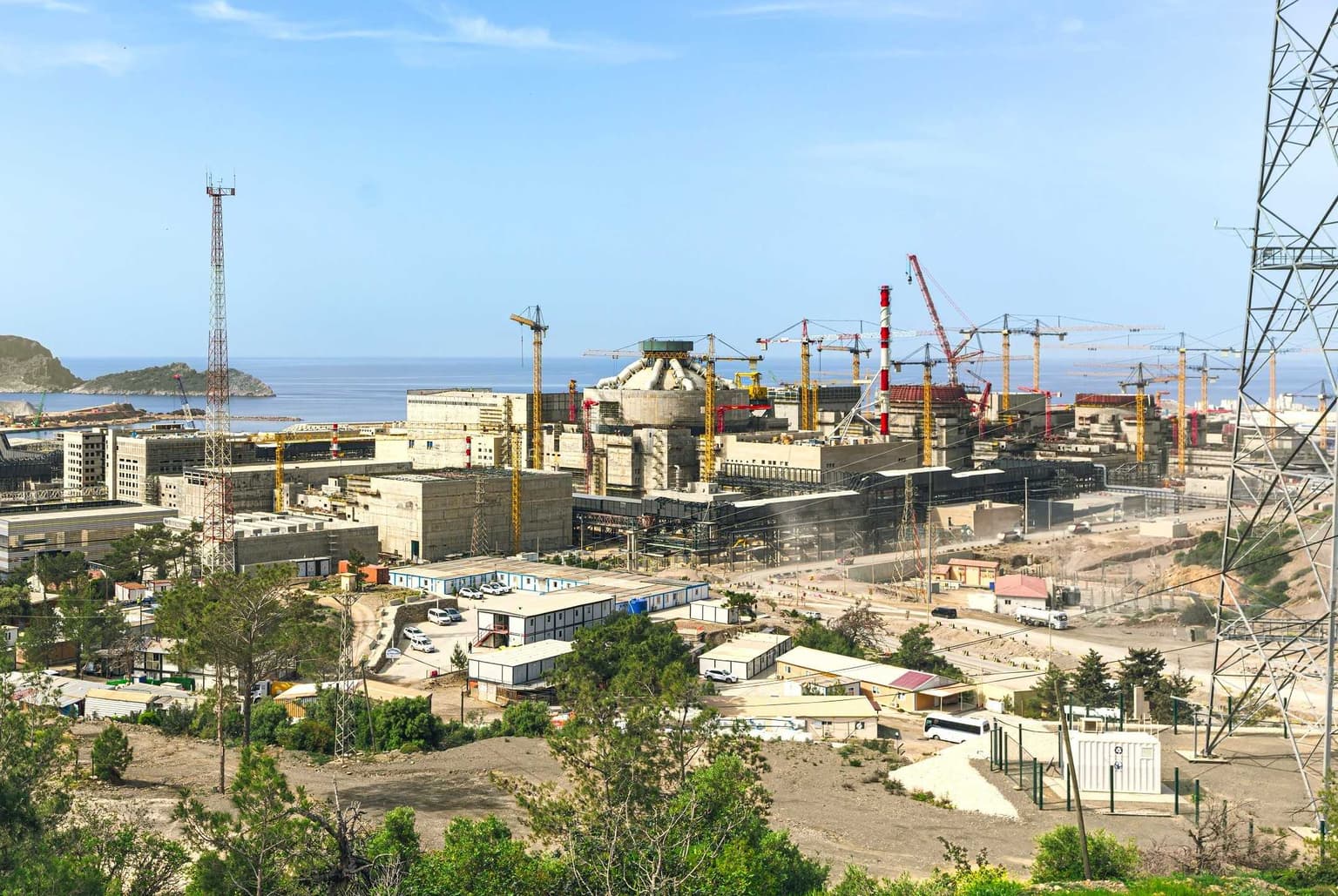
Akkuyu Nuclear Power Plant, VVER 1200, Turkey. Source: Akkuyu Nuclear
This development is also reshaping the position of nuclear technology suppliers. The NEA notes that China and Russia have a strong position in the international nuclear technology market, while suppliers from OECD countries have a significant but less developed pipeline of planned projects. For countries seeking to develop their own nuclear programmes, the ability to participate in stable and diversified supply chains will therefore be important alongside financing.
Without long-term operation of existing units, targets will slip further away
According to the NEA, long-term operation of existing nuclear power plants will also play an important role. The original operating licences for many units in OECD countries expire before 2040. Extending operation to 60 years, and in some cases to 80 years, could keep a significant share of reactor units online and reduce pressure to rapidly replace large low-emission power sources.
The report also notes that nuclear units with a total capacity of more than 50 GWe in OECD countries do not yet have licences allowing them to operate through 2040. If these sources were not kept in operation, the need for new construction and for ensuring a stable electricity supply would increase.
People, industry and capital will be decisive
According to the NEA, higher nuclear development scenarios will depend primarily on three areas: the workforce, supply chain capacity and financing. In many OECD countries, the slowdown in construction of new units over the past 25 years has weakened industrial capabilities and experience in managing large nuclear projects. The agency therefore recommends moving from individual, isolated projects to programmatic construction and closer cooperation between countries with similar priorities.
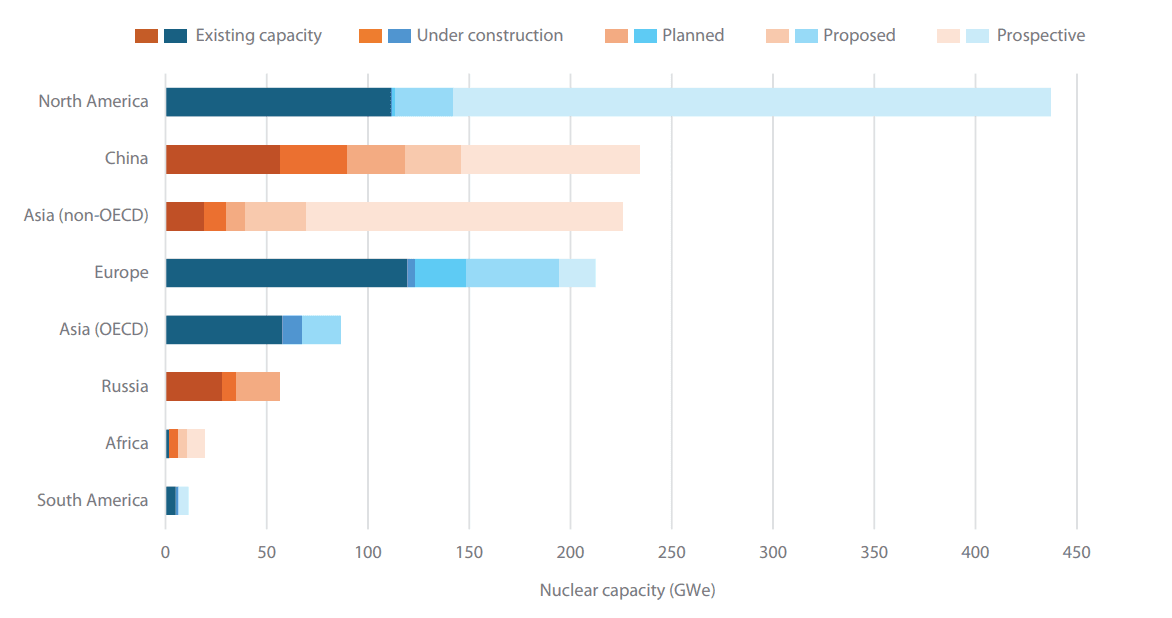
Nuclear power plants under construction, planned, proposed and prospective by region. The NEA report shows that the immediate focus of new construction is primarily outside OECD countries. Source: OECD NEA, Nuclear Energy Outlook: Global Installed Capacity to 2050 and Beyond.
According to the NEA, the financial requirements are exceptional. Global capital expenditure on new nuclear capacity has averaged around USD 30 billion a year in recent years, primarily thanks to projects in China and Russia. In OECD countries, however, annual investment would need to rise from around USD 12 billion over the past decade to an average of USD 68 billion a year to achieve the ambitious scenario. Under the transformative scenario, it would reach USD 143 billion a year, and requirements could approach USD 200 billion annually during the 2030s.
Given the pressure on public budgets, the NEA says private capital will need to be involved. This, however, requires projects with a clear allocation of risks, a predictable revenue model and government mechanisms to limit construction, market and political risks. Without such tools, a significant share of announced nuclear ambitions will remain merely political targets.
Translation disclaimer
This article is a machine translation of the Czech original and has not yet been fully reviewed. In case of any doubt, please refer to the Czech version.
Sdílejte článek prostřednictvím:
You might also like
3 October 2026, 07:43
2 October 2026, 21:55
2 October 2026, 15:14