23 October 2026, 14:38
Loading...
Reusing nuclear fuel does not yet make economic sense, says Czech radioactive waste expert
Ekonews.cz
9 December 2022, 13:59
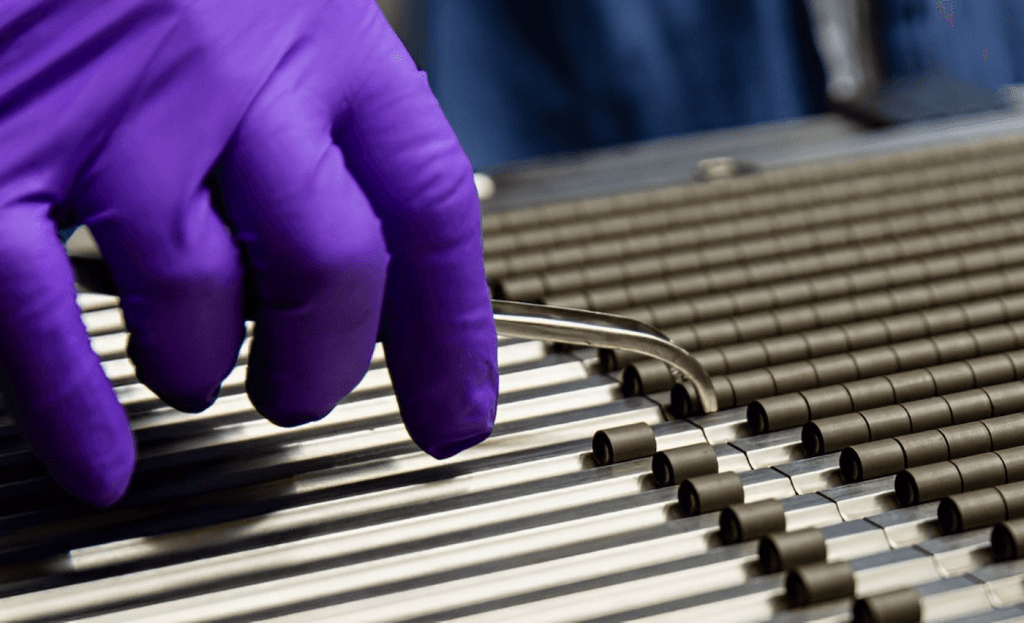
Uranium reserves for energy generation should last humanity at least a hundred years. However, spent nuclear fuel can still be partly used. But this would require converting current reactors so that they could operate on a mix of uranium and plutonium, says Radek Trtílek of ÚJV Řež, director of the Radioactive Waste and Decommissioning Division. At present, however, it is not worthwhile.
The institute is also preparing for the dismantling of nuclear power plants and the disposal of spent nuclear fuel in a deep geological repository. “We design it so that the civilisations that come after us can lose awareness that anything is stored there,” Trtílek says in an interview with Ekonews.
If we already had a selected and approved site for a deep nuclear waste repository, could we start building tomorrow? Is the technology ready and researched?
If we were in China or Russia, yes, because a single executive authority decides there. From the public’s perspective, the process of finding, selecting and confirming a site is the most closely watched aspect and the one with which people associate their concerns. But it is not just about finding a site. Such a project is subject to permitting not only under mining law, which has a centuries-long tradition here, but also under nuclear law. Administrative processes take ten to fifteen years. Existing plans assumed that 35 years would pass from identifying the final site to opening the repository, and under the Czech strategy we should open the repository in 2065. The European Union requirement says that anyone wishing to build nuclear generation or operate nuclear power beyond a certain time limit should have a repository available by 2050. If only technological and administrative deadlines are considered, that requirement can be met.
Is there no deep geological repository anywhere yet, or is there?
None is in operation yet. Finland is the furthest advanced in preparations, where opening is due in 2025. In Sweden, the programme was interrupted: a site had been selected, but there was a delay in the administrative process, and development has only now resumed. It is a matter of ten years before the repository is brought into operation. Others are being developed in France and Switzerland, where the relevant authorities approved the final site this year. They are ten years ahead of us.
But not everything has to go deep underground. Many types of radioactive waste are less dangerous, is that right?
There are several types of radioactive waste, and there is much more of it than spent nuclear fuel. It arises in medicine, research and nuclear power plants—from laboratory standards to protective equipment used by operations and maintenance staff. It contains only fractions of the activity found in fuel and is disposed of in near-surface repositories. Handling nuclear fuel is far more technologically demanding, including in terms of oversight. Storage and disposal must be distinguished. Disposal means placing it in a final repository and leaving it to natural processes. Storage is a technological activity fully controlled by humans.
Where are the near-surface repositories located?
Three are in operation. The oldest is the repository in the former Richard limestone mine near Litoměřice, beneath the twin ridges of Radobýl and Bídnice. During the Second World War, the Germans had an aircraft and tank engine factory there, where prisoners from Terezín worked. In 1964, part of the mine was modified for use as a radioactive waste repository. The mine is extensive, with only a relatively small part used as a repository. Waste from hospitals, research facilities, schools and industrial companies is disposed of there. Currently, around 500 barrels a year are sent there, or roughly one hundred cubic metres of waste.
How long is it disposed of there for?
Permanently. No one will remove it after the disposal chambers are concreted over. The accompanying engineering barriers and safety assessment assume 300 to 500 years of institutional control, after which it can be left to natural processes. The mine has thick layers of limestone rock both below and above it, providing excellent isolation from the biosphere. The mine itself is a straight adit cut into a hillside ridge, with a gentle slope from the inside out, so that any water flowing there does not flood the mine.
And the other repositories?
The second repository is in the former Bratrství uranium mine near Jáchymov. It is also a horizontal adit, originally an exploratory one. It receives radioactive waste contaminated with naturally occurring radionuclides, rather than radionuclides produced artificially here. Uranium is typically not used only as fuel for power plants; it is also an excellent shielding material, and many containers are made of depleted uranium. The Bratrství repository will soon be full, and closure and the end of operations are expected by 2030. The aim is not to keep drilling there and looking for further disposal space.
On the other hand, the system of the aforementioned Richard mine near Litoměřice makes it possible to create further disposal chambers, so waste disposal could move there.
The third repository is at the surface. It consists of partially buried and partially protruding concrete vaults at the Dukovany nuclear power plant site. This repository receives non-fuel waste from the nuclear power plant, such as used protective equipment, small replacement parts after replacement work, or waste filtered from reactor water. All these near-surface repositories are state-owned and managed by the Radioactive Waste Repository Authority.
Germany wanted to close its last three nuclear power plants this year and switch to green energy, but is now postponing this until next spring due to the energy crisis. Among the services your institute offers is “decommissioning nuclear facilities”. Would you be interested in participating in the dismantling of German nuclear plants?
We are pursuing this. We have contacts in Germany and can cooperate with them on certain matters. However, I would say that the German market is closed in this respect. The Germans assume they can do most things themselves and will be more likely to seek capacity than know-how.
Unlike Germany, Czechia is discussing the completion of the Temelín nuclear power plant. The older Dukovany plant is already approaching the end of its operating life. When should it be dismantled?
That has not been determined. The plant operator, ČEZ Group, assumes a 60-year operating life, with the first unit operating since 1985 and the last since 1987. The 60-year period is based on the operating life extension permit, which in turn relies on a number of studies on reactor pressure vessel lifetime. This is determined using so-called surveillance irradiation specimens (monitoring changes in the material’s mechanical properties, editor’s note), which are regularly removed and assessed in Řež. Every five years, the estimate of the pressure vessel’s lifetime is therefore refined again. Sixty years is not a point at which it starts falling apart. It is long before the safety limit for the material’s lifetime could theoretically be reached. Political considerations or the European Commission’s view are another matter.
How long will uranium last humanity at the current rate of use in nuclear power? Should we not conserve it?
Available resource reserves are assumed to last a hundred years. As exploration and mining efficiency improve, this estimate remains the same today as it was thirty years ago. Reprocessing nuclear fuel could extend it by 40 years. For fission reactions, a solution is to use a fuel cycle based on thorium 232, of which global recoverable reserves are many times greater, so it could last humanity perhaps a thousand years. But thorium has one disadvantage: it cannot be used in the types of reactors we have today, of which there are 450 worldwide. Theoretically, after the end of the uranium reactors’ life cycle, a transition could be made to reactors using a thorium fuel cycle.
Nuclear power was conceived from the beginning as a transitional solution because it was believed that energy would one day be obtained from nuclear fusion. We have enough hydrogen; for energy needs, hydrogen would last longer than the anticipated astrophysical lifetime of planet Earth. This is also a nuclear process, based not on fission but on the fusion of hydrogen nuclei. It takes place in a tokamak (a device that prevents plasma from touching the chamber wall using a magnetic field, editor’s note), and facilities and experimental reactors are under construction. Personally, however, I am sceptical about it.
So will we reprocess spent nuclear fuel before permanently disposing of it underground?
The Czech strategy for managing spent nuclear fuel treats reprocessing as an alternative, but did not develop it further because it proved economically inefficient. Moreover, reprocessing does not eliminate waste; it only reduces its volume, so it does not greatly reduce repository costs. Reprocessed fuel has an advantage if you can further use it in power reactors. That would probably not even be possible under legislation at Dukovany, and at Temelín it would entail substantial regulatory and technical costs. You would have to demonstrate and calculate everything, and possibly make some changes at the plant. Reprocessed spent nuclear fuel only becomes meaningful for us with new nuclear capacity, and from a certain number of operating reactors. However, this may change in connection with the energy crisis and price developments. That is why the repository does not assume that fuel would be removed from it again.
How much energy remains in spent nuclear fuel?
Put simply, one-third to 40 percent of the energy content remains in “unburned” fissile uranium and in plutonium produced during the reaction. Reprocessing is advantageous when you can use mixed fuel in a reactor, known as MOX, which contains uranium 235 and plutonium. Our reactors were not designed for this. They could not use the fuel, and converting them for its use would probably be too costly. One of our conditions for building the new nuclear unit currently subject to a tender is that it must be able to operate with this mixed fuel. We could then find it worthwhile to reprocess it and use it as mixed fuel in new reactors. Unfortunately, with such a small number of units, this does not apply to all fuel. We would need more new units to process all spent fuel. Reprocessing therefore still appears more expensive than underground disposal.
Spent fuel is now stored for decades at storage facilities at nuclear power plants. How do you explain that this does not provoke as much public opposition as a deep geological repository?
That is a question for sociologists. People here generally accept nuclear power, and people in the immediate vicinity of a nuclear power plant accept it because it provides them with jobs or enables them to work in supporting services. They see that nuclear facility operators engage openly with the public and frequently report events at the plant and safety incidents. They see spent fuel storage as being within the plant and accept it as part of an existing nuclear site. A deep geological repository requires a new site, as if a new power plant were being built.
For the public, the repository’s construction period is more unpleasant than its operation itself. There will have to be a stockpile of excavated material, lorries will be driving there... The initial drilling phase could raise concerns about water resources being threatened—I understand such public concerns, and the state must prove to citizens that this will not happen.
What will a deep geological repository look like in, say, 500 years? Will it be a fenced site with security guards that people are not allowed to enter?
As long as civilisation and humanity exist, it will probably be monitored to ensure nobody drills there. We assume that after the repository is closed, an oxygen-free atmosphere will form within around 500 years, and we choose a disposal depth (550 metres, so that the ambient temperature permits the removal of residual heat from the fuel, editor’s note) and type of bedrock so that subsequent processes proceed only through slow geological processes. This is so that civilisations that come after us can lose awareness that anything is stored there. If they were looking for some raw material there, they would see that there is nothing but rock, and if they drilled, they would encounter containers of spent fuel. It is assumed they will be at a level of development at which they can identify it as a potential danger.
Will the containers degrade before the fuel does?
Yes. However, once an oxygen-free atmosphere is established in the geological environment, the degradation of engineering barriers, such as containers or bentonite and clay seals, will proceed only very slowly, at a rate comparable with geological processes measured in hundreds of thousands and millions of years. We design the barriers to delay their natural degradation, according to calculations, for a hundred thousand years. By then, radioactive decay will have reduced activity so greatly that substances will enter the geological environment with activity many orders of magnitude lower than their initial activity at disposal. The basis of long-term safety, however, is the geological environment itself: we are seeking bedrock with monolithic granite. It cannot be in sandy bedrock permeable to water. People often ask why we do not use old mines. But an old mine is usually riddled with adits and exploration boreholes, all of which are preferential pathways for water. Water is precisely what will eventually wash radioactive components into the environment.
And contaminated water in hundreds of thousands of years cannot harm living organisms?
We are getting into a complex technical debate. A lens of rock is a waterless environment, but we assume that sooner or later water will reach it through some fissures and fracture the rock. This water does not communicate directly with surface water, from which rivers and the like originate. All diffusion and convection of radionuclides takes place in an environment with retention properties that hinders water penetration. Water molecules are small too, and if they pass through with difficulty, large molecules of radioactive substances pass through even less easily. We are aware that radioactive decay will continue for so long that it exceeds our civilisation’s technical ability to prevent the spread of radioactivity throughout the entire period. At the same time, we cannot pass this information on to future generations. That is why we seek a suitable geological environment that we know—thanks to its exploration and our knowledge of Earth’s geological evolution—has been stable for tens and hundreds of millions of years. On that basis, we assume it will remain stable for one million or ten million years into the future. If it were to lose stability during that time, the event would have to be so powerful that it would destroy civilisation here anyway.
How does a nuclear physicist view renewable energy sources? Do they have a future?
They certainly have a future; at the very least, they cannot be ignored. But they have low efficiency and variable output, meaning installations must be massively oversized relative to demand and complemented by backup energy storage systems, which is a challenge and will remain so for a long time. Efficiency has physical limits that cannot be overcome. The strategies of “only large conventional sources” versus “only renewable sources” are extremes; a combination is optimal. This will differ across regions. If we want to eliminate the burning of carbon fuels, in Czechia a renewable energy mix is possible only with nuclear power, at roughly a 50:50 ratio.
Coastal regions or regions with abundant water and large elevation drops will have a different energy mix and proportions, and may even avoid using nuclear power, as Norway does, for example. Austria is not a good example because it imports “dirty” and nuclear energy. The current energy crisis nevertheless shows that we waste an incredible amount of energy, that our high standard of living directly depends on abundant energy, and that relatively low energy prices are unsustainable in the long term. The idea that electricity is a public good, or even that access to it is a human right, is, in my view, fatal nonsense.
The article is part of the Where to put nuclear waste series, supported by the Independent Journalism Endowment Fund.Republished from the online portal EkoNews.cz, a website covering business and sustainability.
Translation disclaimer
This article is a machine translation of the Czech original and has not yet been fully reviewed. In case of any doubt, please refer to the Czech version.
Sdílejte článek prostřednictvím:
You might also like
23 October 2026, 11:01

23 October 2026, 06:34