23 October 2026, 14:38
Loading...
Small modular reactors in Czechia and around the world
Martin Ševeček
7 March 2018, 18:24
Small modular reactors (SMRs) have been under development for decades. Recently, their characteristics have brought them to the forefront of interest for many organisations and countries. In mid-February this year, the Faculty of Nuclear Sciences and Physical Engineering at the Czech Technical University hosted a conference dedicated to these reactors. Many new technologies were presented at the conference, including the Energy Well concept for a Czech small reactor.
Small reactors
There is no absolute consensus on what does and does not constitute a small modular reactor. Two different classifications are generally used: one by the International Atomic Energy Agency (IAEA), and the other by the US Department of Energy (DOE). The IAEA defines small, medium and large reactors according to electrical output. Reactors of up to 300 MWe are classified as small reactors.
In contrast, the US DOE classifies reactors according to thermal output, which makes more sense in this category. The intended use of small reactors is not limited to electricity generation, but also includes seawater desalination, hydrogen production and the generation of heat for heating, for example. The DOE defines small reactors as units with an output of up to 1000 MWt (roughly equivalent in size to 300 MWe), and mini-reactors as those of up to 50 MWe or 250 MWt. Some manufacturers also introduce new classes and classifications for marketing purposes (microreactor – Westinghouse Electric Company), or classify their medium-sized reactors as SMRs (Rolls Royce), further complicating the definition of an SMR.
SMR classification
| Classification | IAEA | US DOE |
|---|---|---|
| Mini-reactors | Not defined | Up to 50 MWe or 250 MWt |
| Small reactors | Up to 300 MWe | Up to 1000 MWt |
| Medium reactors | 300 – 700 MWe | 1000 – 2000 MWt |
| Large reactors | Above 700 MWe | Above 2000 MWt |
There are several reasons to favour small reactors over large ones. First and foremost, this concerns the potential phasing of investment. Several smaller units can be built according to demand over several years, rather than making a one-off, long-term investment in a large reactor. However, it should be noted that the cost per installed MW is lower for large reactors, although the investment cannot be divided into smaller parts. Another argument for their construction is the potential reduction in construction costs. The reasons for delays in building current units are linked to their complexity and increasingly stringent safety requirements. In the case of small units, the risks of delays and cost overruns are partly eliminated.
Another reason for building small reactors is grid requirements. The grid may not be designed and built to accommodate a large reactor with an output of, for example, 1600 MWe. It may therefore be more advantageous to use small reactors and distribute them in a way that reduces the burden on the grid.
Potential applications also include the use of SMRs in locations cut off from central power grids. These may include islands, isolated areas away from civilisation, military bases and the like. In such cases, SMRs can provide a stable supply of electricity or heat.
Challenges in SMR development
Several SMR licensing processes are already under way in the US and the UK. Most SMRs differ considerably in design, and each must therefore be assessed carefully on an individual basis. Licensing also entails significant costs and can take several years.
Other potential problems are related to reducing the operating costs of these reactors. SMRs can operate for decades, but they need to be regularly inspected, controlled and maintained. This entails additional costs that need to be reduced. Securing SMRs against proliferation may also be a challenge. SMRs are intended for use in developing countries or remote areas, and it is therefore necessary to ensure that they cannot be misused in the event of an unstable political situation.
Current status
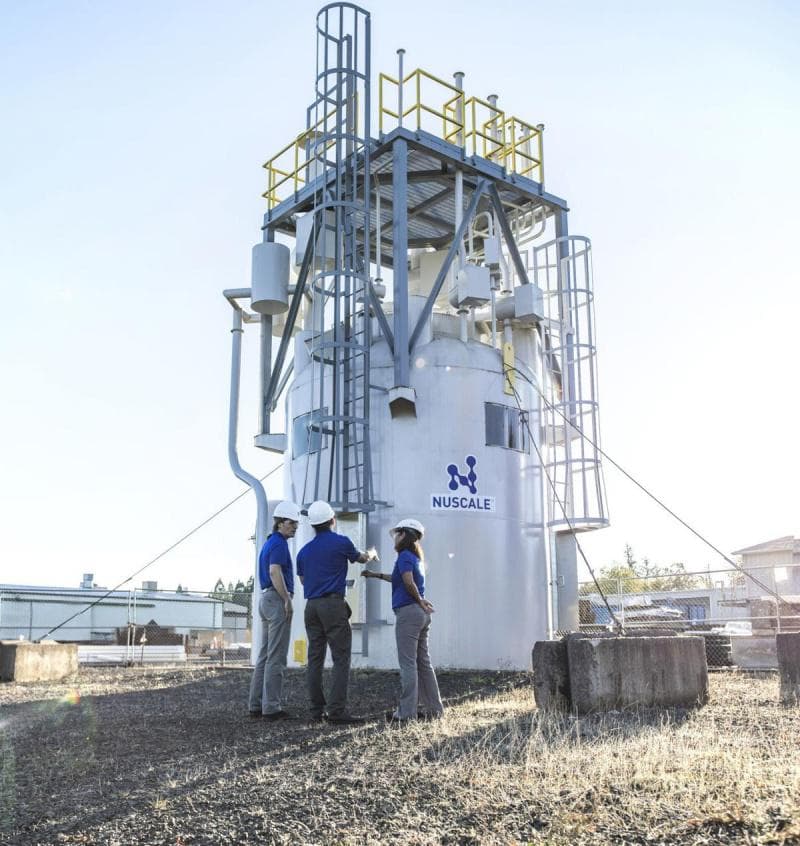
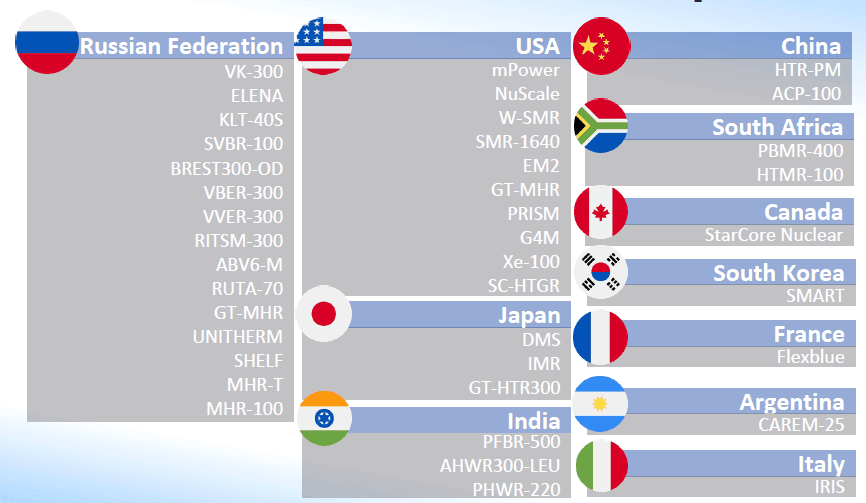
The US, Canada and the UK are very active in SMR development. In these countries, pre-licensing assessments and licensing of certain types are under way, and governments support these projects through loans or grants, but none is yet under construction (X-energy, NuScale and others).
According to the IAEA database, only one type of SMR is in operation. It is the Indian IPHWR-220 heavy-water reactor with an output of 220 MWe. This is an originally Canadian reactor that India has improved over the years, and it successfully operates 16 reactors of this or a derivative design.
In addition to the Indian units, two SMR reactors are under construction in Russia (KLT-40S and RITM-200), three in China (2xHTR-PM and ACPR50S), and, perhaps surprisingly, one in Argentina (CAREM-25). According to current information, all of them should be commissioned either this year or next year. The South Korean SMART reactor has already received a licence, while licensing procedures are under way for other types (NuScale).
Russian SMRs
Russian state company Rosatom is developing many reactor types with its partners, a large share of which can be classified as SMRs. These include modern GenIV reactors (RDE, SVBR-100 and BREST-OD-300), as well as small and mini-reactors based on current light-water technologies (VVER-600, SHELF, VBER). As mentioned above, only the KLT-40S and RITM-200 are currently under construction.
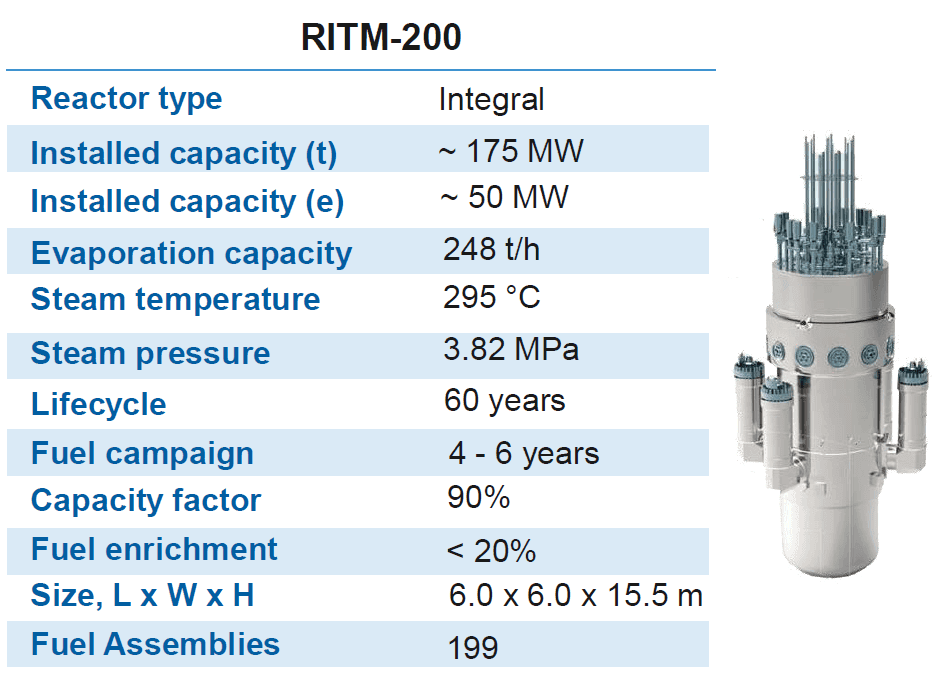
The RITM-200 is Russia's flagship SMR. This integral reactor has an output of 175 MWt (50 MWe), fuel is replaced every 6 years, its guaranteed lifetime is 60 years, and construction takes 3-4 years. The power plant is to comprise several modules with an output of 200 MWe, although it can be expanded with additional modules. Very similar reactors are used on the Arktika and Sibir nuclear icebreakers. The stated dimensions of the reactor are 6x6x15.5 metres. The fuel used is similar to that for KLT-40 reactors. These are smaller reactors used on older icebreakers (Vaygach, Taymyr, Sevmorput). Their upgraded version (KLT-40S) will operate on the floating nuclear power plant Akademik Lomonosov, which is expected to be in operation in 2021.
Chinese SMRs
HTR is a Chinese high-temperature reactor. The technology is based on an originally German design for high-temperature gas-cooled reactors. A prototype of this reactor was built in Beijing at Tsing Hua University and is designated HTR-10. Its construction began in 1995, it achieved first criticality in 2000 and reached full output in 2003. It is a test prototype on the basis of which the HTR-PM reactor design was developed.
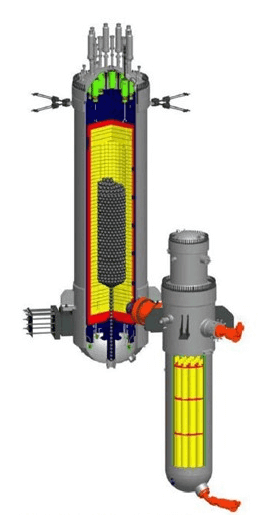
It is an enlarged version of the HTR-10 reactor with an output of 250 MWt. Two reactors are currently being built at the Shindao Bay nuclear power plant site. Construction began at the end of 2012. The reactor vessel head had already been installed in December last year, and test operation should begin at the end of this year or the beginning of next year. The plant comprises two identical reactors with an electrical output of 200 MWe, but a six-module plant with an output of 600 MWe is planned.
The second Chinese SMR is being developed by CGN. It is a reactor designated ACPR, which has two versions. The first is a conventional SMR with an output of 140 MWe intended for land-based operation (ACPR), while the second is the ACPR50S floating power plant (similar to the Russian Akademik Lomonosov project). The floating plant is intended to be highly flexible. For example, it can supply energy or water to oil rigs or isolated areas, and can also operate as a heating plant or, conversely, an air-conditioning unit.
CAREM-25
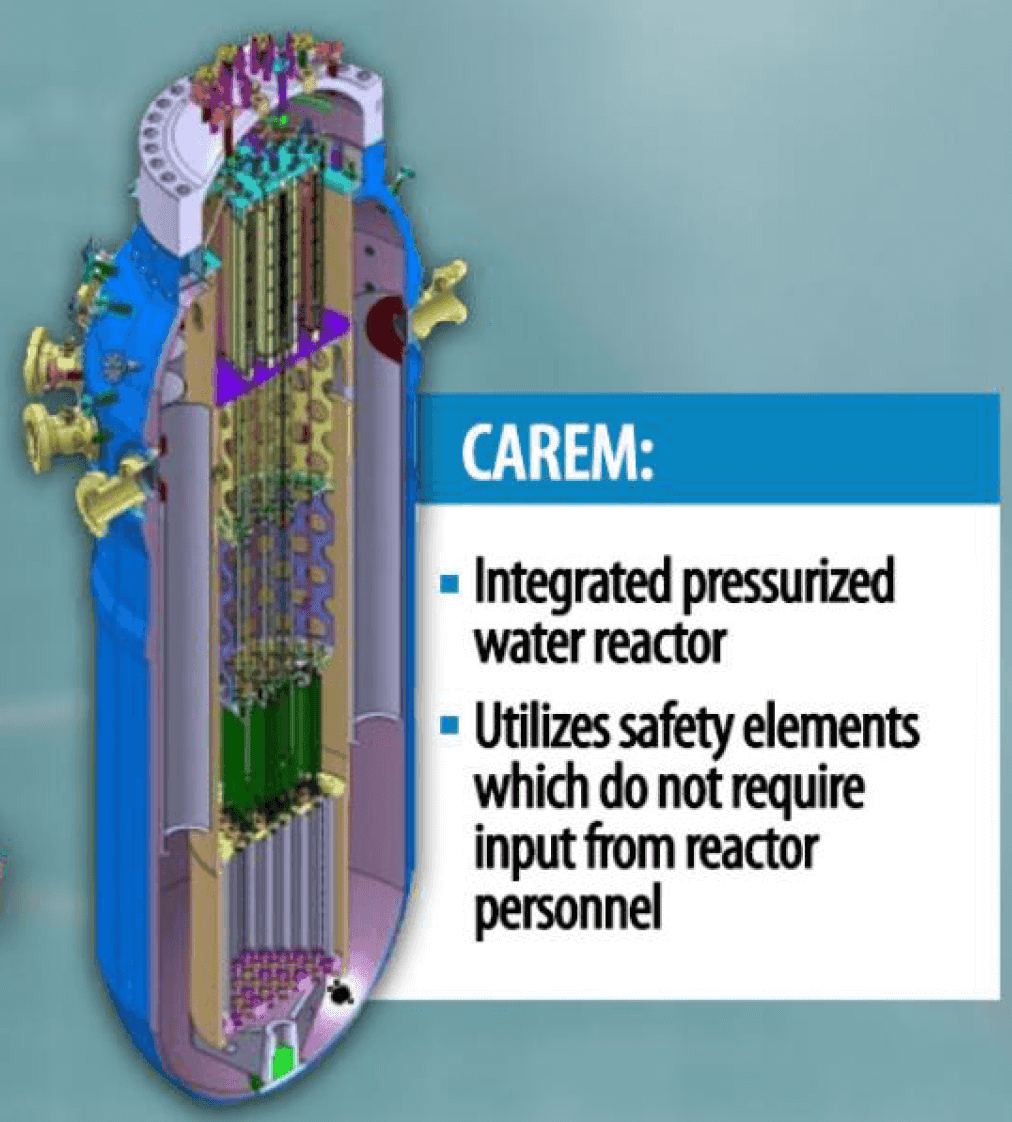
CAREM is an SMR under construction in Argentina. It was also designed entirely in Argentina, and construction is taking place at the Atucha I nuclear power plant site. It is a prototype with an output of 25 MWe. It is an integral reactor based on the design of conventional pressurised-water reactors. However, thanks to its size, it is much safer. Details concerning the exact design and progress of work are not publicly known, but commissioning should take place at the end of 2018. An enlarged type with an output of 100 to 200 MWe should subsequently be built in Formosa province.
The conference also presented highly interesting reactors from Rolls Royce (a three-loop pressurised-water reactor, 400-450 MWe), the French underwater Seanergie reactor (160 MWe, located on the seabed at a depth of around 100m), progress in NuScale's licensing and planning, and the ÚJV Group's Energy Well project.
Energy Well
This is a new Czech small modular reactor project being developed by ÚJV and CV Řež. It is currently only a conceptual project design, and its design is likely to undergo further changes in the future. Feasibility studies, economic analyses and other studies must also be carried out to determine the reactor's potential applicability and the actual market for this product.
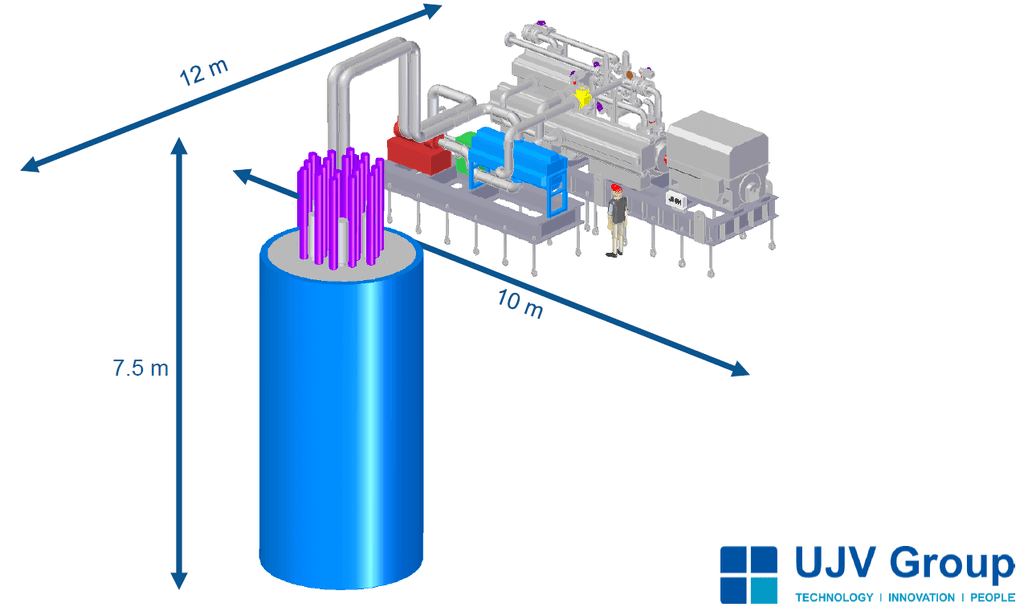
The reactor is cooled by FLiBe molten salt and has a thermal output of 20 MWt. A secondary circuit with inactive NaFNaB salt transfers heat to a tertiary circuit, which, depending on the selected cycle, can generate 6.95 – 8.4 MWe at the turbine. The fuel consists of TRISO particles enriched to 15 % uranium-235, which can achieve a burn-up of 69.8 MWd/kgU over a seven-year fuel cycle. The reactor itself is relatively small and can therefore be transported in containers the size of those used to transport spent nuclear fuel. Once the fuel cycle is complete, the reactor can be transported away in the same container and the old reactor replaced with a new one.
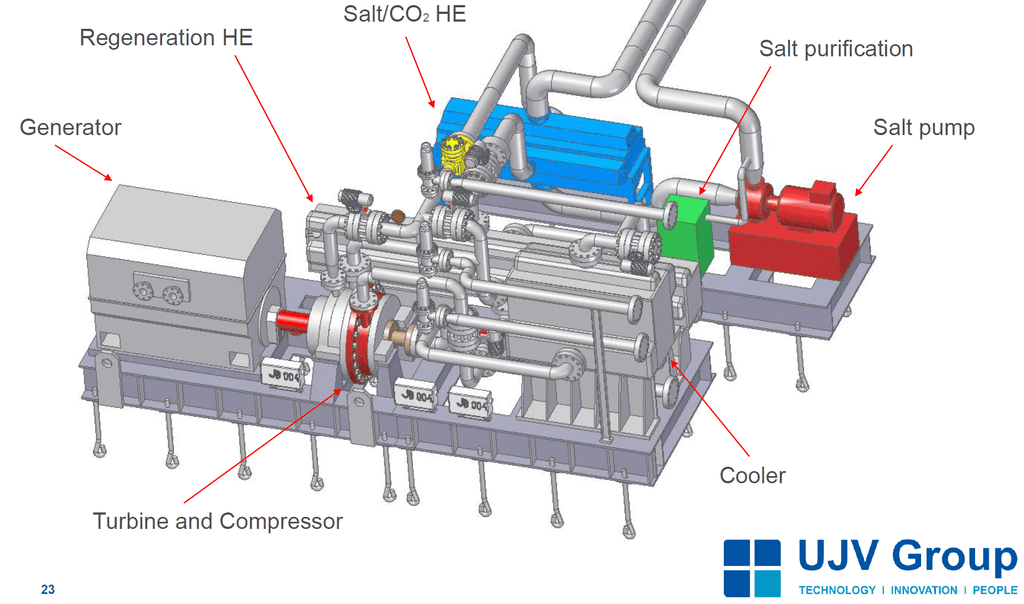
Development will continue, and issues such as the behaviour of materials in molten salts, thermohydraulic characteristics, fuel production, fuel replacement and salt recycling must be resolved. Nevertheless, it is very positive that such projects are being pursued in Czechia (the Allegro project can also be mentioned), and that Czech researchers are succeeding in securing funding and support for their research.
Translation disclaimer
This article is a machine translation of the Czech original and has not yet been fully reviewed. In case of any doubt, please refer to the Czech version.
Sdílejte článek prostřednictvím:
You might also like
23 October 2026, 11:01

23 October 2026, 06:34