The future of data centers? Tech giants Google and Amazon invest in SMRs

U.S. tech giants Google and Amazon want to reduce their carbon footprints and secure stable energy supplies using small modular reactors (SMRs), which could help meet the growing energy needs of their data centers. However, experts told Montel they were skeptical, predicting that successful implementation by the end of the decade is unlikely. Interest in investing in the sector could also influence the development of SMRs in Europe.
In October, Amazon and Google reached agreements to secure energy from small modular reactors (SMRs) with the aim of reducing their carbon footprints and meeting the growing energy demands of data centers.
SMRs for data centers: a path to sustainability or an unattainable plan?
Data centers have high and steady energy demand, which is growing further with the development of artificial intelligence. Small modular reactors could therefore offer a long-term, reliable solution that also supports sustainability goals and reduces environmental impacts. SMRs can operate outside the main power grid, allowing them to be connected directly to data centers and providing greater energy independence.
However, high costs and complex infrastructure are preventing wider adoption of the technology. Experts are therefore skeptical, saying it is unlikely that companies will be able to secure power supplies from SMRs by the end of the decade.
According to Timothy Judson, head of the U.S. nonprofit Nuclear Information and Resource Service, power from SMRs is unlikely to be available to data centers for at least another decade.
Judson told Montel that there was “no hope” that these agreements would “provide nuclear power to supply these data centers in the coming decade”.
Regulators have not yet approved any SMR project, and most companies in the sector are start-ups that depend on venture capital investment. Judson suggests the industry should focus on one or two standardized reactor designs, which would help reduce construction and licensing costs. However, the market still features one-off offerings for various reactor types and designs.
French engineer Antoine Bonduelle, author of a report on SMRs, also emphasizes that the nuclear industry should focus on serial production.
“Without economies of scale from serial production, the infrastructure is too complicated and expensive,” Bonduelle said.
Both experts agreed that large companies' plans to reduce their carbon footprints through nuclear power remain more theoretical than practical for now.
Companies are also seeking to reduce their carbon footprints by buying energy from renewable sources, with Amazon already among the largest buyers of this energy for many years. However, the development of projects in both the United States and Europe is being held back by outdated infrastructure with insufficient capacity.
Due to an inadequate grid, many renewable energy projects in the United States are not being built. As a result, the country has even postponed the closure of some coal- and gas-fired power plants to meet rising demand from data centers. Directly connecting data centers to SMRs could therefore be a more efficient alternative, as these reactors can operate outside the main grid.
Small modular reactors in Europe
The U.S. agreements are a positive boost for the global industry and have sent an encouraging message to potential investors, said Ludovic Dupin, spokesperson for the French nuclear energy lobby group SFEN. He also stressed the need for increased support and funding in Europe if it is to compete with the United States over the long term.
He also warned that if Europe leaves its market fully open to U.S. technologies, the United States could come to dominate it.
SMRs are expected to become commercially available in Europe around the beginning of the 2030s, but issues of public acceptance, such as safety and environmental impacts, will need to be addressed. The Eurelectric lobby group estimates that Europe could reach SMR capacity of up to 5 GW by the mid-2030s.
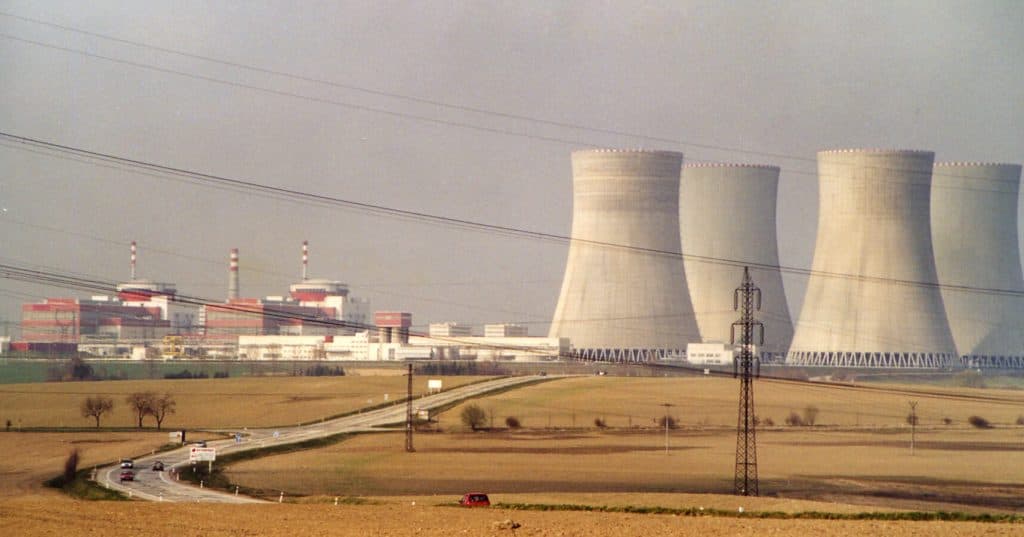
In October, the Czech semi-state-owned energy company ČEZ also signed a strategic partnership with Rolls-Royce to develop modular reactors. The first Czech modular reactor is expected to be built at the Temelín nuclear power plant in the first half of the 2030s, with ČEZ planning to build modular reactors with a total capacity of three gigawatts by 2050.
Translation disclaimer
This article is a machine translation of the Czech original and has not yet been fully reviewed. In case of any doubt, please refer to the Czech version.