Zdroj: Patrick Theinert / Creative Commons / Public domain
More Generation III+ reactors are currently being completed, while the management of Chinese company SNPTC has also published the total cost of building AP1000 reactors in China. Total costs are now known for other units as well. It is therefore interesting to look at how much such reactors can be procured for, especially as their construction is being considered in Czechia.
A recent article provided an overview and comparison of Generation III reactors already operating or under completion. The Sanmen 1 AP1000 reactor is currently operating at 75% capacity as part of testing, with all parameters reaching planned values. It is thus progressing successfully towards commercial operation. The second unit has undergone its final inspection before start-up and approval of its preparations. On 8 August 2018, a nuclear chain reaction began at the first AP1000 unit at the Haiyang plant, while fuel loading began in the second unit that day. It is almost certain that all four AP1000 reactors in China will be operating at the beginning of next year.
At the same time, the Chinese published information that the cost of each pair of reactors at these plants was 50 billion yuan, or USD 7.3 billion. The original estimate was 40 billion yuan. Construction thus exceeded the original budget by 25%. This is not much compared with projects in Europe and the US. Another piece of good news for Westinghouse, alongside the completion of the four units in China, is that after completing its acquisition by Brookfield, it was able to emerge from creditor protection after restructuring.
Latest developments in Generation III+ reactors
Before looking at the prices of the other units being completed, let us review some developments over the past month involving other Generation III+ reactor types. We will first focus on the Russian VVER1200 reactor. The first unit of the second stage of the Leningrad plant successfully completed its final intensive tests and is moving into commercial operation. At the second unit of the second stage of the Novovoronezh plant, the main pumps were tested on 17 July 2018, and cold tests followed by hot tests began. Everything is being prepared for reactor start-up. Concrete pouring for the reactor island began at the second unit of this type at Bangladesh's Rooppur plant, eight months after the same milestone at the first unit. Construction there is proceeding exactly according to schedule, involving 4,200 workers.
The predecessor of the Hualong One unit, the ACPR-1000 reactor, began commercial operation as Yangjiang 5, while Yangjiang 6 is approaching start-up. On 8 August 2018, installation of the control room equipment at the first Hualong One (HPR1000) reactor under construction was completed six days ahead of schedule. The reactor is thus moving from the construction phase into testing and commissioning, and the pace of construction at Fuqing 5 is truly remarkable. The decision to install this type of unit at the Fuqing plant was made in November 2014, and the first concrete for the reactor island was poured in May 2015. It should be fully completed and commissioned in 2019.
The Korean APR1400 reactor at Barakah 2 successfully completed hot testing, while the first unit received authorisation to generate electricity, although it still requires an operating licence. Only then will fuel loading and commissioning be possible.
Reactor prices
The Chinese have also published the costs of the two EPR units at the Taishan plant. A perhaps finally definitive cost estimate has also been reached for this unit at Flamanville. The APR1400 units at the Barakah plant are also nearly complete, and their price can likewise be considered final. Numerous cost figures for VVER1200 units at various stages of construction can be found in publicly available online sources. At the Astravets nuclear power plant in Belarus, the reactors are already almost complete, so this should be a final figure.
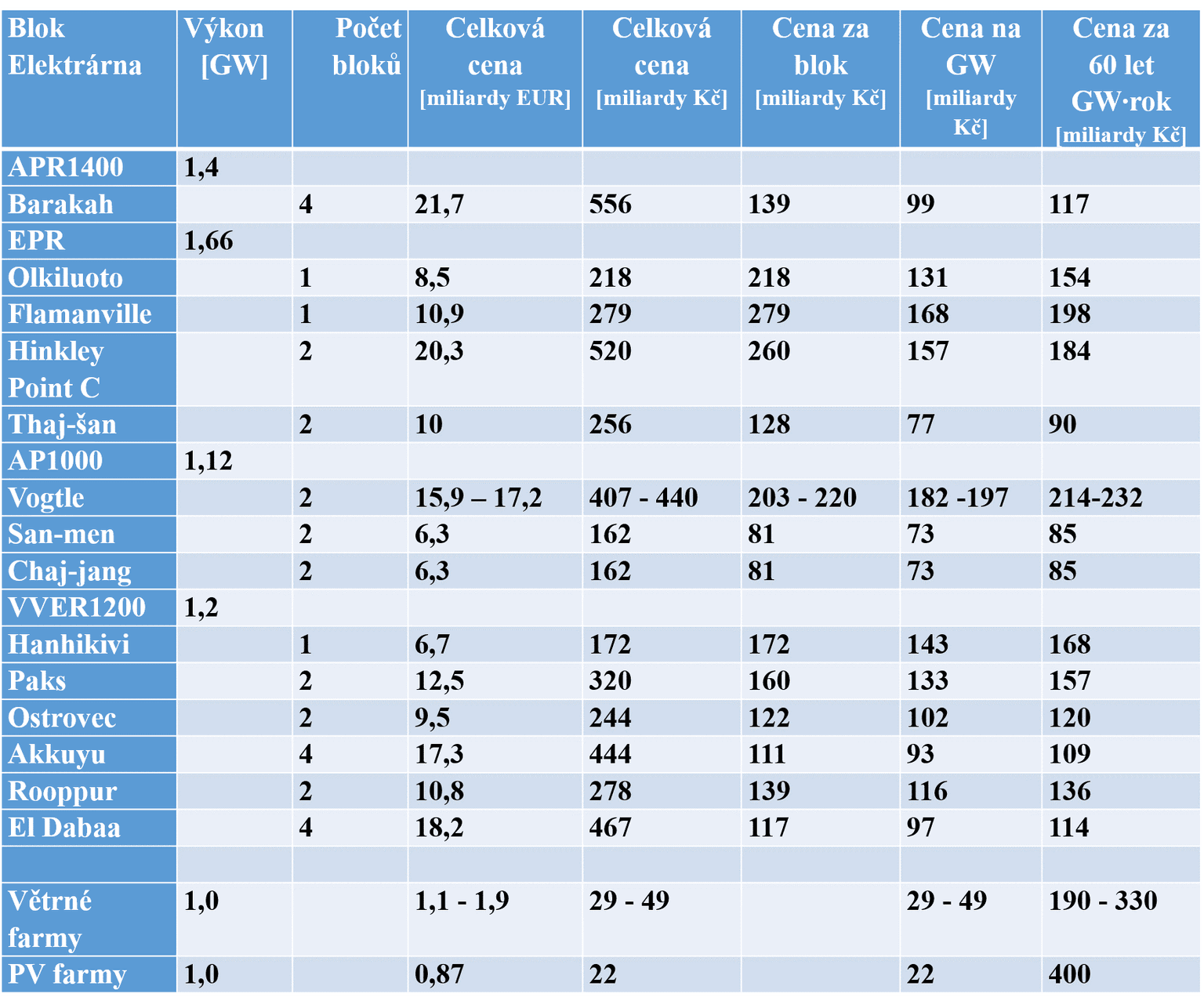
An overview of the known figures is given in the table below. The data used come from various recent online sources. They should represent construction costs, although there may be differences between cases in what is included in the figure, though probably not major ones. Differences may also result from differing conditions; costs in areas at risk of earthquakes will certainly be higher. The cited prices were stated in euros or dollars; for our purposes, dollars have been converted into euros. Prices should therefore be viewed with perspective, as approximate figures.
For comparison and a better idea, prices have been converted into Czech crowns and recalculated per 1 GW of capacity. This allows the costs of different reactor types and specific projects to be compared. When comparing them with other sources, it is necessary to take into account the different capacity factors and lifetimes. For Generation III+ nuclear units, our estimate assumes 85%, which is likely an underestimate, and a lifetime of 60 years. In reality, it should be even higher.
For comparing different sources, the final column gives the investment cost over 60 years of operation with annual output of 1 GW-year. Of course, the cost of electricity is also determined by operating and maintenance costs. For nuclear units in particular, the method of financing and any cost of loans are also of considerable importance, which is why guarantees of political and economic stability are particularly important for such a large, long-term investment.
A rough estimate of renewable energy costs was taken from links by organisations promoting these sources: wind here and here, and solar here. The assumed price is for large farms and is therefore lower for this reason. In the Czech Republic, however, a more decentralised form of renewable energy deployment is expected, so prices would most likely be higher, especially for photovoltaics. A 30% capacity factor is assumed for wind power, a figure not currently achieved here but which there are efforts to reach. For photovoltaic systems, figures for Czechia were also used, namely 11%. A 30-year lifetime is assumed for both wind and photovoltaic sources. A lower lifetime is more likely, but efforts are being made to achieve such a lifespan.
Comparison of the costs of units under construction and with the costs of wind and solar parks.
What can be seen from the table? Nuclear units are largely built by domestic companies and with domestic suppliers, so the final price is strongly dependent on the cost of local construction work and, above all, the ability and efficiency of delivering major infrastructure projects in the given country. This is why construction of EPR and AP1000 units in China was completed at the very good price of just under CZK 80 billion per GW of capacity. There is not much cost information available on China's 1 GW Hualong One reactor, but China appears to want to offer it for less than USD 3 billion, or CZK 67 billion. Based on experience from further construction projects involving different reactors in China, it seems that the country could take advantage of more serial construction and experienced construction teams to routinely build units at a cost per GW approaching CZK 60 billion. The question is how successfully it can transfer such prices elsewhere. In photovoltaics, imported components from China make up a large share of the price, and these have significantly contributed to cost reductions. It is far from certain whether China can achieve something similar in nuclear power.
The cost of the Barakah units in the UAE and Russian VVER1200 units in Belarus and Asian and African countries is roughly CZK 100 billion per 1 GW. Projects in the European Union then cost approximately between CZK 130 billion and CZK 160 billion per 1 GW. At the upper end is Flamanville, where a number of errors led to disproportionate cost increases. For the Sizewell C plant, Framatome wants to prepare an improved EPR based on experience to date. Its cost should be 20% lower than the offer for Hinkley Point C, or roughly CZK 127 billion per 1 GW. In this respect, the price will be similar to the VVER1200 offer. It can therefore be estimated that reactors for Czechia could be in the price range of around CZK 130 billion per 1 GW of capacity. Standing out negatively is the estimated cost of AP1000 units at the US Vogtle plant. However, a number of mistakes were made there, the main reason being a construction company lacking the necessary experience and capabilities. A number of shortcomings therefore had to be rectified.
The calculation enabling comparison of investment costs for different sources has been described. It is one possible approach. Every reader can use another one and prepare an additional table column. They can thus develop their own basis for thinking about the future Czech energy mix. As I mentioned, the figures are approximate and intended to provide a broad overview. In my view, however, the cost of nuclear units remains lower under Czech conditions than that of wind and photovoltaic power. What is much more important, and was described in my previous analyses (the final part of the series), is that the use of wind and photovoltaics is limited under Czech conditions, and nuclear power cannot be avoided when replacing fossil fuel sources. It is already possible to form a fairly good idea of the potential costs of building new nuclear capacity here.
Written for oEnergetice and Osel.
Lead photograph: Hot testing was completed at Barakah 2 (source: ENEC).
Translation disclaimer
This article is a machine translation of the Czech original and has not yet been fully reviewed. In case of any doubt, please refer to the Czech version.