Breakthrough on the path to inertial fusion and future interstellar propulsion
The first reports that inertial fusion had produced more energy than was supplied to heat it emerged as early as the summer. However, there were no details at the time. Scientists working at the NIF (National Ignition Facility) at the US LLNL (Lawrence Livermore National Laboratory) have now submitted a paper to a scientific journal and released details of their achievement. It is genuinely a breakthrough achievement in inertial fusion. It should be stressed that it was unexpected, particularly after the previous peak phase of experimentation at the facility failed to deliver success and its conclusions led, in 2018, to uncertainty over whether such a goal was technically achievable at this facility at all.
In order for fusion reactions to produce more energy than the energy supplied to heat the plasma, or indeed more than the energy required to operate a fusion power plant, an appropriate temperature and the so-called Lawson criterion must be achieved. This states that the product of plasma density and confinement time must exceed a certain value. It follows from the above that there are different types of Lawson criterion. We therefore speak of scientific break-even and ignition criteria, which concern the physical requirements for sustaining fusion, and the engineering break-even criterion, which concerns balancing the energy needs of the entire fusion power plant.
The Lawson criterion can be met in two different ways. The first is to confine low-density plasma for a long time. In this case, a magnetic field is sufficient for confinement, and we speak of magnetic plasma confinement. An example of a fusion reactor using magnetic confinement is the ITER tokamak, under construction in Cadarache, France.
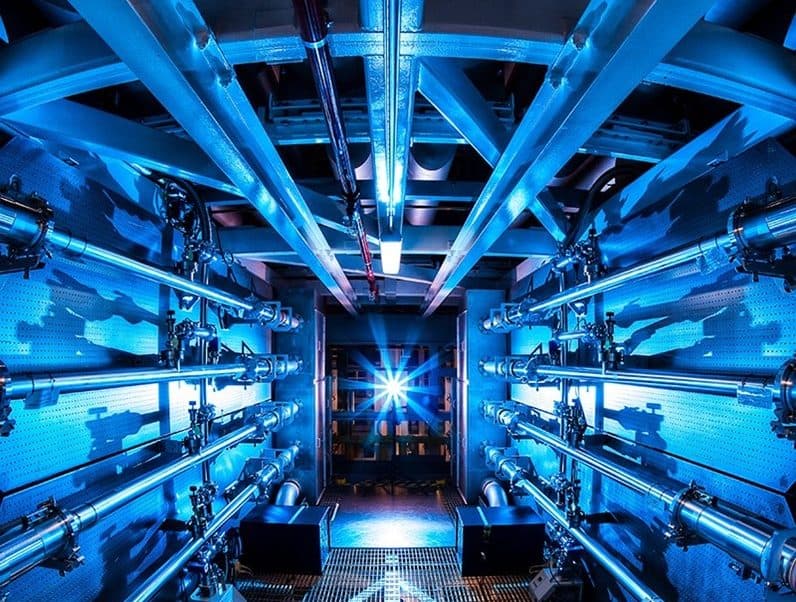
The second option is to create extremely dense plasma. In this case, a very short confinement time is sufficient. We must therefore find a way to compress the plasma very strongly. Once ignited, the resulting plasma does not immediately fly apart due to inertia. This is known as inertial plasma confinement. The higher the density that can be achieved, the shorter the confinement time can be. If the density reaches values exceeding 1026 ions/m3, the confinement time can be many orders of magnitude shorter than a microsecond. Lasers are most commonly used for such compression. A major problem is achieving the most symmetric possible isotropic irradiation by laser beams and compression. It is therefore advantageous to use a single laser and then split its beam into many beams. NIF is precisely such a facility.
These are essentially fusion micro-explosions. They take place in a vessel with a radius of several metres. To ensure that its walls withstand the released energy, the mass of fuel involved in the explosion is limited to around milligrams. The released energy is therefore in the range of megajoules.
The US NIF facility at LLNL
The critical issue in inertial plasma confinement is achieving isotropic irradiation and compression of the fuel capsule. Solving this problem is the greatest challenge facing physicists and engineers at NIF. The following description draws on the relevant part of a review article on the current state of fusion research. NIF is currently the most advanced facility in this field. It uses an extremely powerful neodymium laser. Its beam is split into 192 beams, which are then used to irradiate as uniformly as possible a capsule filled with a mixture of deuterium and tritium. The laser power is 0,5 PW for a period of the order of nanoseconds. In this case, a density exceeding 1029 ions/m3 must be achieved.
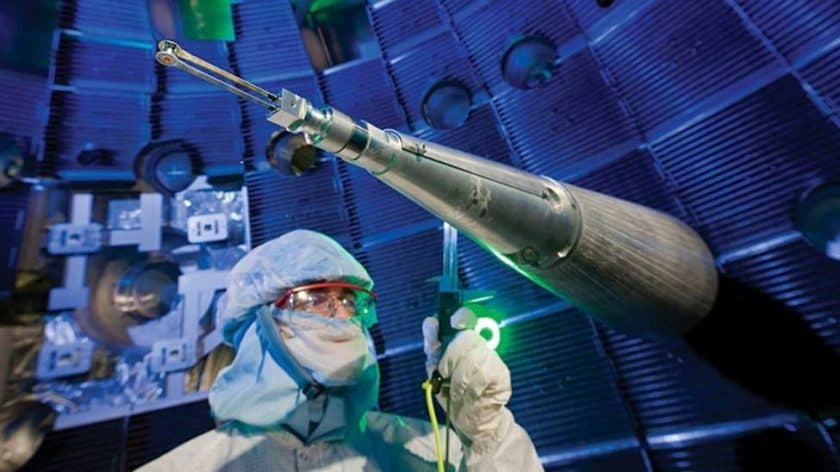
Compressing the fuel itself is a relatively complex matter. The capsule is a plastic shell roughly the size of a peppercorn. Inside it is a frozen mixture of deuterium and tritium. The laser beam can strike the capsule directly or a special device called a hohlraum (German for cavity). This is a gold cylinder into which the laser beams enter through two opposing openings.
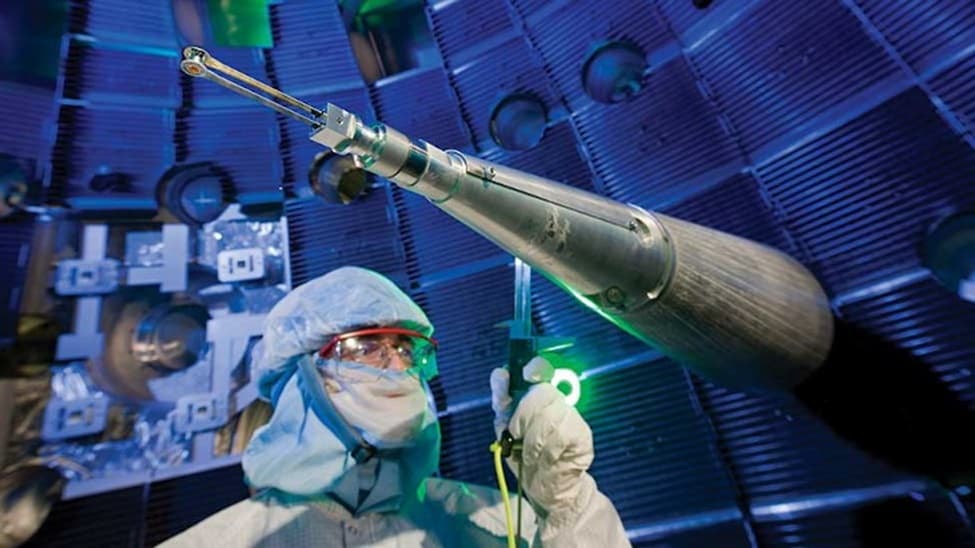
When a hohlraum is used, the inner walls of the cavity are heated by the impact of an extremely intense ultraviolet laser beam, eventually establishing thermal equilibrium at a very high temperature. At the temperature reached, the cavity emits X-rays. These strike the plastic shell, which vaporises and expands. At the same time, under the law of action and reaction, this creates conditions for the implosion of the fuel inside the plastic shell, and for its extreme compression and heating. The velocity of the imploding fuel can reach several thousand km per second. This produces extremely dense plasma, albeit for a very short period. If homogeneous irradiation without asymmetries could be created, temperatures of more than 50 million kelvin and plasma densities two orders of magnitude greater than the density of lead should be achieved. The fusion reaction is then ignited in the hot spot at the centre, and the alpha particles produced in it further heat the plasma. A fiery shock wave then spreads from the centre, gradually igniting all the fuel.
The NIF facility was completed and began operating in 2009. The first three-year experimental campaign was launched at that time. Based on experience from previous facilities, direct irradiation was not used; instead, a hohlraum was employed. During the campaign, continuous efforts were made to improve the laser irradiation profile. Nevertheless, the conditions for igniting the fusion reaction could not be achieved. Several problems and challenges that needed to be addressed were identified. The fuel capsule does not contract symmetrically and does not retain the shape of a perfect sphere. Instabilities occur in the forming plasma during implosion, causing turbulence, especially at the edge. The shell material mixes into the fuel, while mixing of fuel layers at different temperatures cools the inner regions. In addition, material released from the hohlraum wall scatters light from the incoming laser beams, causing energy losses. The hohlraum design itself is asymmetric and disrupts the symmetry and isotropy of capsule irradiation.
Results of efforts to ignite the fusion reaction
Long-term work and efforts to ignite a fusion reaction in the fuel inside the capsule have thus continued. The shape and pulse profile of the laser beam are being modified. The capsule material is being changed from plastic to diamond, as is the hohlraum design, especially its shape. Gradual improvements led to more than a fortyfold increase in fusion yield. As early as 2012, laser power of 500 TW and total laser beam energy of nearly 2 MJ were achieved. Nevertheless, the energy released in fusion did not even come close to equalling the energy consumed to heat the plasma. By 2018, the ratio of these energies had reached only 0,1. A return to direct heating instead of using a hohlraum therefore began to be considered. This approach had been abandoned because of problems with symmetric irradiation. In this case, the requirements for laser beam quality and homogeneity are even greater. Work on the size and design of the capsule could also help. Its precise positioning and the overall geometry of the entire assembly are also critical. It is clear that ensuring precise placement of an object the size of a peppercorn is far from easy. Very thin wires were used for this purpose.
This phase of intensive experimentation concluded in 2018 with the finding that it could not be said whether the goal of exceeding energy production equal to the energy invested in heating could be achieved at this facility at all by improving the conditions and parameters of the beam and target.
The results now presented clearly show that this facility can reach such a milestone. The shot carried out on 8 August 2021 produced 1,3 MJ of energy, a value higher than the energy absorbed by the fuel droplet during heating. This energy was eight times higher than that achieved in experiments in the preceding months and twenty-five times higher than the energy achieved in the 2018 experiments on which the cited conclusions were based. This is indeed a dramatic breakthrough, showing that even the current facility can reach the critical threshold. So far, this has occurred in only one specific shot. It will be very important whether such a result can be reproduced routinely. If so, it would truly be a key breakthrough.
Conclusion
NIF is only an experimental facility. It can carry out only one laser shot per day. In a real fusion power plant, this would need to be roughly ten shots per second. It has been shown that we can achieve a situation in which fusion reactions produce more energy than is absorbed in the fuel capsule. However, the laser beam energy itself was 1,9 MJ, higher than the 1,3 MJ produced by the fusion reactions. Yet only one-fifth of that energy is transferred to the fuel pellet during a shot. A fusion power plant would have to create enough energy in fusion reactions to replace its entire energy input and generate additional electricity. We are still a very long way from this with inertial fusion. Magnetic confinement in the form of tokamaks remains far more advanced in this respect, particularly once ITER is completed.
On the other hand, this is encouraging for advocates of using fusion for the propulsion of future starships. Inertial fusion is precisely what should be used in them, as described in more detail in an earlier article on Osel. It should be recalled that, unlike ITER, which is being built as a precursor to a fusion power plant, NIF is a facility predominantly intended for research into technologies related to thermonuclear weapons. To some extent, it replaces thermonuclear bomb tests. Another focus is fundamental research into extremely dense plasma states, important primarily for astrophysicists.
In the autumn, I gave a lecture as part of Physics Thursdays on nuclear power sources for spaceflight. Although it focused mainly on fission sources, as an update I also described this breakthrough in fusion.
Translation disclaimer
This article is a machine translation of the Czech original and has not yet been fully reviewed. In case of any doubt, please refer to the Czech version.