
23 October 2026, 14:38
Loading...
Chernobyl 35 years on
Vladimír Wagner
26 April 2021, 20:07
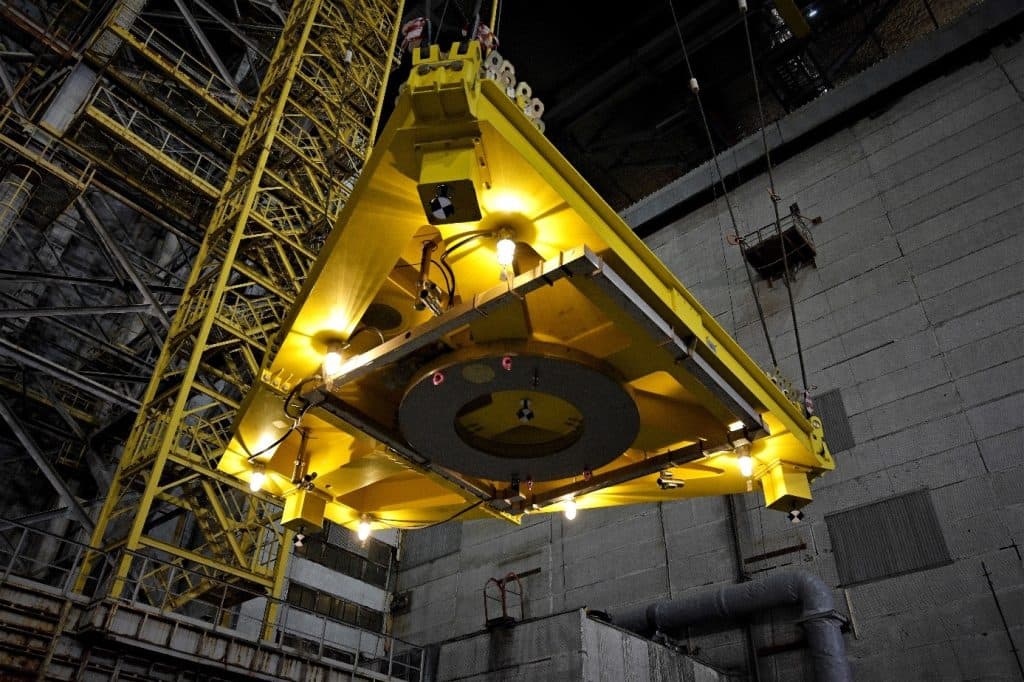
This year marks 35 years since the accident at the fourth reactor of the Chernobyl nuclear power plant. As in other areas, the previous year was heavily affected by the coronavirus pandemic. Nevertheless, progress is being made in decommissioning the plant as well as in revitalising and opening up the affected areas. Let us look at how the situation is developing there.
The 35th anniversary of the Chernobyl disaster is intended to symbolise the transition towards the renewal and rebirth of the area. As I described in previous articles, this has been made possible by the completion and commissioning of the new sarcophagus. Its construction has eliminated the danger posed by the destroyed reactor, making it possible to begin revitalising previously closed areas. Development in several directions should help achieve this.
Research into the destroyed reactor itself, and the dismantling of the original sarcophagus and later the destroyed reactor, will require highly advanced technologies and cutting-edge research that could also advance other technological fields. A science and technology incubator is therefore planned to harness the potential of research and work in this area. It would also provide facilities for Ukrainian and foreign scientists and technicians working there.
It is also necessary to build storage facilities and installations enabling longer-term storage of spent fuel and nuclear waste accumulated during the decommissioning of retired power plants and the destroyed unit. Suitable conditions will also be used to build a repository for spent nuclear fuel from Ukraine's other nuclear power plants.
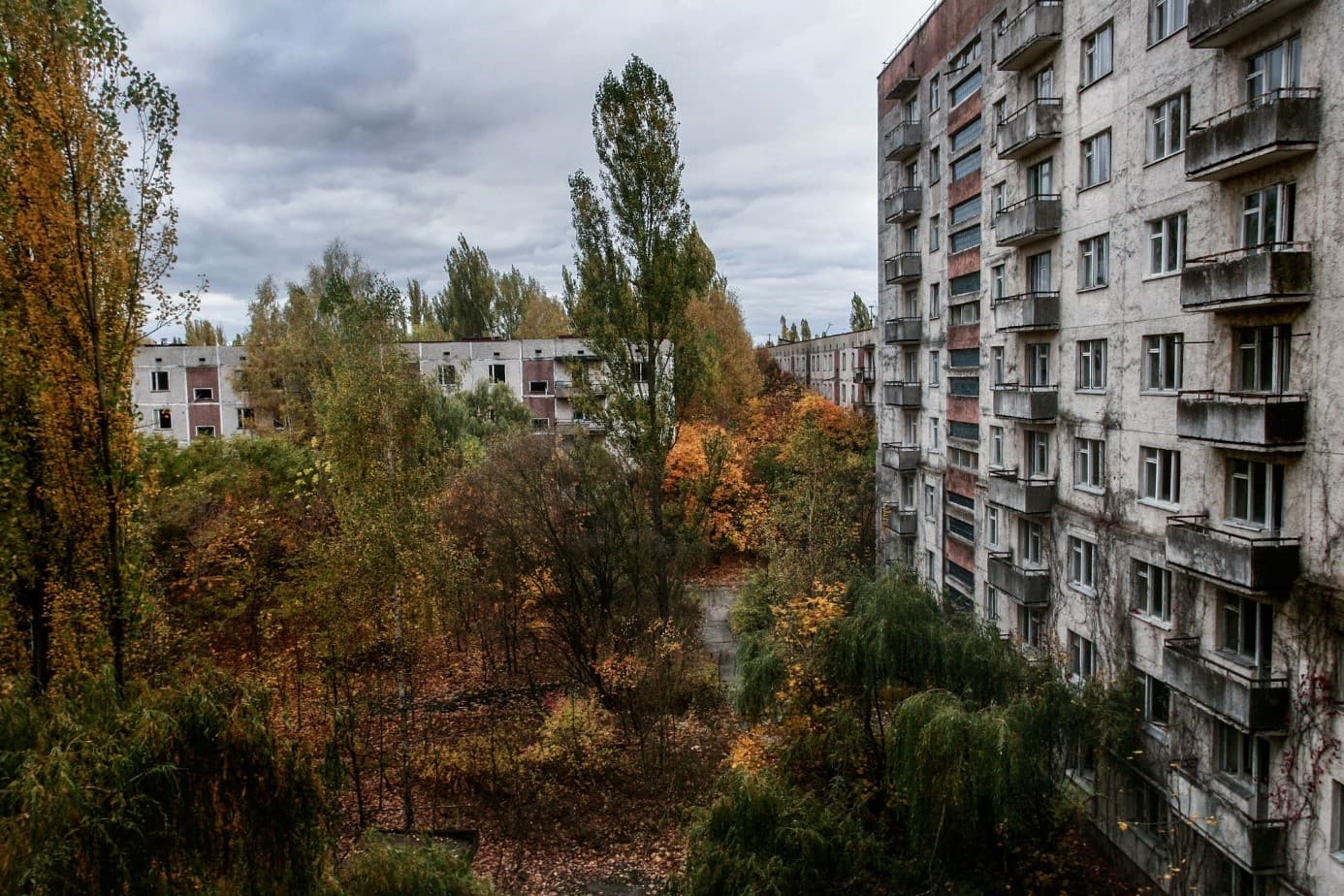
The city of Pripyat is being overgrown by vegetation; the structural stability of decaying buildings will need to be addressed (photo: Václav Vašků – further use only with the photographer's permission)
In the immediate vicinity of the plant, space is being created for a technology park that will use the local transport and energy infrastructure. Earlier overviews already mentioned the start of construction of a photovoltaic power plant, whose area will gradually expand. This and other activities could attract investors to the area.
Nearly 80 % of the affected area is occupied by the Chernobyl Radiation and Biosphere Reserve, which is already a paradise for wildlife and naturalists. It is Europe's largest wilderness forest. In the future, it could also become a magnet for tourists. However, future tourism development must be reconciled with protection of the nature reserve, which has so far been protected from people by its status as an exclusion zone.
Memorials to the accident, intended to recall the heroism and sacrifices of those who faced it not only in its first days, will also be a tourist attraction. They should remind us of the need for humility and respect. The new sarcophagus will be an attraction, and some parts of the plant, part of the city of Pripyat, the town of Chernobyl, some village buildings and the burial ground for equipment used in the accident response will certainly be preserved. However, a large part of these sites must be secured so that future tourists are not endangered when visiting them.
Work inside the sarcophagus
The new sarcophagus has been in place for more than four years. Not only does it protect its surroundings, but it has also dramatically reduced the release of radioactive substances from the old sarcophagus, which is not airtight. It is now protected from sunlight and dramatic temperature changes, which had caused air currents inside the old sarcophagus, as well as from wind. In June 2020, following an intensive testing period, industrial operation of the new sarcophagus began. The most important initial task is a careful inspection of the condition of its structure and equipment. At the same time, 3D scanning of the internal volume and structures of the old sarcophagus was carried out. The radiation data obtained should make it possible to accelerate work on dismantling and disposing of structurally unstable parts of the old containment. It should enable detailed planning of the work and ensure that workers spend as little time as possible in heavily contaminated areas.
It should be recalled that the old sarcophagus was completed and commissioned on 30 November 1986. Its steel structures weigh around 7,000 tonnes, and around 345,000 cubic metres of concrete were used. Around 90,000 workers gradually took part in building the sarcophagus. Since it entered service, a wide range of research has been conducted around and inside it. Locations containing remnants of molten material with fuel have been identified.
During the melting of the reactor core and the boron-containing sand used to cover the burning reactor, a melt known as corium was formed. This also created a new artificial crystalline mineral: zirconium silicate with a high uranium content. The resulting crystals measure between 5 and 500 micrometres. The structure discovered in 1986, from which the first samples of this mineral were taken, came to be known as the Elephant's Foot. Its first photographs and an analysis of radiation conditions near it were obtained using remotely operated devices. Several more locations containing the melt were gradually found. In 1996, when radiation levels had fallen somewhat, Artur Korneev, deputy director of the sarcophagus, took what are probably the best-known photographs of the Elephant's Foot.
In the future, once laboratories and equipment inside the new sarcophagus are fully operational, intensive work will begin, after the removal of structurally compromised parts of the old sarcophagus, to fully identify all locations containing remnants of the core and heavily contaminated graphite. It will also gradually become possible to begin retrieving these highly contaminated materials. However, this task is not expected to be completed for roughly another 50 years.
Extensive work will need to be carried out at the plant site in an environment with high radiation levels and radioactive material. At the same time, the site offers ideal conditions for training and preparing workers for such work, or for upgrading their qualifications. Belgian company ENGIE SOLUTIONS is involved in such training, which is currently primarily intended for workers at the Chernobyl complex. The company is also involved in seeking methods for decontaminating equipment from decommissioned nuclear units at Chernobyl, helping reduce the volume of nuclear waste that must go to a repository. The environment is also used by companies wishing to test their robots in such demanding high-radiation conditions. In autumn 2020, scientists from the University of Bristol tested their robots there. A robot dog designed by Boston Dynamics also got to stretch its legs there.
Work at the plant site and in its immediate vicinity
Over the past year, significant progress has been made in commissioning the ISF-2 dry storage facility for fuel accumulated during the operation of Chernobyl's nuclear reactors. For now, the spent fuel assemblies are held in the ISF-1 wet storage facility (pool). The dry storage facility itself has rows of concrete vaults into which containers holding fuel assemblies are inserted. Before being placed in a container, however, the assemblies must be processed, chiefly by cutting off the non-fuel sections. This processing takes place in hot cells. These are hermetically sealed rooms where material with very high radioactivity is handled. All operations there must be performed automatically using remotely controlled manipulators. In total, around 21,000 fuel assemblies are to be processed and placed in containers, each of which will hold 93 assemblies.
The facility was built by Holtec and financed to a large extent by European countries. I was able to visit the facility five years ago, when the hot cells had been completed and installation of the internal equipment was beginning. It was completed in December 2019, and the first real tests began in autumn 2020. On 18 November 2020, the first container could be placed in a concrete vault, followed by a second on 14 December. These were among the highlights of the comprehensive hot testing of the entire facility. During the tests, operators trained by Holtec also gained practical experience. On 22 April 2021, exactly on schedule, the facility received a licence for standard operation.
Equally important for efficient work on decommissioning Chernobyl nuclear power plant's retired units is the liquid radioactive waste processing plant. Here, liquid waste is concentrated and the residues are immobilised by cementation in 200-litre drums, which are sent to the repository.
Good progress is also being made on completing the first stage of construction of dry storage for spent fuel from the VVER-1000 units at Ukraine's other nuclear power plants. This too is being delivered by Holtec. All buildings, structures and equipment for receiving the assemblies and storing them in the first part of the facility have now been completed. The area where the fuel-assembly containers will stand is also ready. The first stage of construction has therefore been completed. Testing of all equipment began at the end of December 2020. Completion is now awaited of a 43 km railway line connecting the storage facility to Ukraine's rail network. This dry storage facility was thus expected to enter service in May 2021. Ukraine will therefore stop exporting spent fuel to Russia in 2021. The first fuel assemblies to be delivered will come from the South Ukraine nuclear power plant. By 2040, another 14 similar complexes will be built at the site. Fuel assemblies from three Ukrainian nuclear power plants—Rivne, Khmelnytskyi and South Ukraine—are to be stored there gradually. The Zaporizhzhia nuclear power plant has its own dry storage facility.
Chernobyl begins opening to tourists
The development of tourism infrastructure is very important in this respect. Sites that symbolise the accident need to be gradually preserved. Ukraine is preparing a proposal to include them on the UNESCO World Heritage List. Visitor facilities need to be prepared, tourist routes established and safety ensured in the areas that will be opened to tourists.
The opening of the zone to tourists was somewhat delayed by the COVID-19 pandemic and travel restrictions. The opportunities created by the popularity of HBO's Chernobyl series were therefore not fully used to attract visitors, especially from abroad. However, there is hope that tourism development will accelerate once the pandemic subsides.
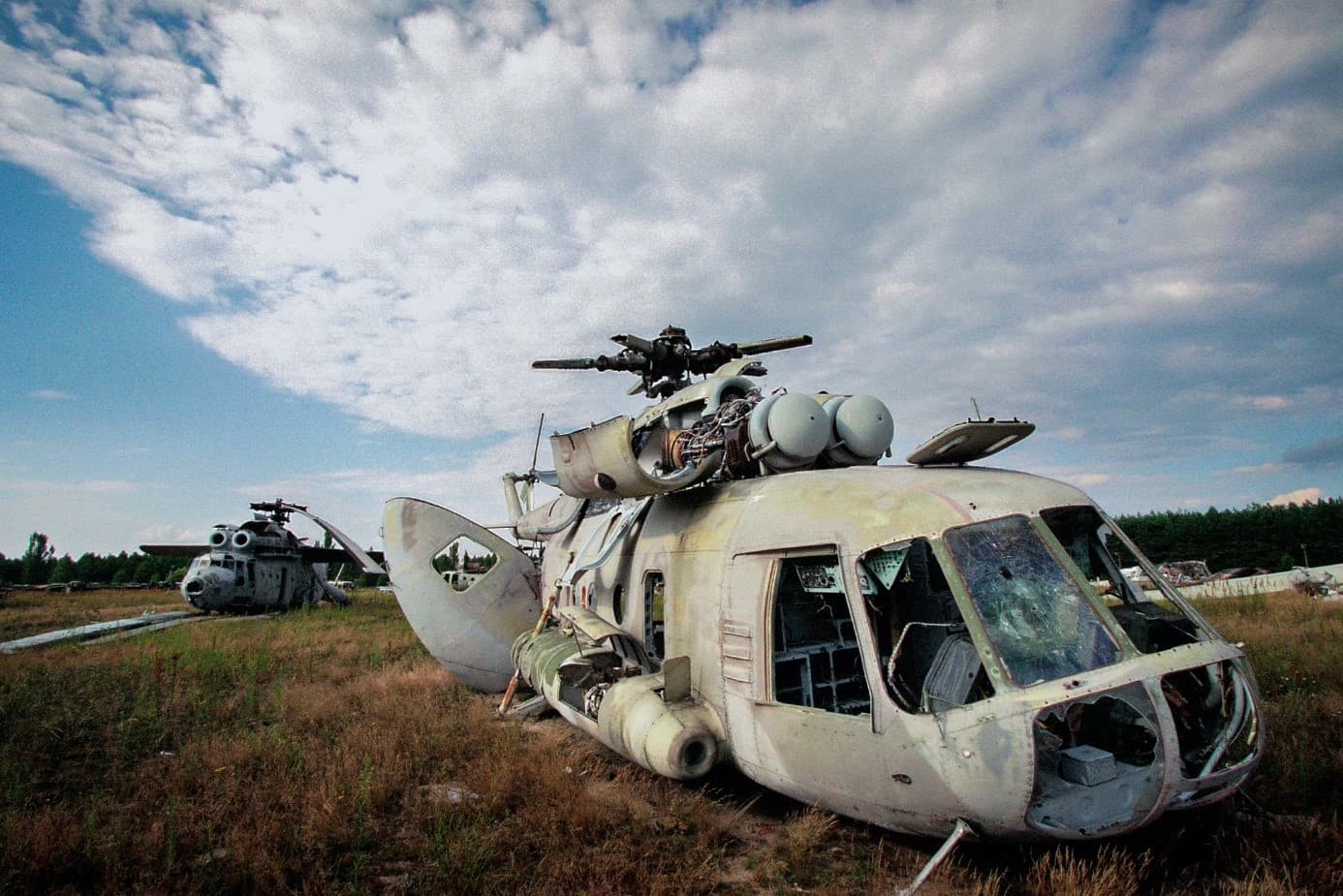
Aircraft were used extensively in responding to the consequences of the accident. Today, they too are symbols and memorials of the event. (photo: Václav Vašků – further use only with the photographer's permission).
The local forests will become an increasing attraction for the growing number of tourists. The abundance of wildlife will be a major draw. Animal populations have flourished greatly since people left. In addition to deer, moose, European bison and Przewalski's horses, there are also large predators such as wolves, lynx and even bears. However, forest management also needs to improve, and ways must be found to reduce fire risks. In 2020, the scale of fires was unusually large. Experience from other nature reserves around the world shows that the risk of fire outbreaks rises with the arrival of more extensive tourism.
The first cycling route, which will lead through areas that have so far been closed, is being prepared for opening. Its total length will be around 45 km and, initially, it will only be accessible to groups of cyclists with guides. Both the cycle path itself and rest and support facilities are being built.
The anniversary as an opportunity to commemorate the event
This year marks the 35th anniversary, which Ukraine wants to use to accelerate development of the zone and commemorate the accident. As part of the anniversary events, a collection of historical photographs was announced, covering life at the plant and in the surrounding area, the accident itself and the response to its consequences. The anniversary is an excellent opportunity to collect and preserve not only photographs, but also documents and memories from private archives. The aim is to preserve the memory of the event for future generations.
The opening of classified documents from the Soviet era, dating from 1937 to 1987, initiated by Ukraine's Ministry of Defence during 2020, could help historical research into the causes of the accident, its course and the response to its consequences.
At the end of March 2021, Danila Kozlovsky's film Chernobyl had its first screening in Kazan. Its premiere was delayed by around half a year because of the pandemic. The film then entered Russian cinemas in mid-April, just before the 35th anniversary of the accident, and topped Russian box-office attendance over the following weekend. The film cannot really be compared with the Chernobyl series. It does not attempt to show the origin and course of the accident, the subsequent response and the causes and those responsible, as the series did. Instead, it is a cinematic portrayal of one human fate against the backdrop of the accident. It will be interesting to see what reception the film receives outside Russia.
One of the historical photographs (source: Chernobyl nuclear power plant).
Conclusion
The start of standard operation of the new sarcophagus is key to the gradual dismantling of the destroyed reactor. It marks the culmination of a major Ukrainian effort that was very significantly supported by European countries. Structurally unstable parts of the old sarcophagus will be removed first. The situation inside it will then be examined in detail, and parts of the melted reactor core will gradually begin to be removed. However, this work will take many decades.
The commissioning of dry storage for spent fuel assemblies from the Chernobyl nuclear power plant is another very important milestone. It represents progress in work to decommission the plant. Other completed facilities at the plant are also helping accelerate this process. An important part of the industrial complex being developed in the immediate vicinity of the destroyed reactor is the dry storage facility for spent fuel from Ukraine's other nuclear power plants. Its operation will begin this year.
The current period is crucial for opening previously closed areas to tourism and other activities. The opening of the first tourist trails, some focused on water tourism and cycling, is symbolic. The main challenge is to preserve and create memorials to the accident. Their inclusion on the UNESCO list of memorials could help. Another challenge is reconciling tourism with the protection of some of Europe's most valuable wilderness forest areas and their rich wildlife. If this succeeds, there is a strong chance that the area will contribute to the development of Ukraine and Europe as a whole.
The 35th anniversary of the Chernobyl accident is also the subject of a recent podcast by the Czech Academy of Sciences.
The differences between reality and the HBO series are discussed in greater detail in a lecture recorded at the Teplice Observatory.
For this year's round anniversary of the Fukushima I accident, a second edition of the book Fukushima I afterwards has been published. This e-book contains an appendix describing events that took place from the first edition until this March.
Written for oEnergetice and Osel.Translation disclaimer
This article is a machine translation of the Czech original and has not yet been fully reviewed. In case of any doubt, please refer to the Czech version.
Sdílejte článek prostřednictvím:
You might also like
23 October 2026, 11:01
23 October 2026, 06:34