10 September 2026, 15:21
Loading...
Czech coal giant over the abyss: 29 years of wrangling over OKD
Beáta Packová
15 October 2019, 16:24
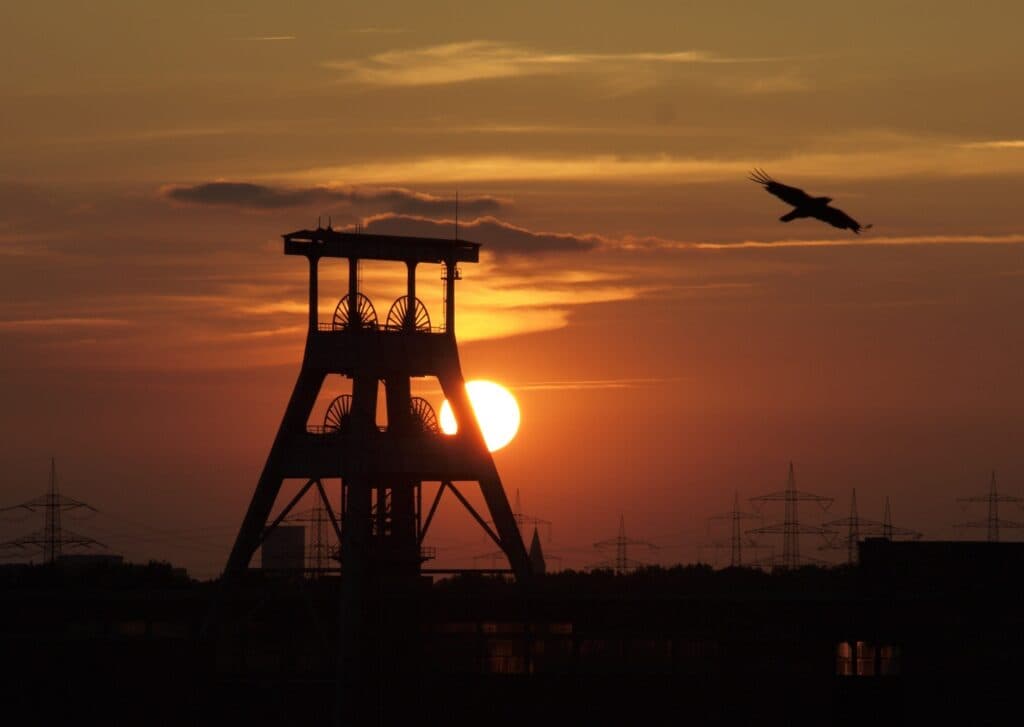
Last week, the OKD Inquiry Commission published its long-awaited final report, on which it had worked for nearly two years. Headlines about planned criminal complaints immediately proliferated in the media. Did the commission manage to investigate the entire story of the mining company, or did it merely repeat known facts to have its cake and eat it too?
Under the previous regime, the Ostrava region was known as the steel heart of the republic – the planners of the time used the energy potential of the local hard coal deposits to build a heavy-industry base. Coal mining was the dominant economic activity in the region, and the umbrella national enterprise became the Ostrava-Karviná Mines (OKD). By the end of communism, the mammoth company still employed more than 100,000 people. As the MPs themselves acknowledged, “OKD was and remains an exceptional company, and for many citizens of the Czech Republic, especially those from the Moravian-Silesian Region, it is an emotional matter.” But there is no room for sentiment in the business world, and pragmatism prevails over nostalgia.
Who put together the puzzle?
Members of the commission themselves compared the immensely complex story of OKD to assembling the pieces of a mosaic. Several question marks had hung over its work from the outset. The inquiry was approved by the Chamber of Deputies on the proposal of Pirate Party MPs, who had made campaigning against corruption cases of the past their flagship cause. Jakub Michálek, deputy leader of the Pirate Party, said at the time that the commission’s purpose was not to replace the work of the courts, but above all to investigate political responsibility. The commission included members of all parliamentary groups, though two of them are no longer in their parties – Václav Klaus Jr left the Civic Democratic Party (ODS) and Lubomír Volný left Freedom and Direct Democracy (SPD). Václav Klaus Jr’s participation prompted objections from some over a potential conflict of interest – Václav Klaus Sr is known as the “father of voucher privatisation”, and it was under his government that part of the shares was privatised.
Over two years, the commission heard from around 50 invitees, including President Zeman. The fact that Lukáš Černohorský went directly to the president’s “home” in Lány, while threatening others with being brought in by police, did little to bolster confidence in the commission’s impartiality. However, the commission members’ ongoing comments also challenged the narrative most commonly heard in Czechia: that the transparent OKD company functioned flawlessly under state management and that everything went wrong only when Zdeněk Bakala took over the business. The commission’s work instead uncovered an intricate story of a chain of mistakes, in which one bad decision subsequently necessitated several more.
Perhaps the clearest example, and the most sensitive part of the entire privatisation case, is the housing stock, which includes around 44,000 housing units. The story of the miners’ flats illustrates well the legal jungle in which the architects of privatisation operated in the 1990s. According to the commission’s conclusions, the mistake occurred at the very beginning of 1990, when the flats, occupied mainly by miners and their families, were transferred into the ownership of OKD as a joint-stock company. However, the commission found that the owner of the flats was not the OKD national enterprise but the state. All subsequent steps – the privatisation of the flats as part of OKD, their separation from OKD and their sale – therefore hang in a legal vacuum. Above all, the case of the OKD flats highlights the absurdity of criticising businesspeople for behaving according to market principles in a market environment if the state enabled them to do so through its decision.
Coal twilight
The report repeatedly criticises OKD’s management most harshly for failing to prepare for harder times, when coal prices would inevitably fall as a result of their cyclical development. In the MPs’ view, a financial cushion should have been created that would have enabled the company to weather a difficult period. The fact that this did not happen is, for them, evidence that the owners and management of the company failed to meet their duty of due care. Although such statements may sound logical at first glance, they do not reflect market reality. First, coal prices are indeed subject to cyclical movements, but these cannot be predicted as simply as the commission’s conclusions suggest. The MPs are thus displaying either a total lack of understanding of economic principles or an effort to support their conclusions with false arguments. In economics, this effect is called hindsight bias – looking back, it seems to us that everything had to turn out exactly as it eventually did. Apparently, no one explained to the commission members the essence of investment risk.
It should be recalled that the company filed for insolvency in 2016 after months of futile attempts at restructuring. What was the situation at other mining companies around the world at the time? Just one month before OKD, Peabody Energy, the world’s largest private hard coal mining company, filed for bankruptcy. Between August 2015 and May 2016, two other major global hard coal producers filed for bankruptcy alongside Peabody, and experts at New York’s Institute for Policy Integritystated in their analysis at the time that we were witnessing not merely an era of major coal company failures, but the failure of coal as a commodity. They cited competition from cheaper natural gas and pressure to reduce greenhouse gas emissions as the main causes.
The global move away from coal is precisely a significant and non-negligible factor that made the decline in coal prices in recent years exceptional. This is not merely a cyclical fall in coal prices, but also a manifestation of the gradual end of the coal era. Even in the Czech Republic, a coal commission has already been established to plan the definitive end of coal use in Czech industry and energy. Under such conditions, standard patterns by which business operated in the past cannot be applied, because the entire sector is experiencing the unique process of permanent decline. While companies in any line of business normally plan their growth, prosperity and expansion, coal companies around the world today are planning how to make the inevitable end as painless as possible.
Besides this fact, it is fair to acknowledge that coal businesses were not the only ones failing at the time. In the same year, engineering company Vítkovice Power Engineering, owned by businessman Jan Světlík, also entered insolvency. It had often been held up as an example of a popular local business, precisely in contrast to OKD’s owners. But failure, as a natural part of the market economy, threatens all companies regardless of their owners’ media image.
Impressions before the court
If the commission failed to understand economic processes, did it at least demonstrate political and legal expertise? Although it originally set out to investigate political responsibility, the MPs themselves admit in the report that they gave up on that task when they described the privatisation as “a political decision of its time, with which the inquiry commission does not intend to take issue. Nor does it intend to take issue with the method of privatisation; that was for the government to decide.” Instead, they largely shifted the commission’s remit into the realm of criminal law – commission chairman Černohorský announced that he was preparing to file 14 criminal complaints.
The commission believes that if the state suffered damage during privatisation, it should seek compensation. Specifically, the inquiry commission wants to achieve this by filing a complaint with the European Commission (EC). The problem will apparently be that, if the EC finds the complaint justified, the Czech state will be demanding money from itself, because OKD Receivables Administrator, which inherited all financial claims from OKD, now acts as the legal successor to the entire chain of OKD owners. Thus, either this is merely a symbolic step with no practical consequences, or the inquiry commission hopes to recover money from former OKD owners. It fails to take into account that a dispute of the same nature has already taken place in London, where a British court found nothing unlawful in the conduct of the former owners, even though it assessed the matter under Czech law.
The inquiry commission brought virtually no new information, merely linking together already known facts into a coherent story. The problem is that several key individuals refused to cooperate with the commission because of its alleged bias. If the criminal complaints reach court, their criminal-law merits will begin to be examined, and only then will it become clear whether the law was breached. This is probably the most serious flaw in the entire commission: it reflects the impressions of its members rather than hard legal reality. And the fact is that legal chaos prevailed in property matters in the 1990s. Who bore political responsibility for it? The commission could have addressed that, but apparently did not find the courage to criticise figures who still occupy the highest levels of the Czech political scene. We have yet to learn how the MPs’ impressions and feelings will stand up in court. But we have already learned from both the commission’s work and its conclusions how well our elected representatives understand the laws of the market economy, and that gives Czech citizens little reason for optimism.
Translation disclaimer
This article is a machine translation of the Czech original and has not yet been fully reviewed. In case of any doubt, please refer to the Czech version.
Sdílejte článek prostřednictvím:
You might also like

10 September 2026, 10:37

9 September 2026, 15:05
9 September 2026, 13:24