23 October 2026, 14:38
Loading...
Czech nuclear energy in 2025, part 3: Addressing five key challenges for nuclear energy
Vladimír Wagner
31 January 2026, 08:24
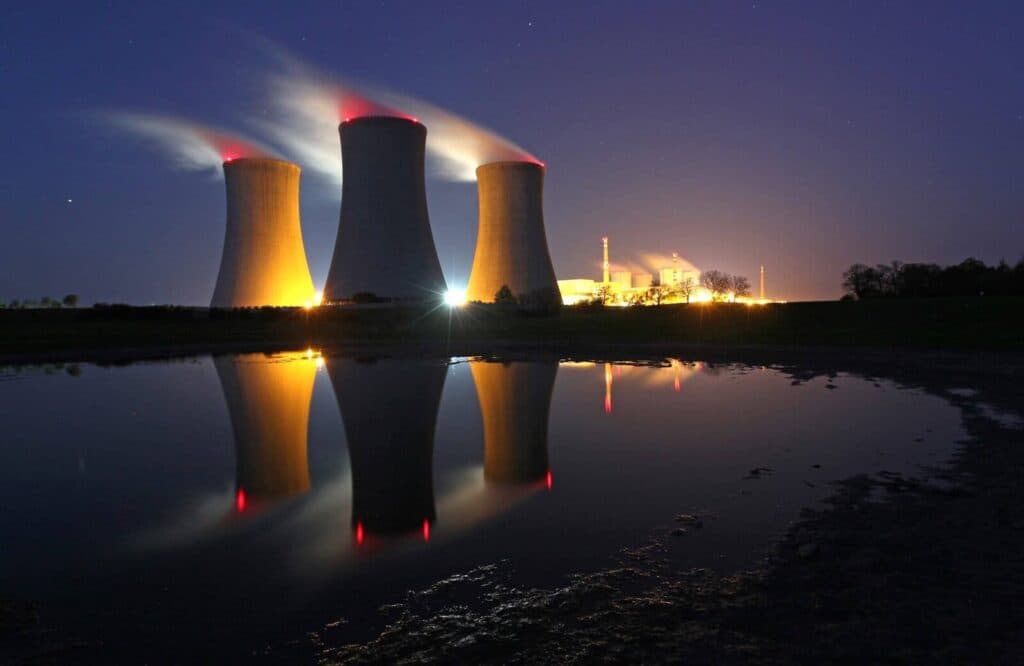
In the third part of our overview of nuclear energy in 2025, we look at the five main challenges currently facing the sector. The first is operating existing units for as long as possible. The second concerns the deployment of Generation III reactors. The third stems from the need to use nuclear energy to supply heat to buildings and industry. The fourth is the deployment of small modular reactors, and the fifth is the path towards closing the fuel cycle, namely the deployment of Generation IV reactors.
We discussed the first and second challenges in detail in the previous article. Let us summarise them. An increasing number of units are operating successfully and safely for more than 40 years; a number of them have already entered their sixth decade of operation, and quite a few are licensed to operate for 80 years. More and more countries are reversing their decisions to phase out nuclear power. Some units are being restarted.
If we include the modern Russian VVER1000 reactors being built in India, which have similar characteristics, there are already more than 40 reactors in operation that can be classified as Generation III, while over 30 are under construction. Their share of the total number of reactors in operation has thus reached 10 % and continues to grow. Experience in their construction and operation is also increasing. Above all, their annual capacity factors show that, after resolving initial problems, they essentially meet expectations. Particularly in China, they are already being built in series, and their advantages in construction are being confirmed.
Let us now look in more detail at the remaining three challenges facing contemporary nuclear energy.
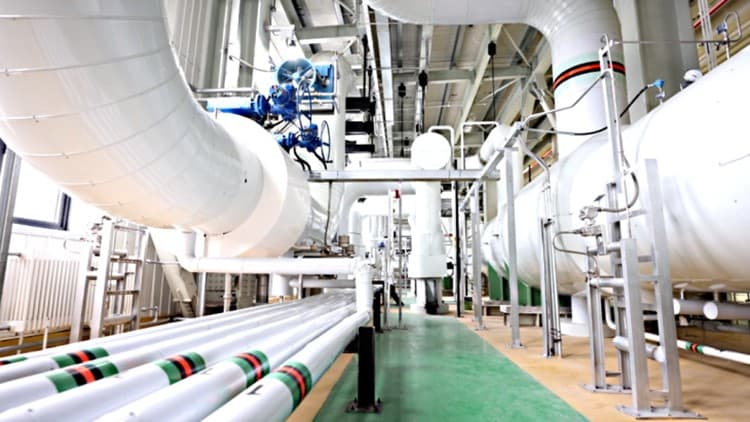
The Haiyang nuclear power plant supplies heat to several Chinese cities, and its district-heating networks continue to expand (source: SPIC)
New nuclear heat sources are coming online
Interest in using nuclear heat continues to grow. As a result, more and more projects are entering the preparation stage, including in Czechia and Slovakia.
Public support for the hot-water pipeline project from Dukovany to Brno will not need to seek approval from the European Commission. Teplárna Brno will be the main investor. The project will cost CZK 19 billion, with CZK 10 billion potentially coming from an EU subsidy financed from emissions allowance revenues. In October 2025, Teplárny Brno signed a contract with AFRY CZ, which will prepare the pipeline design. Construction itself should begin in 2027 and be completed in 2031.
Slovakia wants to use a hot-water pipeline from Mochovce to heat the town of Tlmače, which has just under 4,000 residents. Construction of this first use of heat from the plant should begin in 2027. It should be recalled that Jaslovské Bohunice already provides heating to Trnava, Leopoldov, Hlohovec and the municipality of Jaslovské Bohunice.
For a seventh heating season, the hot-water pipeline from the Haiyang nuclear power plant supplied an ever-growing area. It now serves the three cities of Haiyang, Rushan and Rongcheng. As noted in the previous overview, heat from the plant should reach the city of Qingdao, with a population of 10 million, in 2026.
Small modular reactors – construction of the first Western one has begun
Small modular reactors are beginning to move from the planning stage into implementation. The first conventional small modular reactor, China’s ACP100, is nearing completion. It is scheduled to enter operation in 2026. Construction has begun in Canada on the first Western small modular reactor, the BWRX-300. A number of reactors are beginning to approach their first deployment.
Reactors for nuclear icebreakers
The Northern Sea Route is becoming increasingly important to Russia. Construction of new nuclear icebreakers is therefore proceeding very intensively. In May 2025, work began on the first metal components of the seventh Project 22220 icebreaker, named Stalingrad; the ceremonial keel-laying took place in November, and completion is expected in December 2030. Four icebreakers – Arktika, Sibir, Ural and Yakutia – are in operation, while Chukotka, Leningrad and Stalingrad are under construction. They use the RITM-200 reactor.
In May 2025, the first new, more powerful RITM-400 reactor was manufactured for the first icebreaker of the more advanced Project 10510 type, named Rossiya. The vessel will have two such reactors, each with a capacity of 315 MWt, compared with 165 MWt for the RITM-200 reactor. The new icebreaker will be able to break through ice up to four metres thick.
Russia expects increasingly intensive use of the 5,600 km-long Northern Sea Route, and thus the need to build around five more nuclear icebreakers.
The first floating nuclear power plant, Akademik Lomonosov, uses two older KLT-40S icebreaker reactors. It has been in operation for five years and, at the beginning of 2025, generated its first cumulative terawatt-hour of electricity. Its annual production of electricity and heat is rising every year.
Work continues on the deployment of four additional floating nuclear power plants. Each will use a pair of new RITM-200 reactors.
Construction continues on an onshore plant with RITM-200 reactors in Yakutia. The first unit should be completed in 2027. Construction has begun in Uzbekistan on a plant comprising six of these reactors. For now, site preparation is under way near the city of Jizzakh, along with auxiliary and administrative buildings. In the second half of the year, work began on the construction pit. At the same time, the first reactor components began to be manufactured. Concrete pouring for the nuclear island of the first unit should begin in 2026, with completion expected in 2029. Kyrgyzstan is also considering these reactors.
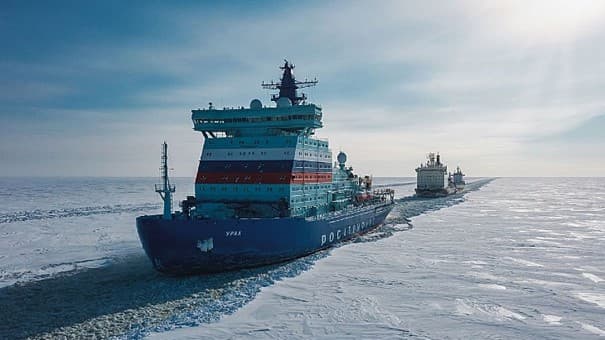
The Project 22220-class nuclear icebreaker Ural during a voyage along the Northern Sea Route (source: Rosatom).
Conventional small modular reactors
As early as 2026, a fission chain reaction should begin in China’s small modular ACP100 (Linglong One) reactor at the Changjiang plant. It is the first conventional integrated pressurised water reactor, to be used for combined heat and power generation. In March 2025, the first of the reactor’s four main pumps was manufactured and shipped to the site, followed later by the others. In mid-October, cold testing was successfully completed, followed by hot testing. Everything is therefore on track.
At the beginning of April 2025, Canadian company OPG (Ontario Power Generation) received a construction permit for the first of four GE Vernova Hitachi BWRX-300 small modular reactors at the Darlington plant. This makes it the first Western type of such facility to enter actual construction. Concrete pouring for the nuclear island could begin in 2026. Arabelle turbines were selected for the reactors, and the company will also supply the turbine hall. The first reactor could begin operating in 2030, with the remaining units to be completed by the mid-2030s. These reactors could likewise be used at the Bruce plant.
Construction of the same reactors is being prepared at the Clinch River plant in the United States. TVA (Tennessee Valley Authority) has submitted a construction permit application to the US nuclear safety regulator. TVA works very closely with OPG and other companies seeking to use these reactors. Site preparation for construction there will begin as early as 2026.
A number of European countries are considering building these reactors. Work is already under way to prepare sites in Finland, Sweden and Norway. Swedish company Vattenfall is choosing between BWRX-300 and Rolls-Royce reactors. It wants to build a total capacity of 1.5 GWe at the Ringhals plant site. A final decision on the model selection should be made in 2026.
The Baltic states are also considering BWRX-300 reactors. Estonia wants to deploy two BWRX-300 units and sought during 2025 to specify a construction site in the north of the country. Construction is being prepared by Fermi Energia AS.
Poland also has major ambitions. The first Polish small nuclear source should be built on the banks of the Vistula in the city of Włocławek, in the Kuyavian-Pomeranian Voivodeship. However, Synthos Green Energy’s ambitions extend beyond Poland: it wants to help spread the use of BWRX-300 units across the wider Central European region, namely in Czechia, Slovakia, Hungary and Bulgaria.
It is clear that the BWRX-300 small modular reactor already has a sufficient number of serious prospective customers. At the same time, a prototype unit is already under construction. I believe it has passed the critical threshold and will be built at sufficient scale.
Close behind is the Rolls-Royce reactor, which Czechia has selected. We discussed the situation surrounding it in greater detail in the section on Czech nuclear energy. Construction of the first prototype unit has not yet started, but this could change soon.
Holtec’s SMR-160 or SMR-300 reactor also looks promising. The company has the advantage of owning nuclear sites that it acquired through the decommissioning of retired nuclear units. The missing prototype project could therefore be deployed at Oyster Creek or at the aforementioned Palisades plant; Holtec is also seeking further potential customers. Use of this reactor is also being considered in Hungary.
Similarly, Westinghouse is seeking potential users for its AP300 reactor, with some European data centres also considering its deployment.
The NuScale project was long at the forefront of the race for first deployment. Its efforts were dealt a blow by the cancellation of prototype construction at INL (Idaho National Laboratory). The first prototype project should now be built at a former coal-fired power plant in Doicești, Romania. In May 2025, an upgraded version with a higher capacity of 77 MWe was approved by the US nuclear safety regulator.
For obvious reasons, India is working on a heavy-water small modular reactor. The 200 MWe BSMR-200 (Bharat Small Modular Reactor) is complemented by the 55 MWe SMR-55 variant. They build on the 220 MWe Indian heavy-water units already in use. The project concept has been completed and is now undergoing approval. The first prototype units should be built at the Tarapur plant.
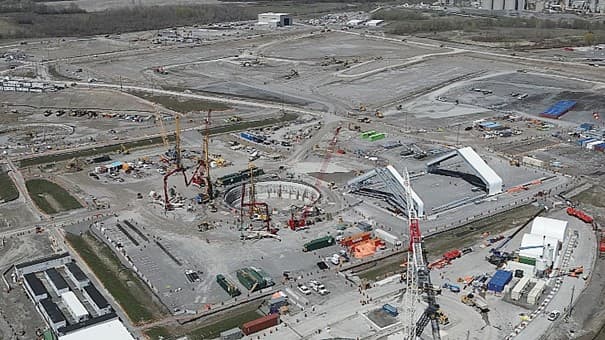
Construction site for BWRX small modular reactors at the Darlington plant (source: OPG).
Small modular reactors for district heating
A highly interesting area for Czechia as well is nuclear sources for district heating, which is also used very extensively in the country. These would be small reactors with thermal output in the tens of megawatts. An advanced project in this area is Finnish company Steady Energy’s LDR-50 small modular reactor, with a thermal output of 50 MWt. It is a light-water, pool-type reactor with a high degree of passive safety. Its digital twin will be created by Fortum. This will enable efficient simulation of the system and its interaction with the district-heating system. The company has already signed contracts to deploy 15 reactors. Work is currently under way on non-nuclear thermal testing of the system. A pilot non-nuclear project to study the system’s thermal properties is being prepared at the closed Salmisaari B coal-fired power plant in central Helsinki. The project is being implemented in the former turbine hall of the decommissioned plant. Everything will be identical to an actual reactor, except that electric heating elements will provide the heat instead of nuclear fuel. As part of the project, heat will also be supplied to the city’s heating system. The first nuclear prototype should begin construction in 2028. Cooperation with South Korea has been established for future projects.
Škoda JS has joined the development of French company Calogena’s CAL30 district-heating small modular reactor, with a capacity of 30 MWt. It is a light-water reactor that will be ideal for integration into district-heating systems. The first prototype project is to be deployed at Cadarache in France.
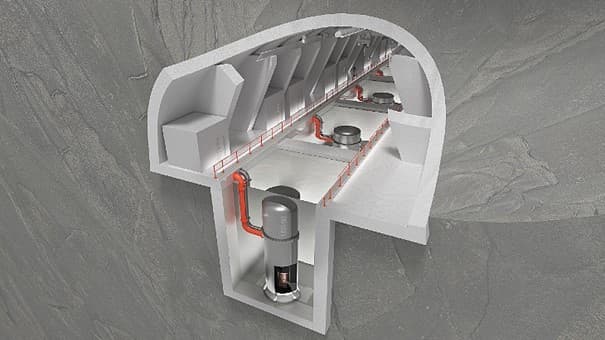
LDR-50 district-heating small modular reactors (source: Steady Energy)
Advanced small modular reactors
A highly interesting Generation IV small modular reactor is the EAGLES-300, being prepared by Eagles, a consortium of four European nuclear organisations established in June 2025. It is a lead-cooled reactor. Its members include Belgium’s SCK-CEN, which has extensive experience with lead-cooled systems. The facility should have a capacity of 350 MWe and be highly flexible.
At the beginning of 2025, TerraPower received a permit to build the Natrium demonstration plant at an industrial site in Wyoming. The Natrium reactor is a sodium-cooled, 345 MWe reactor using fuel enriched to close to 20 %. It will also have the option to store heat in molten salts. Work on the non-nuclear part began in mid-2024. In October 2025, the plant’s environmental impact assessment was completed. The company should receive a permit to build the Kemmerer 1 unit in Lincoln County in 2026. The reactor should be completed in 2030 to 2031.
Amazon has joined the prospective users of X-energy’s XE-100 high-temperature gas-cooled reactor, which it would use to power data centres. The 80 MWe reactor should use TRISO fuel. The first prototype projects should begin construction at the end of the decade. A permit application for construction at Dow’s Seadrift site in Texas was submitted in March 2025.
Thorcon Power has applied to Indonesia’s nuclear safety authority for permission to build the 500 MWe Thorcon 500 reactor, which uses liquid molten-salt fuel.
Nuclear microreactors
Progress is also being made in microreactors. Pennsylvania State University has initiated the process of applying for a permit to construct Westinghouse’s eVinci microreactor. Using HALEU TRISO fuel enriched to close to 20 %, the system should enable outputs ranging from tens of kilowatts to 5 MWe. Fuel replacement should not be required more frequently than once every eight years. It uses sodium and heat pipes for cooling, and is also suitable for space applications.
Oklo Inc’s 15 MWe Aurora microreactor is also intended to use sodium heat pipes for cooling and HALEU TRISO fuel. Construction work on the prototype unit began in the second half of 2025 at Idaho National Laboratory. Completion is expected in 2028.
The same HALEU TRISO fuel will also be used by the gas-cooled Pele microreactor, with output of up to 5 MWe, and NANO Nuclear’s 15 MWe KRONOS. They have already selected partner institutions where prototype projects will be deployed. For Pele, this is Idaho National Laboratory, where structures for the reactor core began to be manufactured in 2025.
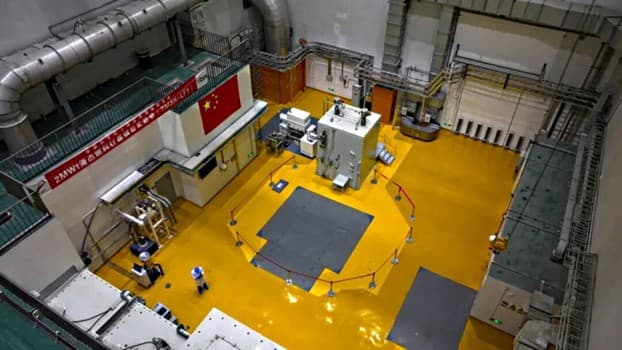
Experimental reactor facility using molten-salt fuel (source: SINAP).
First liquid-fuel reactor achieves a thorium cycle
Closing the fuel cycle requires fast reactors or some highly exotic designs. These include reactors using liquid fuel in the form of molten salts. A major achievement presented in 2025 was the first closure of a thorium cycle in China’s experimental TMSR-LF1 facility of this type, located in the Gobi Desert in western China. The country has a strong interest in using thorium, as it has large reserves of the element. The reactor has a thermal output of 2 MWt. Its construction began in 2018, a fission chain reaction started in October 2023, and it reached full power in June 2024. Four months later, thorium was added for the first time, making it the world’s only thorium reactor with a closed cycle. Another reactor of this type is under construction, with an electrical output of 10 MWe and thermal output of 60 MWt. A more detailed article on thorium reactors and the achievement described was recently published on Osel.
Let us now turn to more conventional fast reactors. These are pool-type, sodium-cooled reactors. The BN600 reactor received a licence in March 2025 to extend operation by another 15 years, until 2040, meaning it will operate for 60 years. This is a very significant development. Together with BN800, the reactor is critical for testing materials, components and methodologies for the planned BN1200 reactor. Unlike BN600 and BN800, the BN1200 reactor will have four sodium loops. At the end of April, Russia’s nuclear safety authority Rostekhnadzor issued a permit for the construction of the fifth unit at the Beloyarsk plant, namely the BN1200 reactor. Preparatory work for its deployment thus began in 2025. Concrete pouring for the nuclear island should begin in 2027, with completion planned for 2034.
The start-up of India’s prototype PFBR sodium fast reactor at Kalpakkam continued to be delayed. According to Indian officials, the delay is due to the technology being entirely new to India. The start of the fission chain reaction will therefore only take place in the first half of 2026.
Two CFR-600 sodium reactors are being built at the Xiapu plant. The first began construction in 2017 and the second in 2020. The first is nearing completion, although exactly when it will enter operation remains an open question. Soon, however, three countries could commercially operate sodium fast reactors.
Construction is also continuing intensively on the BREST-300-OD lead-cooled fast reactor. In 2025, the first heavy components of the internal equipment, with a total weight of 2,300 tonnes, were delivered to the site, along with the steam generator. Installation of internal parts and assembly of the reactor vessel and primary circuit system also began. At the turn of 2025 and 2026, the fourth and final outer vessel was installed. The spaces between the metal parts are being filled with concrete. Assembly of the cooling circuit and installation of all main internal components should be completed in 2026.
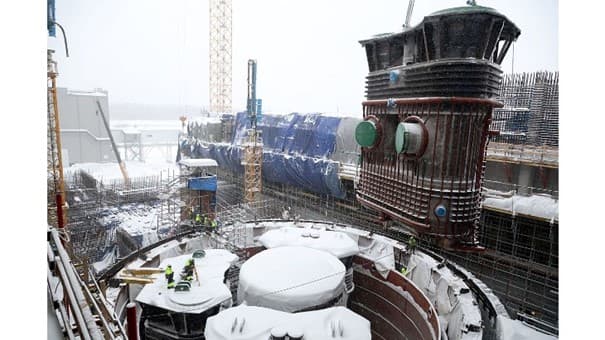
Construction of the BREST-300-OD reactor’s primary cooling system (source: Rosatom)
Conclusion
Only two units entered operation in 2025. This was due to the postponement of start-ups, particularly of new Russian VVER reactors, to 2026, which should therefore be far richer in reactor commissioning. The beginning of 2026 confirms this. As can also be seen from our more detailed assessment of construction progress, at least eight units should start up in the near future. The start of construction on as many as ten units is a highly significant positive sign, as is China’s approval once again of construction of ten reactors in 2025. China is thus heading towards a situation in which it alone will commission ten reactors annually.
In my opinion, the situation in the field of small modular reactors has passed a critical turning point. Several have already exceeded the necessary minimum number of serious customers. The first conventional model is nearing completion in China, construction of the first Western one has started in Canada, and several others should begin building their first prototypes in the near future.
Completion of the heavily delayed units in Slovakia, Finland and France became considerably more expensive, but it is already clear that they are a crucial contribution for those countries. For Slovakia, Finland and France, this not only ensures low-emission electricity systems and meets their own power needs, but also enables exports of low-emission electricity. As was the case with Temelín in Czechia, these will ultimately be hens that lay golden eggs.
As happened in China, delays and financial uncertainty will decline in Europe as the number of completed units grows. Nuclear energy will then ensure the transition to low emissions and the stability of sufficient electricity supplies, not only for the growing needs of artificial intelligence data centres. Opponents of nuclear energy very often invoke cost. However, they fundamentally overlook the need to include the cost of storage and the necessary grids for weather-dependent, variable sources. The full cost of a specific energy mix needs to be calculated and compared, as described in detail with examples in an earlier article. A more detailed response to critics of nuclear power is available in a recent article.
A lecture for Dominikánská 8 on the current state of nuclear energy:
https://www.youtube.com/watch?v=IbmlYKj382I
Thoughts on how to use nuclear energy and survive in the shadow of nuclear weapons:
Translation disclaimer
This article is a machine translation of the Czech original and has not yet been fully reviewed. In case of any doubt, please refer to the Czech version.
Sdílejte článek prostřednictvím:
Topics:Opinion
You might also like
23 October 2026, 11:01
23 October 2026, 06:34