23 October 2026, 14:38
Loading...
Excavation begins at the world’s first spent nuclear fuel repository in Finland
Vladimír Wagner
12 May 2021, 14:05
The world’s first spent nuclear fuel repository is gradually being completed and prepared for commissioning. The underground Onkalo repository near Olkiluoto received a construction licence in 2015 and has now reached the stage where the final disposal tunnels are beginning to be excavated, where canisters containing spent fuel will be placed.
Finland is the first country to complete a permanent geological repository for spent fuel from nuclear power plants. It does not necessarily need it yet; rather, there is a need to demonstrate that a final solution for disposing of nuclear waste in spent fuel is possible and available. The repository is being developed by private company Posiva. Several Finnish locations were interested in hosting the facility, but it is ultimately being built near Olkiluoto, where one of Finland’s nuclear power plants is also located.
Site selection was completed in 2000, with the first excavation work beginning in 2004. However, in the early years this was mainly focused on investigating the site. The excavated tunnels were primarily used for geological surveys, verifying the site’s suitability, and various research and tests. At this stage, sections of the access tunnels were built, gradually reaching a depth of 450 m, where the system of final tunnels will be located to house containers with spent fuel, and then extending to the final depth of 520 m.
Posiva then received a licence to construct the repository in 2015, based on geological and other analyses carried out at the site, and began building the facility the following year. Initially, this involved completing the access tunnels and installing the necessary equipment. The next phase has now begun, with excavation starting on the first tunnel intended for the final disposal of nuclear waste. The very first tunnel is, in a sense, a test facility, and will therefore be shorter, at just 80 m; subsequent tunnels will be up to 350 m long. It will be 4.5 m high and 3.5 m wide. A total of 100 are expected to be built over the facility’s hundred-year operating life, with the combined length of these tunnels reaching around 35 km.
The test disposal tunnel is expected to be completed in 2023 and will contain four holes for placing fuel canisters. The test will use canisters without fuel, but everything else, including bentonite sealing, will correspond to actual disposal operations. Based on this full-scale test, further final disposal tunnels of the planned length will begin to be built. Each of them should contain thirty holes for canisters. Thirty canisters represent a total of 65 tonnes of nuclear waste.
Nuclear waste will be placed in copper canisters. Construction of the canister preparation facility began in autumn 2019 and it is expected to be completed in mid-2022. Once this plant is completed and testing in the first final disposal tunnel has been carried out, the facility should receive its final licence for spent nuclear fuel disposal. Disposal of nuclear waste itself is expected to begin in the mid-2020s. The start of excavation of the first final disposal tunnel is a very important step towards bringing the repository into operation, and it serves as an inspiration for a number of other countries that use nuclear power.
The Finnish project is being closely watched by Sweden, for example, which plans to build a repository of the same type at Forsmark. In February 2020, the nuclear fuel and waste management company Svensk Kärnbränslehantering AB (SKB) commissioned Swedish engineering firm Sweco to prepare a detailed design for the construction of this geological repository. Sweden has thus also made significant progress towards implementing its repository.
The Onkalo repository is an important step in demonstrating the ability to close even the open fuel cycle. From the perspective of the length of time during which spent fuel remains highly radiologically hazardous, this is the most demanding option. If a closed cycle is adopted and a sufficient share of transuranics with the greatest radiological risk and the longest half-lives is burned using advanced nuclear technologies, the required duration of safe geological disposal and the necessary volume could be less demanding. An example of such advanced nuclear technologies is described in a recent article. Recycling spent nuclear fuel would be highly useful, as spent fuel can become a valuable raw material, as described in more detail in an article in Vesmír magazine. A detailed analysis of the decommissioning of a nuclear power plant after the end of its operation, which must also be carried out, is described in earlier articles (here and here).
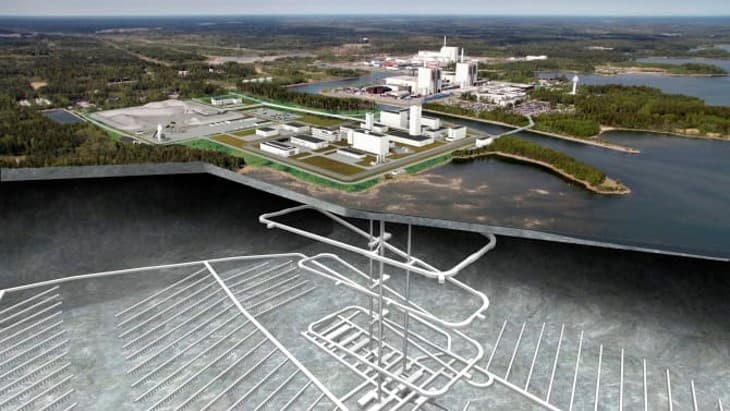
Planned Swedish deep geological repository at Forsmark (source: Lasse Modin / SKB).Written for oEnergetice and Osel.
Translation disclaimer
This article is a machine translation of the Czech original and has not yet been fully reviewed. In case of any doubt, please refer to the Czech version.
Sdílejte článek prostřednictvím:
You might also like
23 October 2026, 11:01
23 October 2026, 06:34