
23 October 2026, 14:38
Loading...
Has Australia's HB11 really overtaken other fusion devices?
Vladimír Wagner
7 April 2022, 11:11
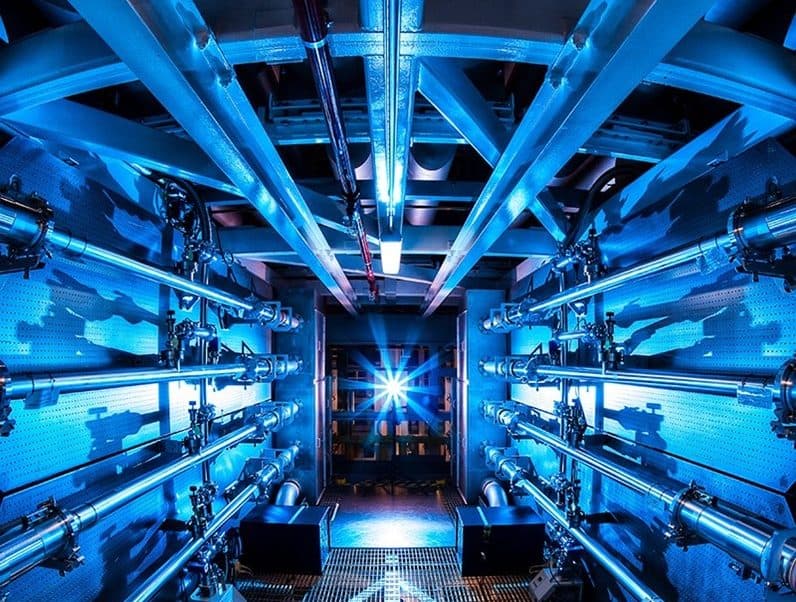
At the end of March, Australian company HB11 announced a major breakthrough on the path to using fusion energy to generate electricity. It is therefore interesting to look at what the company is actually working on, what the real potential in this field is, and how close it is to a fusion power plant.
Australian private company HB11 Energy announced major progress on its path to using fusion reactions to generate electricity. In this case, this involves the publication of its results on proton acceleration and proton-boron-11 fusion reactions in an article in the peer-reviewed journal Applied Sciences.
It is certainly interesting to examine the issue and the results. HB11 Energy may also be of interest to us because its founder, Heinrich Hora, was born in Děčín in 1931. The company's idea is to use the reaction of a proton with the boron isotope 11B, which produces three helium nuclei and releases 8.7 MeV of energy. This reaction has certain advantages and disadvantages. A fundamental disadvantage is that the temperature needed to achieve thermonuclear fusion is almost an order of magnitude higher than for the tritium-deuterium reaction. The reaction probability at the optimum temperature is also an order of magnitude lower than for the reaction expected to be used at the ITER tokamak and other facilities. The energy released is also only half that of tritium-deuterium fusion.
The advantage, on the other hand, is that only charged particles are produced, and their interactions with the surface of the vacuum vessel and other materials do not result in nuclear reactions, radioactivity production or wall damage. At the same time, precisely because charged nuclei are produced, the direct conversion of plasma energy into electricity using a magnetohydrodynamic generator could in principle be used. However, as we will show shortly, harnessing these advantages remains a major challenge that is unfortunately far from reality.
A detailed analysis and comparison of different reactions and ways of achieving conditions for thermonuclear fusion can be found in an earlier popular overview article on oEnergetice (here and here). As already mentioned, thermonuclear proton-boron fusion requires very high temperatures, which is why it is not yet being considered for either magnetic or inertial approaches to thermonuclear fusion. Recent successes in these areas in preparing plasma and using other reactions are discussed in several articles on oEnergetice (here, here, here and here).
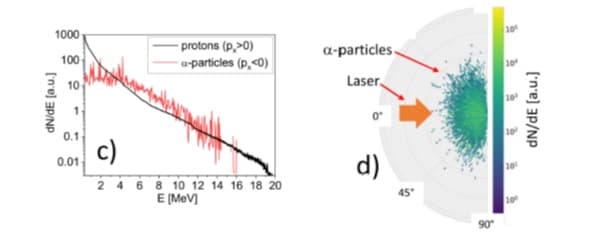
Simulated spectra of protons and alpha particles emitted in the described HB11 Energy experiments. Source: Applied Sciences 12: 1444
HB11 Energy uses a laser beam to achieve proton-boron fusion reactions. The intense electromagnetic field created by a very powerful picosecond laser can accelerate charged particles to relatively high energies. This underpins efforts to use powerful lasers to build compact accelerators. It is a highly promising direction that could yield genuinely very compact and efficient accelerators for electrons, protons and ions. Work on such possibilities is also under way in Czechia, using new laser facilities at the ELI Beamlines centre. Any nuclear reactions, including fusion reactions, can be achieved through collisions of particles accelerated in an accelerator.
The use of a petawatt laser beam with relativistic intensities exceeding 1019 W/cm2 to accelerate protons and use them for fusion reactions is demonstrated in the article mentioned above. The specific laser had a total energy of around 1.4 kJ in a very short pulse lasting just 2.2 ps. On a boron nitride target with a thickness of 0.2 mm and a hydrogen concentration of several percent in the sample, it was possible to achieve a high yield of proton-boron-11 fusion reactions and thus a high intensity of the produced alpha-particle flux. The number of emitted alpha particles per pulse reached around 1010 per steradian. The spectrum of accelerated protons extended up to 25 MeV, while the spectrum of alpha particles emitted from the front side of the target in the backward direction extended significantly beyond 10 MeV.
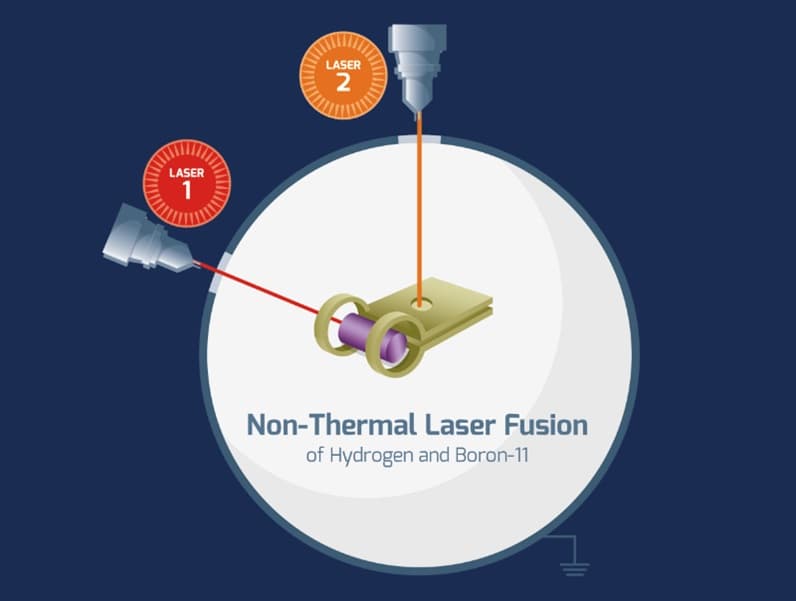
Two lasers and a coil are planned for use in producing energy from fusion reactions. Source: HB11 Energy
The measured values can be used to estimate the total number of alpha particles produced during the pulse and emitted into the target, where they are absorbed. The number of emitted alpha particles and their energy spectrum can then also be used to estimate the ratio of the energy of these alpha particles to the energy of the laser pulse. The result is a ratio of just 0.005%. In this case, we therefore have a highly efficient source of alpha particles, but the efficiency of energy production is far from impressive.
Of course, this parameter can also be improved. HB11 Energy envisages using another laser which, together with a coil generating an intense magnetic field, would help create conditions for magnetic confinement that would enable an increase in energy gain. However, it is entirely unclear how efficient this stage will be.
Another claimed advantage should be the direct conversion of the energy of charged particles into electricity, without conversion to heat and the use of a turbine. For this purpose, a sphere charged to 1.4 megavolts should surround the target and the source of alpha particles (helium ions). This potential difference should stop the helium nuclei, and the neutralisation of these ions should generate an electric current. The planned generator is expected to be simpler and smaller than a system with a steam generator and turbine. However, how it will actually work and what its efficiency will be remain open questions, especially as the alpha-particle spectrum extends far beyond 2.8 MeV.
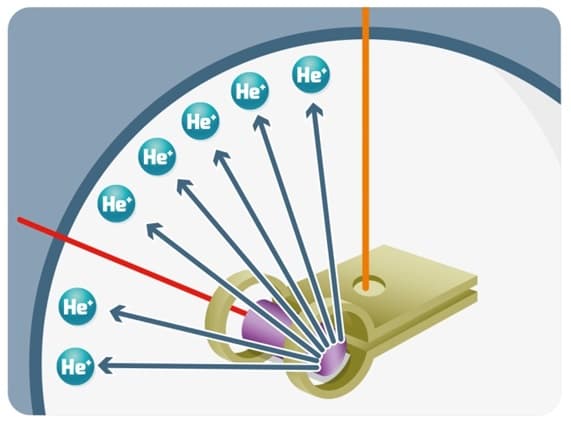
The plan is to use direct conversion of charged-ion energy into electric current. Source: HB11 Energy
Conclusion
Laser acceleration of ions and compact accelerators based on this principle are a very attractive and promising field. At the same time, such proton acceleration and proton-boron-11 fusion reactions can be used to create a very intense source of alpha particles. In this respect, the published results are very interesting and valuable. They will help current efforts to use powerful lasers for efficient particle acceleration and to develop highly compact accelerators and particle sources.
However, presenting these experiments and the results achieved as a breakthrough on the path to a fusion reactor and power plant is a major exaggeration and rather simply PR by the company. The challenges in this direction remain enormous. And it is still an open question whether they can be overcome at all.
Translation disclaimer
This article is a machine translation of the Czech original and has not yet been fully reviewed. In case of any doubt, please refer to the Czech version.
Sdílejte článek prostřednictvím:
You might also like
23 October 2026, 11:01

23 October 2026, 06:34