23 October 2026, 14:38
Loading...
Nuclear energy in 2022 – marked by Russia’s invasion of Ukraine
Vladimír Wagner
17 February 2023, 11:58
Russia’s invasion of Ukraine dramatically affected gas availability and prices in Europe. This further accelerated the shift towards nuclear energy in a number of European Union countries. France returned to building an energy mix based on nuclear and renewable sources. Poland, the Netherlands, Sweden, Czechia and a number of other countries want to build new units. The European Union needs to restore its capabilities in nuclear technologies, where China and Russia have moved significantly ahead of it.
Changes in attitudes towards nuclear energy in European Union society were already discussed in the previous overview. Russia’s invasion of Ukraine on 24 February 2022 dramatically accelerated this process. It became even clearer that without nuclear energy, we can hardly significantly reduce our dependence on fossil fuels. Even Germany, whose Energiewende created an extreme dependence on Russian gas, ultimately postponed the shutdown of its last three nuclear reactors until April 2023 in order to get through the approaching winter period at the turn of the year.
Another significant trend emerged in Europe: extending the operation of nuclear facilities. It is becoming apparent that some reactor types can, with proper care, operate for sixty years and probably even longer. The condition of the reactor vessel is critical in this respect; all other components can be replaced.

Olkiluoto 3 unit finally began supplying electricity (source: TVO).
The importance of the aforementioned proper care of equipment is demonstrated by the current problems with welds in France. France had long flirted with moving away from nuclear power and shutting down its existing units after forty years of operation. This does not encourage operators to maintain the units in a way that enables long-term operation. In March and April 2022, ultrasonic inspections of piping found signs of possible corrosion in auxiliary systems at five units: Chinon B-3, Cattenom 3, Bugey-4, Flamanville 2 and Golfech 1. These concerned welds in the emergency boron injection system. Similar welding problems had already emerged at the turn of 2021 and 2022 at Chooz B1 and B2, Civaux 1 and 2, and Penly 1.
Overall, twelve units had to be shut down, inspected and, where necessary, repaired by the middle of the year, with Bugey 3 and Flamanville 1 added to those mentioned above. Detailed inspections of the at-risk welds were gradually carried out and repairs performed where necessary. The work was significantly delayed, and some units will not restart until during 2023: Civaux 2 in February, Cattenom 3 in March, and Golfech 1 and Penly 1 only in June. It is therefore clear that resolving these issues will take some time. Even clearer is the need for intensive care of existing units. Let us first look at the overall statistics and then at details of nuclear energy developments around the world last year.

Overview of reactors started up (blue) and shut down (purple) in a given year. It shows that in recent years, roughly the same number of reactors have been started up as shut down (source: WNA).
Statistical overview
This current overview of nuclear energy developments over the past year is the fourteenth in the series and follows articles from previous years. The most recent instalment was published in 2021. At the end of 2021, in early December, there were 440 reactors with a capacity of 393.2 GWe, while at the end of 2022 there were 438 with a capacity of 394 GWe (data from the World Nuclear Association website and the PRIS database). A total of 58 units with a capacity of 65 GWe are under construction. These figures are from the end of January 2023. It is clear that roughly the same number of units continue to be shut down as started up.
A total of ten units were shut down in 2022. As noted in the previous overview, three reactors in Germany were shut down on the last day of 2021: Brokdorf in Schleswig-Holstein, Grohnde in Lower Saxony and Gundremmingen C in Bavaria. As mentioned, Germany’s last three reactors were not shut down at the end of the year: Neckarwestheim in Baden-Württemberg, Emsland in Lower Saxony and Isar in Bavaria.
The previous overview had already reported on the shutdown of Hunterston B-1 in the United Kingdom at the end of November 2021. Hunterston B-2 ceased operation on 7 January 2022. This graphite-moderated, gas-cooled AGR reactor operated for 45 years and generated around 300 TWh of electricity in total. Another AGR reactor, Hinkley Point B-2, was shut down on 6 July 2022, followed by Hinkley Point B-1 on 1 August. Both had therefore operated for just under 45 years.
The second unit of the Tihange nuclear power plant was shut down on 31 January 2023. It is a 1008 MWe pressurised water reactor that had operated for 40 years. Belgium’s oldest nuclear reactor, Doel 3, was shut down on 23 September after forty years of operation.
The US Palisades plant in Michigan, with one 805 MWe pressurised water reactor, was shut down on 31 May after fifty years of operation. It is being taken over by Holtec, which will carry out its decommissioning.
In 2022, India’s 100 MWe Rajasthan 1 heavy-water reactor, which had been in long-term outage since 2004, was also transferred to the category of closed units.

Development of electricity generation from nuclear sources. It shows that the 2006 record was matched in 2019 and 2021 (source: WNA).
Eight units entered operation in 2022. In China, an ACPR1000 reactor was started up as Hongyanhe 6. The start-up of Fuqing 6, a Hualong One reactor, was already discussed in the previous overview; it entered commercial operation in 2022. In January 2023, Fangchenggang 3, a unit of the same type, began supplying electricity to the grid. A Hualong One reactor also started up as Karachi 3 in 2022. Two APR1400 units entered operation: Shin Hanul 1 in South Korea and Barakah 3 in the United Arab Emirates. An EPR reactor started up as Olkiluoto 3 in Finland. A VVER440 reactor entered operation as Mochovce 3 at the end of the year.
Construction began on eight reactors, the same number as those started up. These were VVER1200 units: Akkuyu 4 in Turkey, El Dabaa 1 and 2 in Egypt, Tianwan 8 and Xudabao 4 in China. In China, construction also began on the nuclear islands of CAP1000 reactors Sanmen 3 and Haiyang 3, as well as the Hualong One reactor at Lufeng 5.

Overall average annual capacity utilisation currently stands at around 80 % (source: WNA).
Electricity generation from nuclear power reached 2 653 TWh in 2021. This was 100 TWh higher than in 2020, when 2 553 TWh was generated. This confirmed that the gradual easing of the coronavirus epidemic led to higher electricity consumption and higher generation from nuclear sources. Output almost matched both the 2019 figure and the record level of 2006. Generation in 2022 will probably be affected by outages at nuclear power plants in France and Ukraine, meaning it is unlikely to exceed the 2021 figure.

Average annual unit capacity utilisation by age (median value for 2017 to 2021). It shows that reactors can operate for more than fifty years without a loss of reliability (source: WNA).
Europe’s view of nuclear energy changed dramatically
The change in attitudes towards operating existing units in Europe was dramatic last year. A number of countries decided to move away from a rapid phase-out of nuclear power and extend the operation of their nuclear reactors. Belgium thus decided to extend the operation of its two youngest nuclear units, Doel 4 and Tihange 3, by 10 years, from 2025 to 2035. Discussions have now even begun on the possibility of extending operation of three additional older Belgian reactors by two to three years, roughly until 2027. One reason is that the two newer reactors will need to be shut down around 2025 and prepared for a further ten years of operation. The older reactors would help bridge this period.
A very important task is to keep existing units safely in operation for as long as possible. From this perspective, an interesting development for Czechia is Finnish company Fortum’s application to extend the operating licences of Loviisa 1 and 2 until 2050. This would mean operation for a full seventy years. These are VVER440 reactors that entered operation in 1977 and 1981. Their current licences are valid until 2027 and 2030. The experience of operating this plant is highly valuable for Czechia. These are the same reactors as those at Dukovany, only they have been operating longer. Three diesel generators from the shut-down German Krümmel plant were transported to this power plant as part of measures to strengthen its safety. They are intended to provide electricity for the site in the event of an outage. The fact that nuclear facilities can be operated safely and reliably for sixty years or more is also indicated by the fact that annual capacity utilisation does not change with reactor age and remains around 80 %.
A number of units in Europe are now applying for licences to operate for 60 years, including Slovenia’s Krško nuclear power plant, which would then operate until 2043. The Netherlands is also considering extending the operation of its sole Borssele nuclear unit and building new ones. It currently wants to build two nuclear units at the Borssele site, with construction expected to begin in 2028. Sweden is considering extending operation of the three units at Forsmark and two at Ringhals to as much as eighty years. It is also considering building new reactors.
France has scrapped plans to reduce the share of electricity generated from nuclear sources to 50 %. It is preparing to build new reactors. It wants to build six EPR2 units and will consider building another eight. Construction of the first is expected to begin in 2028 and it should enter operation in 2035. France also wants to use small modular reactors. An important task is to extend the operating life of current reactors to 50 years and more.

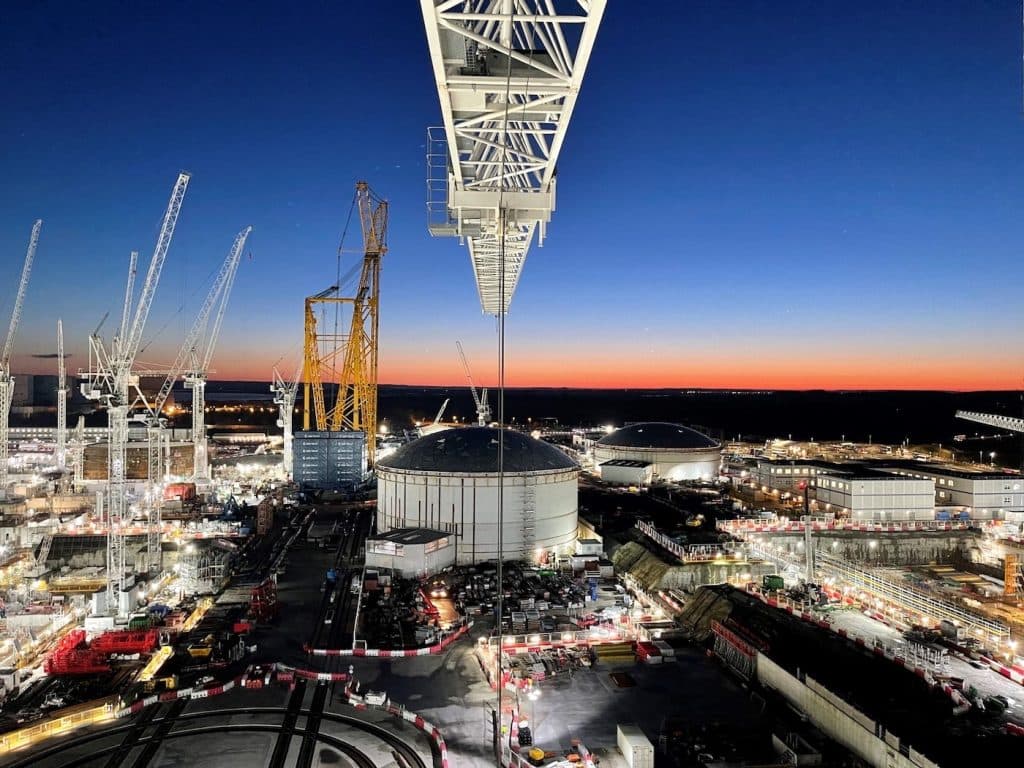
Hinkley Point C construction site (source: EDF).
The third unit of Slovakia’s Mochovce nuclear power plant received preliminary authorisation to start up the reactor on 24 January 2022, and public comments on the decision were accepted until the end of March. On 25 August, the Slovak nuclear safety authority confirmed authorisation to begin start-up, and fuel loading was completed on 19 September. The fission chain reaction began on 22 October 2022. Tests were first carried out at minimum power, which was then gradually raised to 2 % of rated capacity. In mid-January 2023, the unit received permission to move from physical to electrical start-up and output was increased to 5 % of rated capacity. On 31 January 2023, Mochovce 3 supplied its first electricity to the grid, having reached 20 % of its rated capacity. Both turbines of the unit were running before mid-February 2023. Slovakia is thus becoming a country with low-emission electricity generation.
The impact of Russia’s invasion of Ukraine on VVER1200 reactor construction projects in Hungary and Finland was very different. Finland cancelled the Hanhikivi plant project. The question remains as to how this course of action will be resolved legally and what its consequences will be. Even more open is the question of the future of the construction site.
The project to build two VVER1200 units in the second phase of the Paks plant is continuing, having received a construction permit at the end of August 2022. Earthworks began in September, and preparations are under way for the start of concreting of the nuclear island, which should take place in 2024. Hungary agreed with Russia to accelerate the project. General Electric will supply the turbines. Paks II is therefore scheduled for completion in 2030.
A detailed analysis of construction projects and developments in Europe and other parts of the world is available in a lengthy article on Osel. The following parts of this article will look at developments in closing the fuel cycle and small modular reactors. Here, let us look at one more area.
Using nuclear facilities for heat supply
On the path to reducing emissions, use of heat from existing units is receiving increasing support. At Tianwan nuclear power plant, China’s first project to supply industrial heat from a nuclear unit was implemented. Steam produced by units 3 and 4, which are VVER1000 units, will be used at the “Lianyungang Petrochemical Industry Base” complex. The steam pipeline under construction is expected to supply 4.8 million tonnes of steam annually and be completed in 2023.
District heating was also being completed at Hongyanhe nuclear power plant. It will supply hot water to the city of the same name, around 10 km away, serving approximately 20 000 residents.
A major heating project is also being prepared to use heat from Haiyang nuclear power plant. The length of the hot-water pipelines should reach as much as 120 km and could supply heat to up to one million residents. The project should be completed as early as 2023.
Czechia does not want to fall behind in this area either. Completion of the hot-water pipeline from Temelín to České Budějovice is approaching. At the beginning of December 2022, only 4 km of the total 26 km remained to be completed.
The use of heat from Dukovany is now relevant thanks to the decision to build a new reactor there. This guarantees that the nuclear power plant will operate for decades. In 2022, a number of discussions and studies were therefore carried out concerning the possibility of building a hot-water pipeline from Dukovany to Brno. Land acquisition is being prepared along the route of the 42 km pipeline. It would connect to Brno’s hot-water network at the pumping station in Bosonohy. It could be completed in 2030.
Conclusion
European energy, and nuclear power in particular, is currently going through a turning point. Recent winters and Russia’s invasion of Ukraine have clearly shown that the transition to low-emission energy is not possible without nuclear sources. Germany’s Energiewende and the ideological campaign of green anti-nuclear activists led to the extreme dependence of European, and particularly German, energy on natural gas from Russia. It is highly likely that, like the oil crisis, the current energy crisis will lead to a renaissance of nuclear energy in Europe. France, Sweden and neighbouring Slovakia show that a transition to low emissions through a combination of nuclear and renewable sources is possible and successful.
A number of European countries are stepping back from shutting down their operating nuclear reactors and are instead seeking to keep them in operation for sixty years or more. The oldest nuclear units currently in operation have already been operating for 53 years. The first experience is thus being gained from their seventh decade of life. It confirms that their reliability does not decline with age. Median annual capacity utilisation remains around 80 %. These are encouraging facts. At the same time, the history of welding issues at French units shows that operating units need appropriate care. It should be recalled that these units are less than forty years old.
Ensuring that European units operate for at least sixty years, and up to eighty, is very important because the vast majority are already approaching or have exceeded forty years of operation. Extending their use by another twenty years or more will make it possible to build replacements and increase nuclear capacity.
This also applies to the Czech Dukovany nuclear power plant and, in future, Temelín. In the case of Russian nuclear reactors, it is important to be independent of Russia in their maintenance and fuel supply following Russia’s invasion of Ukraine. This should gradually be resolved. Temelín currently has fuel reserves for two years and Dukovany for three years. From 2024, fuel for Temelín will be supplied by two suppliers, Framatome and Westinghouse. Westinghouse expects to begin supplying nuclear fuel for VVER-440 reactors in 2024 together with Spanish company Enusa.
A number of European countries are planning to renew their nuclear fleets, while countries such as Poland are working to build their first nuclear power plants. In addition to plans to build large Generation III units, the use of small modular reactors is being intensively prepared. Restoring the European Union’s capabilities in these technologies is key to achieving this task. This also applies to Czechia.
In Czechia, a tender was officially launched to build one Generation III unit at Dukovany, with a non-binding option for another unit at Dukovany and two at Temelín. Three bidders submitted their offers, which are now being assessed. They are Westinghouse’s AP1000 reactor, EDF’s EPR reactor and South Korea’s APR1400 reactor. It should be noted that the French and South Korean reactors will be scaled-down versions. The Czech Republic has also selected the Temelín site for its first small modular reactor and is working on selecting sites for its broader deployment.
The situation is similar in a number of European countries. There is therefore hope that Europe, too, will see a nuclear renaissance, which is already under way in China. At present, the number of units being closed and started up is roughly in balance, while nuclear electricity generation is matching the historic highs of 2006. Last year, overall nuclear electricity generation was slightly worse due to this year’s problems with French units and reduced output from nuclear facilities in Ukraine, but further growth in nuclear electricity generation can be expected in the coming years.
The impact that Russia’s invasion of Ukraine and Rosatom’s involvement in it will have on nuclear energy remains very much open. It is highly likely to lead to reduced cooperation with the company. Given that Russian nuclear technologies are among the world’s leading technologies, this will certainly affect nuclear energy.
Over the next decade, it will gradually become clear how successful Generation III reactors are, as their share exceeds 10 % and grows rapidly. It will likewise be seen whether small modular reactors fulfil the hopes placed in them. We can hope that, with the help of nuclear sources, the European Union will overcome the energy crisis and gradually achieve the transition to low-emission sources. In this respect, it is important that energy policy is not dominated by ideological activists but is based on knowledge and rational facts.
Lecture “Czechia and low-emission energy” for the Vision for Czechia conference in Tábor.
Translation disclaimer
This article is a machine translation of the Czech original and has not yet been fully reviewed. In case of any doubt, please refer to the Czech version.
Sdílejte článek prostřednictvím:
Topics:Opinion
You might also like
23 October 2026, 11:01

23 October 2026, 06:34