23 October 2026, 14:38
Loading...
Nuclear energy in 2023, part 4: Five challenges facing Czech nuclear power
Vladimír Wagner
3 February 2024, 12:52
In my view, today’s nuclear power sector faces five main challenges. The first is operating existing units for as long as possible. The second concerns the deployment of Generation III reactors. The third is driven by the need to use nuclear energy to supply heat to buildings and industry. The fourth is the deployment of small modular reactors, while the fifth is the path towards closing the fuel cycle, namely the deployment of Generation IV reactors. We discussed the first and second challenges in detail in the previous article; we will now look at the remaining three.
Nuclear heat sources
Industrial heat supplies in particular represent an enormous challenge in the transition to low emissions, and nuclear heat sources could make a significant contribution to addressing it. One option is heating using low-emission nuclear electricity, which is widely used in France. Electricity is likewise needed for heat pumps. Another option is to use heat from existing large nuclear plants, or to deploy small modular reactors. Innovative high-temperature reactors are needed to provide high-grade heat for industry.
A key development in the use of heat from existing nuclear sources took place in Czechia. This winter season, České Budějovice began using a district heating pipeline from the Temelín nuclear power plant. It supplies roughly 30 % of demand, or up to 800 TJ per year. Preparations are also continuing for a project to bring a district heating pipeline from Dukovany to Brno.
A number of district heating pipeline projects to supply homes with heat, as well as steam pipeline projects to supply industrial facilities, are being implemented or prepared in China. The previous overview also discussed preparations for a district heating pipeline from the Haiyang nuclear power plant to the city of Weihai. This is the third stage of using the plant for heating. During the first test stage, heating was supplied to plant accommodation buildings and several nearby houses. The second stage provided heating in the city of Haiyang. The third stage extended heating to a much larger community. Construction of this stage began in mid-February 2023 and was completed in November of the same year.
The previous overview already covered the steam pipeline project from the Tianwan plant. It was completed in 2023. It supplies steam to the “Lianyungang Petrochemical Industry Base” complex. A steam pipeline project from the Sanmen plant is also being prepared. It is intended to supply hot steam to the Rongsheng New Materials (Taizhou) Company plant. The steam pipeline is due to be completed in 2026 and should supply 1800 tonnes of steam per hour. The plant has two AP1000 units in operation and two CAP1000 reactors under construction.
Small modular reactors – successes and problems
The path towards deploying small modular reactors has seen both successes and problems. Key successes include the rapid construction progress of China’s conventional ACP100 (Linglong One) small modular reactor, and above all the entry into commercial operation of the innovative HTR-PM200 high-temperature reactor. Key companies in the nuclear technology sector are becoming increasingly involved in the development of small modular reactors, and the number of potential customers is rising.
The key problem last year was the increase in the cost of NuScale’s small modular reactor, with the expected electricity price rising from 58 USD/MWh to 90 USD/MWh, followed by the cancellation of the prototype project that was to be built in cooperation with the UAMPS (Utah Associated Municipal Power Systems) consortium at INL (Idaho National Laboratory). Let us look at last year in this field in more detail.
As in the previous overview, we will first look at progress in nuclear icebreakers. Russia has seven such vessels in operation. Of these, three are of the most modern type: Project 22220, which uses two RITM-200 reactors. These are the prototype Arktika and the serial vessels Sibir and Ural. Two more icebreakers of this type are under construction and two others are being prepared. At the end of 2024, the fourth serial icebreaker, Chukotka, received its second RITM-200 reactor and moved closer to completion.
Funding for the fifth and sixth serial Project 22220 icebreakers was discussed in the previous overview. In 2023, they were named Kamchatka and Sakhalin. Their construction will begin progressively in 2024 and 2025. However, the first construction work on the former began at the Baltic Shipyard in the second half of 2023.
An even more advanced icebreaker is the Project 10510 Lider. The first prototype is already under construction. It will use two larger RITM-400 reactors with a thermal output of 315 MWt. The second Project 10510 Lider icebreaker began construction in 2023. Construction of the third should begin in 2025. They are expected to be completed in 2030 and 2032.
The importance of the Northern Sea Route for Russia is continuously increasing. Between 2014 and 2022, the volume of cargo transported rose from 4 to 34 million tonnes. It then increased dramatically following its invasion of Ukraine and the severing of ties with Europe. This highlighted Russia’s dependence on contacts with the Far East and the use of this transport route to export raw materials and import industrial components and other goods, not only from China. The year 2023 was a record year, with icebreakers escorting more than 730 vessels. In 2024, Russia wanted to ensure year-round operations in its eastern section. Nuclear icebreakers are crucial for this.
The first floating nuclear power plant, Akademik Lomonosov, which uses two older KLT-40S icebreaker reactors, is operating very well. At the end of 2023, the first successful fuel replacement took place in the first reactor. The second reactor is due to undergo this in 2024.
Four floating nuclear power plants with RITM-200 reactors are being developed for mining companies in the Bilibino region of Chukotka. New mines and copper, gold and other metal processing facilities are being opened there (the Baimskaya ore zone). Rosatom is seeking, in cooperation with other companies, to prepare a project for floating power plants for export, mainly to the Middle East.
The same small modular reactor will also be used by a power plant planned in Yakutia. Equipment for it began to be manufactured in St Petersburg in 2023. Its completion is planned for 2028.
The construction progress of China’s ACP100 (Linglong One) small modular reactor at the Changjiang plant deserves considerable attention. It is the first conventional small modular reactor for electricity and heat generation under construction. Economic conditions in China differ from those in Europe or the US. However, if a small modular reactor can compete economically with large reactors in China, this should also be the case in Europe. Construction of the ACP100 reactor began in July 2021. In March, installation of the main internal structures of the reactor building began. The reactor is genuinely modular, and efforts are being made to carry out as much work as possible in a factory away from the construction site. In July, the central module, containing the reactor pressure vessel and steam generator, was delivered to the site; it was installed in August, marking a key stage of construction. Another important step was placing the containment dome in position.
A very important event was the entry into commercial operation of the HTR-PM200 high-temperature gas-cooled small modular reactor in December 2023. It should be recalled that the reactor first supplied electricity to the grid in 2021 and first tested operation at 100 % of nominal output at the end of 2022. Owing to its high temperature, this reactor has highly efficient conversion of heat into electricity. The temperature of water used in the steam turbine is up to 500ᵒC. The reactor can also be used to supply this high-temperature steam. Operating experience, which will also demonstrate the reactor’s economic parameters, will be very important. China would like to offer these reactors on the global market in the future.
The NuScale reactor aspired to become the first Western small modular reactor to enter operation. Its INL project was due to enter operation in 2029. As already mentioned, however, investors withdrew from the project after the expected costs increased, and it was therefore cancelled. This is a significant problem for NuScale. All other projects to build this reactor around the world are at a much less advanced stage, and their potential implementation remains an open question. Korean companies are cooperating intensively on this reactor, and a centre (the E2 Centre) with its simulator was opened in Korea in November. Korea’s Doosan, which is already preparing material for the manufacture of components for these reactors, will continue its preparations. It can be assumed that intensive work will be carried out in 2024 to select a new site for the first prototype project.
The previous overview provides a detailed description of the division of small modular reactor projects, both conventional types that could reach the market as early as the 2030s and innovative ones whose development will require more time. However, all of them still remain largely at the project preparation stage. Although 2023 saw quite rapid developments in efforts to secure preliminary licensing and find potential partners and subcontractors, the main focus is on finding potential customers. The economics of small modular reactors are critically dependent on the number of units produced. Only once a certain number of orders is exceeded will the economic advantage of modularity and mass production begin to materialise.
The fact is that the number of countries and industrial companies considering the use of small modular reactors is currently growing rapidly. As noted in the previous overview, this is leading an increasing number of major players in the nuclear technology market to develop their own small modular reactor. Last year, Westinghouse therefore began intensive work on the AP300 small modular reactor. It is a compact single-loop design based on scaling down the AP1000 reactor. It plans to obtain a licence in 2027, and the first prototype unit should enter operation in 2033.
The path towards closing the fuel cycle
Russia and China are furthest ahead in this area. We will therefore focus mainly on these countries in our overview of the current state of the field. The only fast sodium reactors in commercial operation are at the Beloyarsk nuclear power plant. Operation of the BN600 unit should be extended until 2040. Work was carried out in 2023 to obtain the necessary licences. The reactor could thus operate for sixty years.
The previous overview noted that, at the end of 2022, the BN800 reactor began operating with a core containing almost one hundred percent plutonium MOX fuel. By 2023, there was therefore already a year of experience of operating such a MOX core. This clearly demonstrated the possibility of closing the fuel cycle on an industrial scale in the commercial operation of a nuclear power plant. At the same time, the first three fuel assemblies containing, in addition to plutonium, the minor actinides americium 241 and neptunium 237, were produced in mid-December 2023. This fuel should then be tested directly in the BN800 reactor the following year. This is another step towards burning hazardous transuranic radionuclides from spent fuel and an important breakthrough on the path towards closing the fuel cycle.
In 2023, work began on geodetic, geological, hydrological and environmental surveys of the future construction site for the plant’s fifth unit, the BN-1200 fast sodium reactor. Work is also continuing to refine its design.
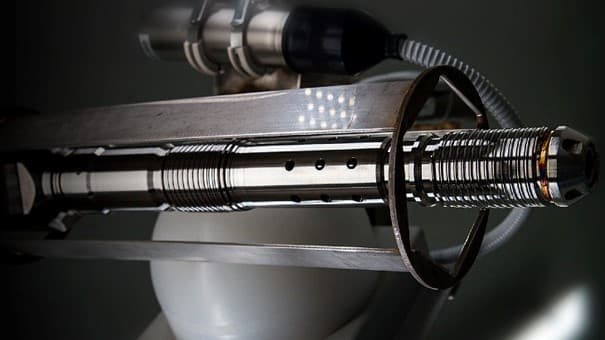
Fuel for the BN800 reactor containing, in addition to plutonium, the minor actinides americium 241 and neptunium 237 (source: TVEL).
The MBIR experimental reactor in Dimitrovgrad is intended to test the potential of different types of fast reactors. In addition to liquid sodium cooling, it will also study lead and gas cooling. In 2023, a cooling tower was built; the reactor building dome was completed in mid-October; a 125-tonne gantry crane was installed; and a range of key equipment was fitted. The reactor is expected to be completed and commissioned in 2027.
Construction of the BREST-300-OD reactor, being built as part of the Proryv project, also progressed. At the beginning of 2023, a test prototype of a pump for the reactor’s cooling circuit was completed. In this case, lead is used for cooling, and developing the necessary pumps is challenging. At the end of 2023, construction began on the power evacuation line from the plant. It will be 36 km long and have a total of 160 pylons. If the concept proves successful, it will be followed by the commercial BR-1200 fast reactor version. Preliminary work on the concept of this project is already under way.
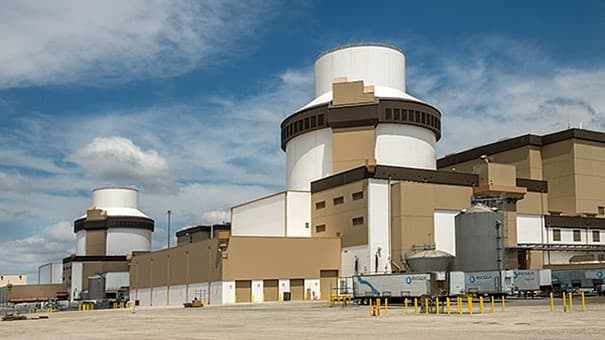
The AP1000 reactor, which began operating at the Vogtle plant, is also being offered for Dukovany (source: Georgia Power).
Conclusion
As can be seen from the preceding text, a renaissance of nuclear energy is getting under way around the world, including in Europe. In the European Union, this is happening despite a long-running intensive campaign by green anti-nuclear activists. A practical comparison of the outcomes of the energy concepts pursued by France and Germany shows that the path to low emissions lies in a combination of nuclear and renewable sources, and that low emissions cannot be achieved using renewables alone. The unsuitability of following Germany’s path to low emissions was discussed in greater detail in a recent article.
The problem for the European Union is that it has largely lost its expertise in nuclear technology over recent decades. While it was at the forefront of both the development and use of nuclear power in the last century, it now lags far behind both Russia and China. Energy policy is predominantly the responsibility of individual EU member states, but we can see that it is very strongly influenced by decisions of the European Commission and the European Parliament. These decisions are very often strongly shaped by ideology and detached from reality. Today, even these institutions feel the effects of reality much more acutely and views are slowly changing, but the process is slow. The importance of European Parliament elections is also illustrated by a recent domestic example. Our State Energy Policy includes the construction of new nuclear sources and the use of nuclear energy. Nevertheless, during negotiations on including nuclear sources in the taxonomy, all Pirate Party MEPs, led by Mikuláš Peksa, voted against it. Fortunately, they failed to prevent its inclusion.
The European Union ultimately also made a decision favourable to nuclear power on the conditions for producing green hydrogen. Electricity from low-emission sources, such as nuclear power plants, may also be used for its production. Every green hydrogen production facility must be linked to a specific low-emission source that meets the relevant conditions. The exception is low-emission electricity systems, where emissions are below 65 g CO2 equivalent per kWh. However, apart from specific countries such as Norway, this condition is currently met only by France and Sweden.
The coming decade will be a critical period for reviving the development of nuclear energy in the European Union and in Czechia. In Czechia, ČEZ is the main company developing nuclear power. The company plans to build both new large units and small modular reactors. In the optimal scenario, ČEZ wants to build four large units and ten small modular reactors. The first prototype small modular reactor would be built at Temelín. It would serve for training and to refine licensing and other approval processes. Others would replace coal-fired units at the Mělník, Tušimice, Prunéřov, Ledvice, Poříčí and Dětmarovice power plants in electricity and heat generation. The selection and assessment of potential sites is currently under way. The focus is currently on the two most promising sites, Dětmarovice and Tušimice. Poříčí, by contrast, will most likely not be used, as an active geological fault may be present at the site. In our future overviews, we will also monitor whether and how the nuclear renaissance will actually unfold globally, in Europe and in Czechia.
A lecture for future engineers at Brno University of Technology on the present and future:
Translation disclaimer
This article is a machine translation of the Czech original and has not yet been fully reviewed. In case of any doubt, please refer to the Czech version.
Sdílejte článek prostřednictvím:
Topics:Opinion
You might also like
23 October 2026, 11:01

23 October 2026, 06:34