23 October 2026, 14:38
Loading...
Nuclear energy in 2024, part 4: Progress in addressing five key challenges
Vladimír Wagner
2 February 2025, 08:06
In this final, fourth part, we will focus on three of the five fundamental challenges facing nuclear energy. In the previous series, we discussed the five main challenges facing today’s nuclear energy sector. The first is to operate existing units for as long as possible. The second concerns the deployment of Generation III reactors. The third is driven by the need to use nuclear energy to supply heat to buildings and industry. The fourth is the deployment of small modular reactors, while the fifth is the path towards closing the fuel cycle, namely the deployment of Generation IV reactors.
We discussed the first and second challenges in detail in the previous article; we will now look more closely at the remaining three.
The importance of nuclear heat sources is growing
The use of nuclear heat sources is steadily growing, with an increasing number of positive examples. However, the untapped potential remains far greater. Czechia is also currently undergoing a major turning point.
In the Czech Republic, the district heating pipeline from the Temelín nuclear power plant to České Budějovice has begun to be used very successfully. The 42 km district heating pipeline project from Dukovany to Brno has taken a significant step forward. Important contracts have been signed covering work on equipment for extracting heat from the Dukovany units and bringing it to the boundary of the power plant site. Agreements to conclude future contracts have also been signed, conditional on the start of construction of the pipeline, expected in 2027. Construction should then take four years, and the pipeline should avoid built-up areas, including through underground routing. The longest such section, exceeding one kilometre, will be in the Bobrava nature park.
The district heating pipeline from the Haiyang nuclear power plant, with two AP1000 reactors in Shandong province, is now in its sixth heating season of operation. It is gradually covering an ever larger area and more cities. In 2026, heat from the plant should also reach the city of Qingdao, with a population of 10 million.
The completion of the project to supply steam from the Tianwan power plant to a petrochemical facility in Lianyungang, Jiangsu province (Jiangsu), was already covered in the previous review. Commissioning of the equipment began in early March 2024. Steam is extracted from the secondary circuit of units 3 and 4, which are VVER-1000 reactors. The steam pipeline is around 23 km long. The system should supply 4.8 million tonnes of steam annually. It entered commercial operation in June.
An example of the use of a high-temperature reactor to supply heat for urban district heating is a project using heat from the HTR-PM200 high-temperature gas-cooled reactor. High-temperature steam heats water through a heat exchanger, which is then supplied to the district heating system. The pipeline was completed on 22 March and connected to the heating system on 27 March 2024.
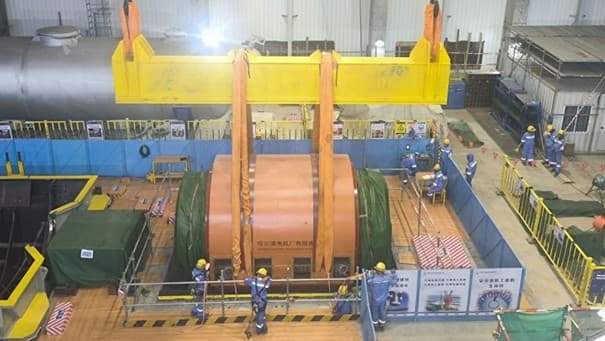
Installation of the stator for the ACP100 small modular reactor (source: CNNC).
Small modular reactors at the starting line
Although construction of the first small modular reactors is still at an early stage and they are so far mostly intended for specific conditions, a major turning point also appears to be approaching in this area. The first field in which we can speak of serial production of small modular reactors is the manufacture of marine reactors and their use for power plants.
Russia is continuing work to build a fleet of the latest Project 22220 nuclear icebreakers. These icebreakers are 173 m long and 34 m wide, while their height from the waterline to the tip of the main mast is 53 m. They use two RITM-200 reactors, each with a thermal capacity of 175 MWt. In 2024, the fourth icebreaker in the series, Yakutia, was completed; the Russian flag was raised on it at the end of December 2024 and it entered service. The fifth icebreaker in the class, Chukotka, was launched at the Baltic Shipyard in early November. It is expected to be completed in 2026. Preparations for two more were covered in previous reviews. Their previously announced names were changed last year. Under the adopted practice of naming vessels after different areas along the Arctic Ocean coast, they were originally to be called Kamchatka and Sakhalin. Their names have now been changed to Leningrad and Stalingrad. Work on Leningrad is already under way at the shipyard, while a contract for the construction of Stalingrad has been signed and work on it should begin this year.
The Northern Sea Route is becoming increasingly important not only for Russia. China is also showing growing interest in it. With the loss of trade routes to Europe through Russia, the importance of this connection is increasing. And it cannot function without nuclear icebreakers. This is why China and Russia are also engaging in close cooperation in this field. A record 37.8 million tonnes of cargo was transported via this sea route in 2024, an increase of 1.6 million tonnes on the previous year.
Small modular reactors are highly suitable for ensuring sufficient electricity and heat for the development of these northern regions. The first floating nuclear power plant, Akademik Lomonosov, which uses two older KLT-40S icebreaker reactors, is already in operation. In 2024, the first refuelling was also carried out for the second reactor.
Four floating nuclear power plants with RITM-200 reactors are being developed for mining companies in the Bilibino region of Chukotka. Assembly of the first two of these new floating nuclear power plants began in 2024.
Construction of an onshore power plant with RITM-200 reactors is being prepared in Yakutia. In 2024, the option of building two reactors instead of one began to be assessed, which could better cover the region’s growing needs. Russia is also offering Uzbekistan the construction of a power plant comprising six of these reactors. A site is being prepared near the city of Jizzakh, with work at the location having started in June 2024.
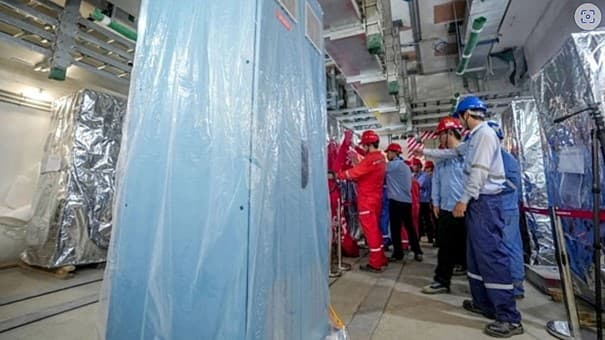
Installation of the digital control system for the ACP100 small modular reactor has begun (source: CNNC).
The first conventional small modular reactor is nearing completion and start-up. It is China’s ACP100 (Linglong One) at the Changjiang power plant. It is the first integrated-type conventional pressurised water reactor under construction that will be used for combined heat and power generation. After the internal dome was installed in November 2023, the outer dome, weighing 550 tonnes, was installed in February 2024. Installation of the reactor’s digital control system began in the first half of April, and the facility’s control room was commissioned in May. In September, internal equipment was installed in the reactor vessel. At the same time, the generator stator was secured and turbine assembly began.
The cancellation of plans to build a prototype at INL (Idaho National Laboratory) was a major blow to the NuScale project. As early as January 2024, NuScale cut its workforce by 154 employees as part of cost-saving measures. It is now seeking another party interested in implementing the prototype facility. It has several potential investors, for example in the US, Romania and Poland, but nothing concrete so far. Last year, it commissioned South Korean company Doosan to manufacture the upper sections of its reactor modules for the Idaho project; it is now reallocating them to another future project.
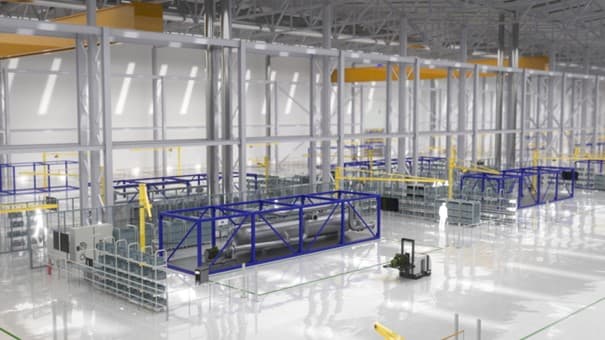
Rolls-Royce reactor modules will be manufactured in factories. The first will be in Sheffield (source: Rolls-Royce SMR).
In the section devoted to ČEZ’s selection of the Rolls-Royce small modular reactor, I wrote that the UK had shortlisted four designs: the aforementioned Rolls-Royce, Holtec’s SMR-160, Westinghouse’s AP300 and GE Hitachi’s BWRX-300. These are indeed currently the closest to possible deployment. Let us look at their recent progress in more detail.
The advantage of the BWRX-300 reactor is that a site for the prototype has already been selected and the licensing process is also at an advanced stage. Since September 2022, Canadian company OPG in Ontario has been preparing the construction site at the Darlington power plant for a total of four BWRX-300 units. The first phase of site preparation was completed on schedule in 2024. At the beginning of 2025, the site should be ready for the start of the first prototype unit, pending the necessary permits. Work is also under way on the licence application for units 2 to 4. The first unit should be completed in 2028 to 2029. For participation in the UK tender, it is important that the reactor passed the first stage of the UK nuclear safety authority’s GDA (Generic Design Assessment) in December 2024 and progressed to the next stage. The second stage should be completed at the end of 2025. This is a voluntary assessment of a design’s compliance with safety and environmental requirements in a given country, but it is an important indicator of the reactor’s potential success. A number of countries are considering this reactor, including Sweden, Poland and Estonia in addition to Canada.
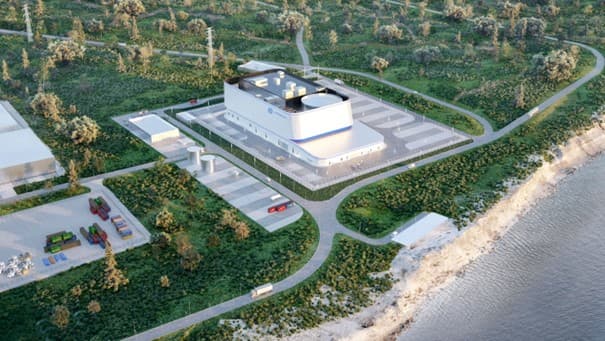
Visualisation of the BWRX-300 small modular reactor (source: GE Vernova).
Rolls-Royce SMR expects the first prototype of its reactor to be built in the UK. The outcome of the British government’s tender is therefore very important for it. The GDA process is also under way for this reactor. No specific site has yet been selected. The first modules should be produced at a factory associated with the University of Sheffield’s research centre in South Yorkshire. The factory will test efficient methods for manufacturing modules. This is an important step on the path to the first reactor prototype. Poland is also considering the use of Rolls-Royce reactors.
Holtec’s SMR-160 reactor is also at an advanced stage of preparation. The company is considering potential sites. One of them could be Oyster Creek. The selection of this site is due to the fact that there is a shut-down nuclear power plant there, whose decommissioning is being carried out by Holtec. It housed a boiling water reactor that entered operation in 1969 and was shut down in 2018. Holtec subsequently took it over. The gradual decommissioning of the nuclear power plant is progressing relatively quickly. The vacated site is highly suitable for a small modular reactor. Similarly, Holtec would like to build two SMR-160 reactors at the Palisades power plant, which it also took over for decommissioning. However, it has decided there to restart the unit shut down two years ago. For the use of the SMR-160 in more southern areas, where solar thermal power plants can be used, Holtec plans to offer a highly efficient combination of a nuclear reactor, a solar thermal power plant and molten-salt heat storage. This would very effectively balance changes in both sunshine and electricity demand.
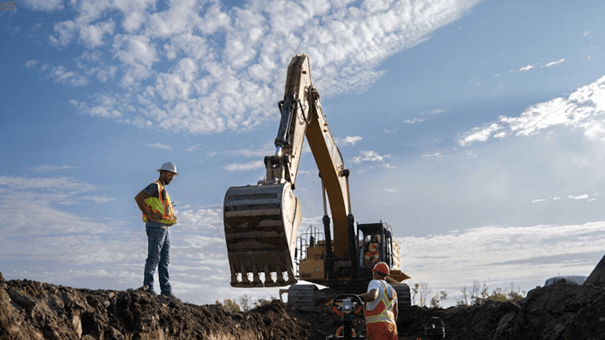
Preparation of the construction site for the BWRX-300 small modular reactor at the Darlington power plant has begun (source: OPG).
Westinghouse is working on the AP300 small single-loop modular reactor, a scaled-down version of the AP1000 reactor. At the beginning of 2024, the company submitted the design for the GDA process in the UK described above.
The NuwardTM integrated reactor project was halted in mid-2024. EDF assessed the situation in which small modular reactors need to be deployed as quickly as possible. The more advanced integrated reactor requires much more time for development and licensing. Several conventional, simpler small modular reactor designs are already very close to potential deployment of their first prototype. In this situation, EDF decided to move to developing a simplified version of the Nuward reactor based on established conventional technologies. The project could therefore be completed and commercially offered sooner, before the market is saturated by other models.
A very interesting project is being prepared in Finland. It is the LDR-50 small modular reactor from Finnish company Steady Energy, with a thermal capacity of 50 MWt, intended for district heating systems. The reactor is designed solely for heat production, and the number of modules would depend on total required capacity. As high temperatures are not needed for residential heating, the reactor could operate at relatively low pressure. Its operating temperature is around 150 °C and pressure up to 1 MPa. This, together with its relatively low output, increases its passive safety. Cooling is ensured entirely by natural circulation. Finland is far north, making heating a key issue for the country. The LDR-50 reactor is based on the use of conventional technologies and fuel assemblies. Work on the project is relatively advanced and has industry support. Several Finnish cities are already studying the possibility of using these reactors, while their deployment is also being considered in Sweden. The company wants to begin construction of its first prototype in 2028. It should be commercially available in the early 2030s.
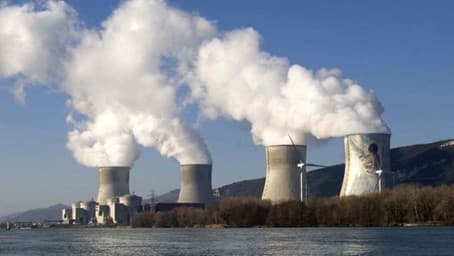
The Cruas power plant uses fuel made from recycled uranium (source: EDF).
Let us look at developments involving some advanced Generation IV small modular reactors. In mid-2024, earthworks began on the non-nuclear sections of the prototype demonstration project for TerraPower’s future reactor at the site of a closed coal-fired power plant in Kemmerer, Wyoming. It is a sodium-cooled fast reactor using HALEU fuel, with a standard output of 345 MWe that can be increased to as much as 500 MWe for up to five hours.
The number of parties interested in X-energy’s XE-100 high-temperature gas-cooled reactor is increasing. The 80 MWe reactor is expected to use TRISO fuel. This increases the likelihood of earlier implementation of its prototype project.
And what progress has been made with microreactors? Earthworks have begun at INL (Idaho National Laboratory) for construction of a building for the Pele mobile microreactor prototype. The reactor should be transportable in four shipping containers. It should supply 1-5 MWe for at least three years. It is a high-temperature gas-cooled reactor using HALEU TRISO fuel. The US Department of Energy, DOE, supports projects for several other microreactors of different types, such as Aurora, Aalo-1, BANR and Kaleidoscope.
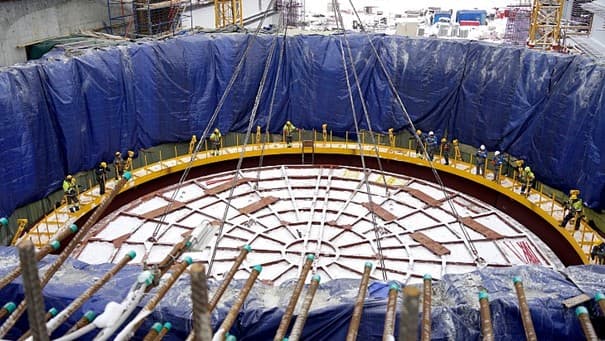
The steel base plate for the BREST-300OD reactor was installed in January 2024 (source: Rosatom).
Progress towards closing the fuel cycle
Spent fuel can be partly recycled even when conventional moderated reactors are used. However, uranium utilisation and the burning of the resulting actinides can only be increased to a limited extent in this way. Fast reactors are needed to genuinely close the fuel cycle.
France is one of the few countries that reprocesses spent fuel from conventional reactors and uses MOX fuel in them. In view of its return to intensive nuclear energy development, it has adopted a long-term strategy for developing spent fuel reprocessing. It considers development in this area an important element of nuclear energy sustainability. The strategy includes three steps. The first is extending the operation of the reprocessing plants at La Hague and Melox beyond 2040. The second is building a new MOX fuel fabrication plant at La Hague, and the third is building a new reprocessing plant at the same site. At present, around 10 % of France’s nuclear electricity comes from recycled fuel. In future, France wants to increase this share to 25 % and later to 40 %. More intensive use of MOX fuel assemblies should also contribute to this. MOX fuel uses plutonium recovered from spent fuel. Reprocessed uranium is enriched and used in REMIX fuel. Four reactors at the Cruas nuclear power plant in France are licensed to use fuel made from reprocessed uranium. Cruas unit 2 became the first to begin using a core composed entirely of this recycled fuel in March 2024.
In French recycling plants, plutonium is recovered from spent fuel and immediately used to produce MOX fuel. Recycled uranium is then stored as a strategic reserve, with part of it used to produce REMIX fuel. France currently reprocesses around 1100 tonnes of spent fuel. It recovers 11 tonnes of plutonium and 1045 tonnes of recycled uranium from it. The latter is still predominantly stored. There is therefore considerable potential for using fuel assemblies made from recycled uranium.
Let us now look at fast reactors that have actually been deployed. These are generally more compact and require more efficient cooling. They are therefore often cooled by liquid metals. First, let us consider sodium-cooled fast reactors. The only two commercially supplying electricity are the BN600 and BN800 reactors at the Beloyarsk nuclear power plant. The follow-on BN-1200 sodium-cooled fast reactor project, planned as the fifth unit at the same power plant, received environmental approval in 2024. Intensive work also began on finalising the design and detailed project documentation, which would make it possible to obtain a licence to begin construction.
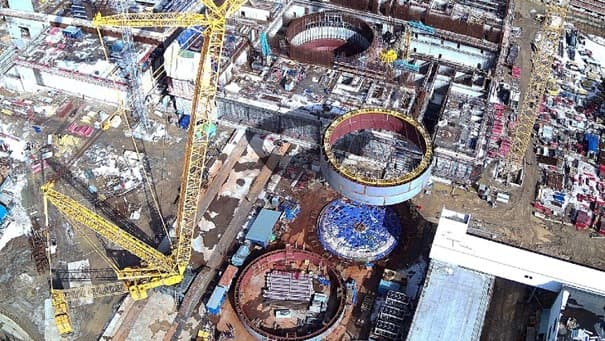
Construction of the containment for the BREST-300OD reactor (source: Rosatom).
Fuel loading began in early March 2024 at India’s prototype PFBR sodium-cooled fast reactor in Kalpakkam. In early August, the reactor received permission to begin criticality tests, namely tests involving a sustained fission chain reaction. Construction of the 500 MWe reactor began as early as 2004 and, after many years of delays, it is finally preparing for start-up. Initially, its core should use a mixture of uranium and plutonium in the central part, surrounded by uranium 238 in the breeding zone. Uranium 238 should later be replaced by a mixture of uranium and thorium. In conjunction with India’s heavy-water reactors, it should make it possible to close the uranium cycle, use thorium and close the thorium cycle.
Another option is lead-cooled fast reactors. Construction of the BREST-300-OD reactor is progressing successfully. It is a lead-cooled fast breeder reactor with a thermal capacity of 700 MWt and electrical output of 300 MWe. Its operating temperature is 540˚C. The reactor’s 165-tonne steel base plate was installed together with the lowest part of the containment in January 2024. This marked the beginning of construction and installation of this integral reactor. The second containment ring was installed in mid-April, followed by the final third ring in August 2024. Installation of internal components, cooling system piping and other structures then began. Work was under way on construction of the turbine hall in the second half of the year. Fuel is also being developed for this reactor type, consisting of uranium-plutonium nitride. In April 2024, the Russian nuclear safety authority authorised the production of depleted-uranium fuel assemblies for this reactor. This is the first step towards preparing fuel assemblies for the fast reactor, which is expected to enter operation in 2026.
An interesting step in studying the possibilities of closing the fuel cycle in the US is the start of earthworks in preparation for construction of the Generation IV research reactor, the “Hermes Low-power Demonstrations Reactor”, in Oak Ridge, Tennessee. It is the first non-light-water reactor to be built in the US in more than 50 years. It is a high-temperature reactor cooled by molten salts. It will use pebble-bed TRISO fuel, similarly to China’s HTR-PM200 high-temperature gas-cooled reactor. However, the experimental Hermes reactor will not generate electricity. It is expected to enter operation in 2027. Based on experience with it, a prototype of the actual power reactor, Hermes 2, generating electricity, would later be built. Kairos Power, which is developing the reactor, cooperates with several US nuclear laboratories: ORNL, INL and LANL.
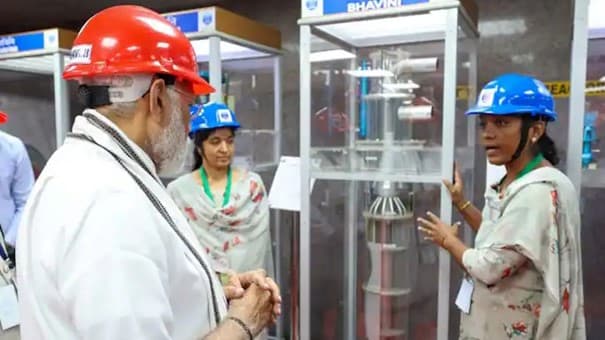
Fuel loading began at India’s PFBR sodium-cooled fast reactor in Kalpakkam in early March 2024 (source: Narendra Modi).
Conclusion
The number of reactors worldwide and the electricity they generate should continue to grow in the coming years. If nuclear electricity generation did not exceed the 2006 record in 2024, it will do so in the near future. The nuclear renaissance is being driven mainly by China. The number of new reactors approved in China indicates that 10 reactors a year will be commissioned in China alone in the coming years. While the nuclear renaissance has not yet really begun in other parts of the world, there is significant evidence that this could change in the near future, and then far more than 10 reactors a year should be commissioned. Reactor construction is accelerating in India. Japan is restarting nuclear units shut down after the Fukushima accident and has returned to developing nuclear energy, including the construction of new reactors, as described in detail in a recent review of progress in addressing the consequences of the Fukushima I accident. The breakthrough could come with the deployment and widespread use of small modular reactors. It is becoming apparent that the ever more intensive use of computing technology and rapid development of artificial intelligence are leading to a sharp increase in the need for stable electricity sources. Rapid electrification of transport has a similar effect. Nuclear sources could provide the solution.
Comparison of energy sector developments and emissions in France and Germany clearly shows that a combination of nuclear and renewable sources enables a rapid and effective transition to low-emission electricity generation, while renewables alone do not lead to low emissions. It is becoming ever clearer that Germany’s Energiewende, pushed through by green anti-nuclear activists, is a road to nowhere. This has even led to such absurdities as the construction of power dissipators, used in cases of large surpluses of renewable energy generation. It is possible to make money this way from the growing number of hours with negative prices. Their construction is also being considered to address grid congestion problems and protect the grid.
Let us recall that Germany’s original idea in the 1970s and 1980s was to follow the same path as France. A long-term intensive campaign by green anti-nuclear activists led to Germany’s complete nuclear phase-out and the halting of nuclear development across Europe. Had this not happened, all of Europe could already have had low-emission electricity generation. More than a quarter of a century ago, during the debates over Temelín, I argued that Greenpeace, Friends of the Earth Czech Republic and other anti-nuclear activists would ultimately prove to be the main culprits for failing to achieve emissions reductions in time; see, for example, here. And the truth of that claim is being increasingly confirmed. The worst thing, however, is that the aforementioned green anti-nuclear activists show almost no self-reflection. They continue to promote energy concepts based on purely ideological anti-nuclear activism regardless of scientific and technical facts, whether Greenpeace, Friends of the Earth Czech Republic or Fakta o klimatu associated with Oldřich Sklenář. I recently wrote an analysis of the energy recommendations put forward by Fakta o klimatu and showed why, in this respect, the organisation should rather be called Climate Illusions.
Lecture for future engineers at Brno University of Technology on the present and future.
Translation disclaimer
This article is a machine translation of the Czech original and has not yet been fully reviewed. In case of any doubt, please refer to the Czech version.
Sdílejte článek prostřednictvím:
Topics:Opinion
You might also like
23 October 2026, 11:01
23 October 2026, 06:34