23 October 2026, 14:38
Loading...
Nuclear power in 2020 – part I
Vladimír Wagner
15 January 2021, 10:29
In 2020, a seventh Generation III reactor design began operating: China’s Hualong One reactor. Russia and South Korea started up their first Generation III units outside their own territories. The Russian VVER1200 reactor began operating in Belarus and the South Korean APR1400 in the United Arab Emirates. China is completing a Hualong One unit in Pakistan. Initial operating experience with Generation III units shows that they could meet the expectations placed on them.
This overview of nuclear power developments over the past year follows on from articles published in previous years. The latest instalment covered 2019. At the end of 2019, there were 442 reactors with a capacity of 392.5 GWe, while at the end of 2020 there were also 442 reactors, with a capacity of 393.5 GWe (data from the World Nuclear Association website and the PRIS database). There are 53 units under construction.
Last year, the number of completed units roughly matched the number being retired. Five units ceased operation. Two units were shut down in the United States. In April 2020, the 998 MWe Indiana Point 2 boiling water reactor, which had operated for 45 years, ceased operation. The other was the 615 MWe Duane Arnold boiling water reactor, which had also operated for 45 years. In France, the two oldest units at the Fessenheim plant on the German border were shut down. Each had a capacity of 900 MWe and had operated for 43 years. There were several factors behind their closure. One was the very strong pressure from German anti-nuclear activists. Another was the approaching start-up of Flamanville 3. France has enacted a law under which new units may only replace existing ones, rather than increase the total capacity of French nuclear power. Russia continues to replace RBMK units with VVER1200 reactors. At the Leningrad plant, Leningrad 2 could be shut down. At the very end of the year, Sweden’s Ringhals 1 boiling water reactor was also shut down after 45 years.
Five units newly entered operation. Two started up in China: Tianwan 5 with an ACPR1000 reactor, and Fuqing 5, the first Hualong One (HPR1000) unit; one South Korean APR1400 unit in the United Arab Emirates; and two Russian VVER1200 units. The first began operating at the second phase of the Leningrad nuclear power plant, and the other was the first unit at Belarus’s Ostrovets nuclear power plant. A fission chain reaction also began at Kakrapar 3, India’s first large domestically designed heavy-water reactor.
Construction began on five reactors. These included three Hualong One (HPR1000) units in China: Taipingling 1, Zhangzhou 2 and, towards the end of the year, Taipingling 2; as well as the second VVER1200 unit at Turkey’s Akkuyu plant. Construction also began in China on the CFR-600 sodium-cooled fast reactor at the Xiapu plant in Fujian province. Completion work resumed on units 3 and 4 of Ukraine’s Khmelnytskyi nuclear power plant.
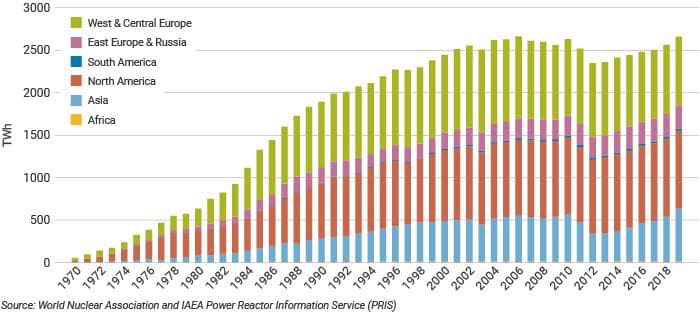
Electricity generation from nuclear power reached 2,657 TWh in 2019. This was up 96 TWh from 2,563 TWh in 2018, almost matching the previous peak of 2,658 TWh reached in 2006. Further developments depend on whether the impact of new reactor start-ups or the closure of ageing ones prevails. The course of Japan’s nuclear power recovery will also have an impact, as a large proportion of the units shut down after the Fukushima I nuclear power plant accident are still not operating.
Four Generation III reactors now operating in Russia
Russia is successfully building Generation III reactors continuously. The fourth to start up in 2020 was the second unit of the second phase of the Leningrad nuclear power plant, which supplied its first electricity on 23 October. Russia is thus also demonstrating that it can continuously replace units that are reaching the end of their service lives. This allowed the second RBMK reactor at the first phase of the Leningrad plant to be shut down. The first VVER1200 reactor there started up in 2018, and its annual capacity factor was around 74 % in 2019. It replaced the first RBMK reactor at the plant. In 2020, facilities linking and optimising power output from the operating units in both the first and second phases of the plant were also completed. Heat supplies and their transition from old to new units are also being optimised. Preparations also began for construction of the plant’s third and fourth units, which should again be VVER-1200 reactors. Project preparation, obtaining the necessary permits and site preparation will begin in the near future.
The first VVER1200 reactor to enter operation was the first unit of the second phase of the Novovoronezh nuclear power plant (Novovoronezh 6), which began operating in 2016. In 2017 to 2019, its annual capacity factors were 60.9 %, 79.4 % and 74.6 %, respectively. This was similar to the first unit of the second phase of the Leningrad nuclear power plant. For the first reactors of an entirely new design, these are not bad results in the initial years. An 18-month refuelling cycle has now been introduced, which will further improve annual capacity factors. We covered the start-up of the second reactor at Novovoronezh II in 2019 in the previous overview. In 2020, Novovoronezh 6 began testing in a mode in which it supports grid regulation and responds to grid needs by changing output. This is an important development in view of projects in Hungary and Finland, where intensive use of nuclear units for grid regulation is envisaged.
Construction of the second phase of the Kursk nuclear power plant is also progressing according to plan. Four RBMK units are to be gradually replaced there. The first two VVER1200 units are now being built, in the refined VVER-TOI variant. This is the design Rosatom would offer for the second phase of the Dukovany project. There are currently 4,700 workers at the site, and construction is proceeding according to schedule. At the end of December, Rosatom’s engineering division in Volgodonsk completed ahead of schedule and inspected the assembly of the reactor vessel, with its internal equipment, for the plant’s first VVER-TOI unit before it was dispatched to the construction site.
In 2020, preparations began for the construction of two VVER-TOI units as the second phase of the Smolensk nuclear power plant. These are also intended to replace the RBMK units currently in operation there. Construction of the second phase will begin approximately 6 km from the existing plant.
The first Russian VVER1200 reactor is operating abroad
The highlight of the year for Rosatom was the start-up of the first unit at Belarus’s Ostrovets plant. It is the first VVER1200 reactor commissioned outside Russia, in the immediate vicinity of the European Union’s border. It was therefore subject to very close scrutiny, including from the European expert community. Several International Atomic Energy Agency missions were carried out even before start-up. They confirmed that the new reactors are safe and comply with all global standards. As construction was delayed by two years, an agreement was signed to postpone repayment of the Russian loan for the construction by the same period.
In February 2020, the final tests before fuel loading were carried out, using dummy fuel assemblies. In mid-April, hot testing, which had been under way since 11 December 2019, was completed. At the end of April, permission was granted to load fuel into the reactor. A fission chain reaction began on 11 October, and the unit supplied its first electricity to the grid on 3 November. By the beginning of 2021, it was already operating at full capacity. It should enter commercial operation in the first quarter of 2021. The second reactor reached the stage immediately before start-up.
For Belarus, this is also a strong stimulus to become involved in the production and operation of modern nuclear technologies. Belarusian companies and experts are therefore participating in preparations for further VVER1200 reactor construction projects. They are involved not only in remote projects such as the El Dabaa plant in Egypt, but also in nearby European projects. Their participation is expected mainly in the construction of two VVER1200 units at Hungary’s Paks plant.
Lithuania has been strongly opposed to the plant, seeking a boycott of electricity imports from Belarus to the Baltic states as well as sanctions against its operator and builder. It is questionable whether such an approach will achieve anything. Belarus will use the new sources to replace gas and is also considering further nuclear power development. In the future, it would like to build a second nuclear power plant in the south of the country.
The first projects within the European Union are exceptionally important for any further expansion of Rosatom into Europe. These are one VVER1200 unit at Finland’s Hanhikivi plant and two such reactors in the second phase of Hungary’s Paks plant. A key step at Paks came at the turn of June and July 2020, when Rosatom submitted all project documentation for the construction permit to the Hungarian nuclear safety authority. The documentation comprises around 283,000 pages. The permit, and thus the start of concrete pouring for the nuclear island, is expected in autumn 2021. Before then, however, the project should receive permission for earthworks, which should begin as early as spring 2021. At the end of November 2020, the project received a permit from the energy regulator (MEKH). Only the above-mentioned decision by the nuclear safety authority is therefore still missing. Hungary plans to cooperate very closely with Belarus and wants to draw extensively on its experience.
The Hanhikivi plant should also receive permission to begin concrete pouring for its nuclear island next year. Construction of an administration building began there in summer 2020. Site preparation and the development of subcontractor supply chains have progressed considerably.
Rosatom has the largest number of reactors under construction abroad
In addition to its European projects, Rosatom has a large number of units under construction and planned worldwide. Work is progressing successfully on two reactors at Bangladesh’s Rooppur plant. In 2020, the reactor vessel and four steam generators for the first unit were completed and delivered to the site. By the end of the year, concrete pouring for the cylindrical section of the containment had been completed. Concrete pouring for the future reactor bed of the second unit was also completed. The pressure vessel and steam generators for this reactor are already being manufactured as well. The reactors should be completed successively in 2023 and 2024. Bangladesh is also selecting a site for the country’s second nuclear power plant. Five potential sites in the southern part of the country have so far been selected.
Four VVER1200 reactors are being built at Turkey’s first nuclear power plant, Akkuyu. The reactor vessel and four steam generators for the first unit are already on site. The first unit’s core catcher was installed at the beginning of 2020. Concrete pouring for the second unit began at the end of June 2020, and its foundation slab was completed at the end of September. The first unit should enter operation in 2023. In November 2020, a construction permit was issued for the plant’s third unit. The permit for the fourth unit is expected in autumn 2021.
Obtaining approval from the nuclear safety authority, and thus concrete pouring for the nuclear island of the first unit at the El Dabaa nuclear power plant, has been postponed to the second half of 2021. The first stage of the project, focused on construction preparation, is now ending, while the second stage, focused on the construction itself, is beginning. Completion of the plant is expected in 2028 to 2029.
During 2020, site selection for the construction of two VVER1200 units in Uzbekistan also advanced. Geological surveys are under way at the preferred site near Lake Tuzkan, connected to Lake Aydarkul. Supply chains are beginning to be arranged, and local specialists are being trained for the future plant. The reactors should be completed in 2028 to 2030.
Construction of the second VVER1000 unit at Iran’s Bushehr plant should be completed within five years, while construction of the third unit will begin within two years.
At Kudankulam, where two VVER1000 reactors are already operating, work is under way on units 3 and 4. These will be improved units of the same type, with characteristics close to Generation III. Several ships carrying important components arrived at the site during 2020. The site is being prepared for the plant’s fifth and sixth units. Manufacturing of components for these reactors began in 2020. India and Russia are preparing to build another new plant with six VVER1200 units. A suitable site is still being selected.
Rosatom has also been very successful in China. Following two years of warranty operation, it handed over Tianwan 4, with its VVER1000 reactor, fully to the Chinese investor at the end of 2020. It thus successfully completed delivery of all four VVER1000 units at the plant. It is now focusing on launching the seventh and eighth units there, which will be VVER1200 units. Supply chains are being prepared for two new VVER1200 reactors planned at the Xudabao plant, units 3 and 4. Construction will begin in 2021 and 2022, with completion planned for 2027 to 2028.
Small reactors from icebreakers gaining wider application
Small reactors originally developed for nuclear icebreakers are finding increasingly broad applications. One example is floating nuclear power plants. Last year, the Akademik Lomonosov floating nuclear power plant entered operation. The plant entered commercial operation at the end of May 2020. More and more district heating and hot water supply circuits are now being connected. The second stage of extending and reconstructing heating pipelines took place in 2020. The final, third stage should be completed in 2021. In the future, the floating nuclear power plant should meet all of Chukotka’s electricity needs and is becoming a very important component of the Northern Sea Route’s infrastructure.
Work continued on an optimised floating nuclear power plant design based on experience from the construction and first months of operation of Akademik Lomonosov. The vessel’s displacement will be reduced by 9,000 tonnes and output increased by 30 %, mainly through the use of more modern RITM-200M reactors, which have already been tested on the new generation of nuclear icebreakers. A major advantage will be that refuelling is needed only once every ten years. The floating nuclear power plant therefore does not require equipment for fuel replacement and storage. Entire power plants will be replaced, as they must in any case undergo an overhaul at their home shipyard after this period.
The RITM-200 reactor is also expected to be used for land-based small modular reactors. Rosatom has prepared a project for further electrification of Chukotka using these reactors, mainly to electrify the new Baimskoye ore deposit. Rosatom expects to obtain a licence for these reactors in 2024. In 2020, a decision was taken to locate the first such plant in Yakutia’s Ust-Yansky district. Site preparation should begin in January 2021, and reactor construction should start after the licence is obtained in 2024. It should be completed in 2028.
The small reactors mentioned have proven highly successful on icebreakers. Arktika, the first icebreaker of the new Project 22220 class, entered operation. It is currently operating without one electric motor, which was damaged and will have to be replaced. This means the loss of one-third of its available power capacity. Even without it, icebreaker tests could be carried out and its first Arctic voyages undertaken. The damaged parts will be replaced during maintenance next year, giving the icebreaker full power. Two further nuclear icebreakers, Ural and Sibir, are due to be completed in 2021 and 2022. Two more, whose construction has begun, have already been named Yakutia and Chukotka. Manufacturing of the first reactor for the former has already begun. Their completion is planned for 2024 and 2026. A further two are being considered, one of which could have an enlarged hull. The icebreaker’s parameters are worth recalling: length 173.3 m, width 34 m, propeller power 60 MWt, displacement 33.54 thousand tonnes, service life 40 years and crew of 75.
Contracts for the construction of more powerful Lider-class nuclear icebreakers were also signed during 2020. Work on their design began in the middle of the year. These icebreakers should have twice the power of the Arktika class, or 120 MW. This will be provided by two new RITM-400 reactors, whose manufacture also began in 2020. The icebreaker should ensure year-round operation along the Northern Sea Route at standard normal speed. The vessel will be 209 m long and 47.7 m wide. It will be able to break ice 4.3 m thick and create a 50 m-wide corridor through the ice for ships. Full completion of the project documentation is expected at the end of 2021. The first icebreaker of this type, named Rossiya, could be completed in 2027. Three such icebreakers are ultimately to be built.
Summary of nuclear power in Russia
Russia commissioned two Generation III reactors this year, one of them outside its territory. It now has five such reactors in operation and is gaining experience in their use. Completion of the unit at Belarus’s Ostrovets plant took seven years. This was two years longer than planned, but it was the first implementation of this unit abroad. Experience gained from construction close to the European Union could help with projects in Finland and Hungary. If Hanhikivi and Paks obtain their permits as expected, construction itself could proceed more quickly. Experienced specialists from the Belarus project could be used.
Russia is building nuclear units continuously at home, where it has demonstrated an ability to replace retiring units in a timely manner. However, it has even more reactors under construction and planned abroad. It can prepare and build units in very different geographical and climatic conditions. It is thus gradually gaining experience and expanding its pool of experienced specialists. The established supply chains can therefore operate continuously in manufacturing, ensuring that acquired experience is not lost. It should be noted that Rosatom also cooperates very closely with a number of Western companies. Its Generation III reactor could therefore fully meet the expectations placed on it. Experience from construction and operation to date confirms this.
The start of commercial operation at the first floating nuclear power plant, Akademik Lomonosov, is also a major success. It too has so far met the requirements placed on it. If the new Arktika nuclear icebreaker is also successful in operation and the RITM-200 reactor proves itself, the way will be open for its successful use not only on ships but also in floating nuclear power plants and as small modular power plants. Alongside large Generation III reactors, Russia could thus have another highly advantageous export product. In addition to raw material exports, nuclear power plants and their servicing throughout their life cycle are becoming a very attractive economic sector for Russia.
China achieved a key success
China’s key success in 2020 was the start-up of the first Hualong One (HPR 1000) reactor. This is another Chinese Generation III+ reactor. The same reactor is also being completed abroad, at Pakistan’s Karachi nuclear power plant. The reactor is expected to become key to China’s international offering. In this respect, a major success in 2020 was obtaining a European licence, confirming that it meets all European standards and requirements. Seven reactor designs now hold a European licence in total. Naturally, any specific project will require approval from the local nuclear safety authority. These units are planned for the UK’s Bradwell plant.
The first Hualong One reactor entered operation as Fuqing 5. Commercial operation of the unit began at the start of September 2020, five years after concrete pouring for its nuclear island began. Fuqing 6 is also nearing completion and should enter operation in 2021. Two further reactors of this type are being built at Fangchenggang, units 3 and 4. They will not enter operation until 2022.
At Karachi 2, concrete pouring for the containment was completed at the beginning of the year. Following completion of the unit and cold testing, hot testing was carried out and completed at the beginning of September 2020. Loading of fuel assemblies into the reactor began on 28 November. The containment dome was installed at unit 3 at the end of August. They will enter commercial operation in 2021 and 2022.
The four VVER1000 reactors at Tianwan, which are already operating there, have been covered previously. Units 5 and 6, of the ACPR1000 type, are currently being completed. Fuel was loaded into unit 5 at the beginning of July 2020, allowing it to enter operation after five years of construction. Tianwan 6 was also completed in 2020. Hot testing was completed there at the end of December 2020.
The ACPR1000 reactors being built as Hongyanhe units 5 and 6 also moved closer to completion. Cold testing of unit 5 was completed in October 2020 and began at unit 6. Their entry into commercial operation is planned for 2021 and 2022.
New construction projects are dominated by the Hualong One reactor. Concrete pouring for the nuclear island of Zhangzhou 2 began at the start of September; one such unit is already under construction there. The second and third phases of the plant, each with two units, are also planned. Concrete pouring for Taipingling 1 began at the start of the year, followed by Taipingling 2 on 15 October. At the beginning of September 2020, China approved the construction of two pairs of these reactors: the first at Changjiang and the second at Sanao. At the start of 2021, first concrete for the nuclear island was poured for the first unit at the Sanao plant in Zhejiang province. A total of six units should ultimately be built there.
Another Chinese design that could be offered abroad is the CAP1400 unit, an enlarged fully Chinese variant of the AP1000 reactor. Two such units are being built at the Shidaowan plant.
A small modular high-temperature gas-cooled pebble-bed reactor, the HTR-PM, is also under construction at this plant. It has two modules sharing a turbine and is nearing completion. Cold testing was completed at the end of October, after which hot testing began. The evolutionary successor to this reactor should be the HTR-PM600, consisting of six modules sharing a turbine, with total capacity of 650 MWe.
China has also advanced towards sodium-cooled fast reactors. It built its first small experimental plant with such a reactor with Russian assistance, with Russia supplying the fuel. The CEFR reactor, intended primarily for testing, began supplying electricity in 2011. In 2020, it began operating at its maximum output of 20 MWe. It was verified that it operates exactly as expected.
Based on experience with the small CEFR reactor, construction began in 2017 on the 600 MWe CFR-600 demonstration sodium-cooled fast reactor at Xiapu. Construction of a second unit of the same type began in 2020. The commercial CFR-1000 unit, with capacity of 1,000 to 1,200 MWe, should begin construction in 2028 and is planned for completion in 2034.
Summary of Chinese nuclear power
In 2020, China succeeded in commissioning the first Hualong One reactor at Fuqing. At the same time, this reactor is being brought into operation abroad at the Karachi plant in Pakistan. China builds Generation III reactors within five years. It too has ensured construction continuity and is expanding both experience and the number of specialists. Unlike Russia, this has so far been predominantly on its domestic market, but it is also beginning to establish itself abroad. Obtaining the European licence is an important step in this regard.
The first modular high-temperature gas-cooled HTR-PM reactor is also nearing operation. If this helium-cooled reactor proves successful in operation and economically, it will also be a highly suitable heat source for industry. To some extent, it is the first Generation IV reactor and a major breakthrough in nuclear technology.
Sodium-cooled fast reactors, which China is developing with Russia’s assistance, should open the path to closing the fuel cycle. In the future, they too could become a very attractive export product. Although in the near term, India needs most of its capacity to develop the potential of domestic nuclear power. In the coming years, it wants to accelerate the launch of new construction projects and commission around 6 nuclear units annually. This is also why it ordered reactors from Rosatom. China currently has 49 units in operation with total capacity of 48 GWe, and 15 units under construction with capacity of 16 GWe. By 2025, it would like to approach 70 GWe in operation and 30 GWe under construction. By 2035, it wants to have 200 GWe of nuclear capacity, rising to 340 GWe in 2050. While nuclear power supplied almost 5 % of China’s electricity in 2019, this should be around 10 % in 2030. Nuclear power could therefore significantly help China’s decarbonisation. Given current developments, these plans could be fulfilled.
South Korea
The start-up of the first South Korean APR1400 reactor at the Barakah plant in the United Arab Emirates is a huge success for Korea Electric Power Corporation (KEPCO). The unit received its operating licence on 16 February 2020. After fuel loading and the start of the chain reaction, the turbine was started once sufficient output was achieved, and electricity supplies to the grid began. In 2021, it is already operating at nominal output. The second unit was completed in July 2020, and an application for an operating licence was submitted to the UAE nuclear safety authority. The third and fourth units are also nearing completion. Cold testing was completed at the fourth unit in May 2020. South Korea and the United Arab Emirates want to use the experience gained in cooperation on joint project offers for third countries.
Shin Hanul units 1 and 2 are nearing operation and should start up in 2021 and 2022. The last units still being built in South Korea are Shin Kori 5 and 6. Following their completion in 2023 and 2024, no further nuclear units are planned. The current political leadership has declared a nuclear phase-out. The highly successful Korean nuclear industry must therefore seek markets abroad. However, this is very difficult without a domestic base, and no further contracts are currently in sight. Unlike Russian and Chinese Generation III reactors, the APR1400 reactor therefore lacks continuous serial production that would reduce costs and ensure highly efficient construction. Its future, unlike that of the preceding Generation III reactors, remains open and uncertain. Securing further contracts is essential, and this could be helped by the highly successful and rapid introduction of nuclear power and construction of four units in the United Arab Emirates, a country that had no previous experience with it. Another advantage is that the APR1400 has both European and US licences, as well as a design for its smaller APR1000 variant.
KEPCO is therefore also seeking to enter the field of small modular reactors and specialised facilities. It has begun cooperating with DSME (Daewoo Shipbuilding & Marine Engineering) on a floating nuclear power plant project. They envisage using the BANDI-60 small pressurised water reactor, with thermal output of 200 MWt and electrical output of 60 MWe, which KEPCO has been developing since 2016.
India focuses on heavy-water reactors
A major success for India was the start of commissioning for the first large domestically designed 700 MWe IPHWR700 heavy-water reactor. This is Kakrapar 3. Fuel assembly loading was completed in mid-March 2020, and a fission chain reaction began in the final quarter of July. At the beginning of 2021, it began supplying electricity to the grid. All components are of Indian origin. It is an important part of the future thorium cycle. Heavy-water reactors have better neutron economics and, together with fast reactors, could use thorium in the future, of which India has large reserves. India currently has only smaller units of this type with a capacity of 220 MWe. Kakrapar 4 should start up in 2021. Two more reactors of this type are being completed at Rajasthan as units 7 and 8. They should enter operation in 2022 and 2023. Construction of a further eight units of this type is under preparation and planned. At the end of November 2020, the first two of these at the Gorkakhpur plant received permission for concrete pouring for their nuclear islands. These units should become the main pillar of Indian nuclear power. The first projects have been substantially delayed, so it will be important for the experience gained to help accelerate and improve the efficiency of their construction.
We have already covered the construction of new Russian VVER1000 reactors at Kudankulam. India wants to accelerate the growth of nuclear capacity by ordering large units from foreign suppliers. This could help it achieve the necessary growth in its currently limited electricity production. India needs to complete electrification and thereby contribute to raising economic and living standards. Nuclear energy could reduce the need for coal-fired generation. Six Westinghouse AP1000 units at the Kovvada plant are still being considered. However, no progress towards implementation has yet been made.
United States
Two AP1000 units at the Vogtle plant are nearing start-up. Concrete pouring for the Vogtle 3 containment was completed in February 2020. In May, the final module was installed: the pool at the top of the containment that provides water for emergency cooling. Fuel began arriving at the plant site at the beginning of December. Turbine testing began in mid-December.
At the end of March 2020, the dome that sealed the containment was placed on the fourth unit. The third unit should enter operation in November 2021 and the fourth in November 2022. Six units of this type will then be in operation. Unfortunately, no further projects using this design are currently in prospect. Its outlook is therefore highly uncertain. A potential breakthrough could come from their deployment in India or Poland. The reactor has a modular structure, and the advantage of assembly from factory-made modules is greatest when units are built continuously in a larger series. Unlike Russian, Chinese and South Korean reactors, this has not yet occurred for the AP1000.
Source of featured image: Rosatom
Translation disclaimer
This article is a machine translation of the Czech original and has not yet been fully reviewed. In case of any doubt, please refer to the Czech version.
Sdílejte článek prostřednictvím:
You might also like
23 October 2026, 11:01
23 October 2026, 06:34