
23 October 2026, 14:38
Loading...
Options for replacing Russian gas
Oldřich Sklenář
7 March 2022, 17:16
The ongoing war in Ukraine raises the question of how supplies of Russian natural gas to Europe will develop. The fact is that by purchasing it, we are helping to finance the criminal regime of Vladimir Putin, which has placed the Czech Republic on its official list of enemies. From an ethical perspective, the only right solution is therefore to immediately stop purchasing this commodity from Russia.
The problem is that the Czech Republic, and indeed the entire EU, is currently heavily dependent on Russian gas. Russia's share of European imports was still almost 47 % in the first half of last year. Russian state-owned company Gazprom thus remains by far the largest importer of this commodity into the EU.
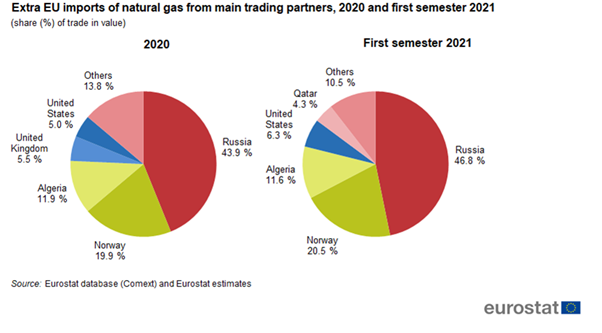
Structure of natural gas imports into European Union countries. Source: Eurostat
It is worth recalling that <the recent sharp rise in energy prices in Europe was largely triggered by the policies of Russia's Gazprom. Although it met its long-term contractual commitments, it curtailed short-term sales and did not replenish its own storage stocks in Europe to the levels seen in previous years. Given the pressure for rising prices, it ultimately managed to significantly increase its profits. The Russian government owns a majority stake in Gazprom. These profits therefore help finance the ongoing military campaign. To put this into perspective, European payments for Russian oil and natural gas combined are equivalent to the amount that could buy dozens of new tanks every day.

Comparison of fill levels at Gazprom-controlled natural gas storage facilities located in Europe. Source: Reuters
If we do not want to participate in Russia's war effort, we must stop buying from Russia. But how can we manage without Russian gas? Back in 2014, following the outbreak of the first crisis in Ukraine, European institutions commissioned an analysis of resilience to a disruption of Russian natural gas supplies. This stress test considered an outage lasting 6 months. However, our dependence on Russian gas is long-term.
Over the next few years, it will be necessary to address this shortfall through imports from other countries. This primarily means increasing supplies via the network of existing pipelines leading into the EU from Norway or Algeria. Given the limited potential of this solution, we will also have to increase imports of liquefied natural gas delivered by sea.
An outlook for next winter is offered, for example, by this analytical article by European think tank Bruegel. Its conclusions suggest that Russian gas can be replaced in the manner described without devastating economic impacts or problems with heat and electricity supplies. In this context, some restrictive measures will of course still need to be adopted.
A detailed analysis specifically for Czech conditions was prepared by Hnutí DUHA. This work also includes an overview of specific recommendations for the Czech government.
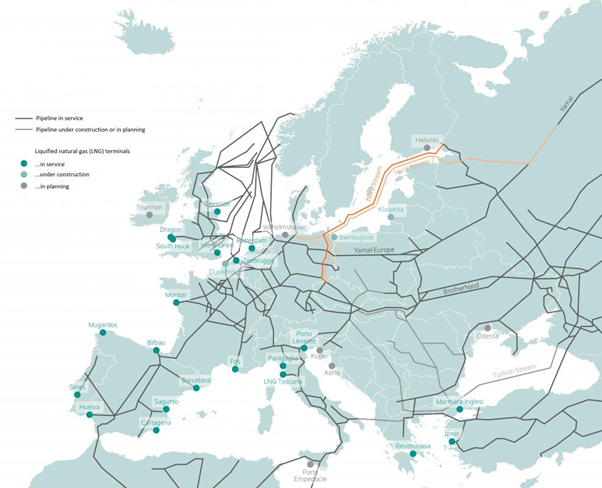
Schematic representation of the existing network of European gas pipelines and LNG terminals. Source: Clean Energy Wire (a detailed map is available, for example, on the ENTSOG website)
In any case, continued import dependence on fossil gas is unsustainable in the long term, not only with regard to energy self-sufficiency but also because of its environmental consequences. Once leaks associated with natural gas extraction, transport and processing are included, its emissions are very similar to, if not worse than, those from burning coal. Methane is to blame, as it is many times more potent than carbon dioxide in terms of the greenhouse effect. And natural gas consists of 70-90 % methane. LNG, or liquefied natural gas, which can be imported into Europe by sea, is not much better, as it is often obtained using the problematic method of fracking. In light of the need to ensure energy security, this factor can be expected to temporarily recede into the background, but it is something that will soon return in the form of climate impacts. These details are addressed, for example, by the new Intergovernmental Panel on Climate Change report.
The long-term solution is a systemic approach aimed at gradually reducing supplies of this commodity. The following hierarchy must be observed: first and foremost, we should address the potential for savings, or energy efficiency. Second is the use of existing secondary resources. Only then come domestic renewable sources, and lastly the import of gas or its alternatives from abroad.
The starting point is an analysis of natural gas consumption in the sectors concerned. Looking at the current use of natural gas as a fuel, we find that it is used primarily for heating buildings, producing process heat and generating electricity. In the case of companies, statistics currently unfortunately do not distinguish between the use of gas for heating buildings and for other purposes, such as manufacturing. Yet the options for replacing it differ significantly in each case.
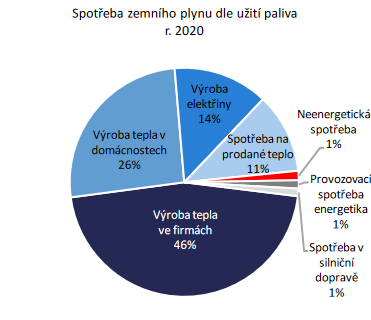
Structure of gas consumption used as fuel. Source: Ministry of Industry and Trade
Heat production
There is considerable scope for energy savings in heating buildings. According to a recent study, involving both the Šance pro budovy organisation and the Czech Technical University in Prague, rapid and thorough renovation of residential buildings could save nearly one fifth of the energy needed to heat them by 2030. By 2050, this could halve heat consumption for heating residential buildings. The potential for non-residential, i.e. commercial and public buildings is only slightly lower. Overall, this could replace around one third of imported Russian gas by the end of the decade. These timelines may seem too distant, but it should be noted that even the planned new nuclear reactor at Dukovany is most likely not to be commissioned before the 2040s.
Full use of this potential could be facilitated by heat suppliers switching to alternative business models, under which district heating companies act not as sellers of heat as a commodity but as providers of heat as a service. End customers would ultimately pay not for the heat physically supplied, but for the thermal comfort provided. In this case, heating companies actively participate in reducing the consumption of heated buildings, or in financing and implementing energy-saving measures, installing renewable or decentralised energy sources, and carrying out energy management.
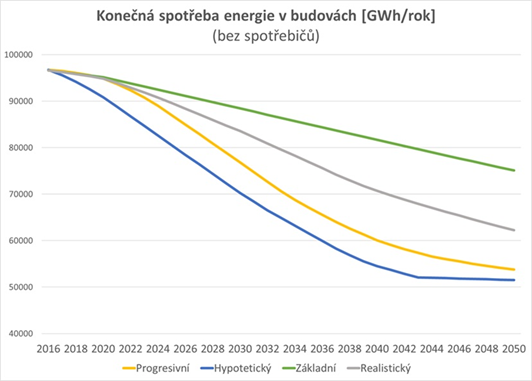
Development of final energy consumption in buildings under individual scenarios. Source: Šance pro budovy
The aforementioned energy management is among the measures that can be implemented very quickly, whether at the level of individual buildings, organisations (such as offices, hospitals and shopping centres) or entire cities. With low costs, this step can deliver savings of around 10 %.
The entire district heating sector is currently undergoing a transition away from coal. It remains to be seen how this development will be affected by current events, but natural gas has until now often been considered one of the possible replacements for coal. Although this solution may still be attractive for many reasons, there is a whole range of alternatives that have not yet been used. These include using waste heat from sewer networks, industrial or computing processes, or shopping centres and the refrigeration technologies operated there.
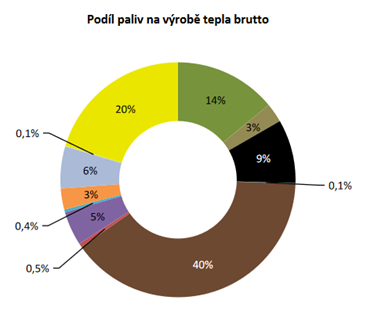
Fuel shares in heat production within district heating systems in 2020. Yellow: natural gas (20%), green: biomass (14 %), brown-grey: biogas (3 %), black: hard coal (9 %), brown: lignite (40 %). Source: Energy Regulatory Office
For example, Stockholm's heat supplier offers the Open District Heating business model, which enables third parties to sell their waste heat into the district heating system.
According to a study by British think tank Ember examining the coal phase-out in the Czech Republic, the use of waste heat combined with large heat pumps could replace most of the heat production currently provided to district heating plants by coal-fired sources. This could significantly reduce natural gas consumption for these purposes.
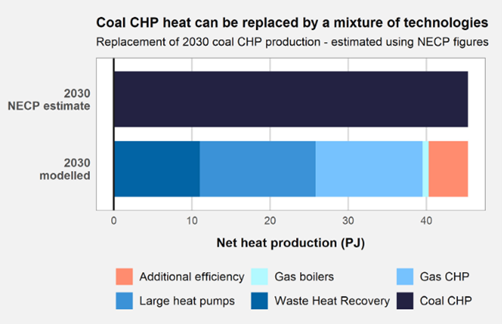
Comparison of heat production under the Czech National Energy and Climate Plan and the EMBER scenario for 2030. Source: EMBER
Electricity and industry
In addition to district heating, growing natural gas consumption can also be observed in the electricity sector. Virtually all coal phase-out scenarios envisage increased use of this fuel. The argument that this amounts to replacing one fossil fuel with another is not entirely justified. For example, according to the aforementioned Ember study, generation from new gas-fired sources would account for approximately 18 % of coal replacement in the baseline scenario, or 14 % in a scenario that also considers the deployment of battery storage. The remaining share should be provided by domestic renewable sources. The main reason these scenarios envisage increased capacity at gas-fired power plants is the high flexibility of these sources. This makes it possible to respond flexibly to demand peaks or complement intermittent renewable sources when the wind is not blowing or the sun is not shining.
In the first of these roles, gas-fired power plants can be complemented by so-called demand-side management (demand side management), or flexibility aggregation. This flexibility is available wherever heat or cold is stored, or in industrial processes where the operation of electrical equipment can be shifted away from demand peaks without significantly affecting the outcome of the process.
According to a recent analysis by German think tank Climate & Company, usable flexibility in industry equivalent to approximately 2,5 GW will be available by 2025. The total potential usable by 2030 is then approximately double that amount, which is more than the new installed capacity of gas-fired sources considered in most decarbonisation scenarios. For comparison, peak load in the domestic power system reached just under 12 GW in 2020, according to a report by the Energy Regulatory Office.
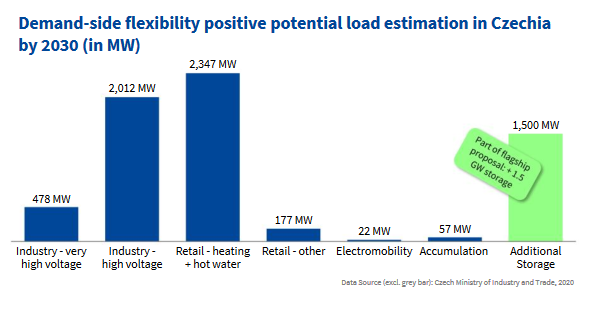
Demand-side management potential according to the Climate & Company analysis for 2030. Source: Climate & Company
Not that demand-side management could fully replace all these planned sources, but international experience shows that it has the potential to substitute for a significant share of the services they provide. One advantage, among others, is that implementing this concept takes considerably less time than building new gas-fired sources. Compared with their operation, it also offers greater cost-effectiveness. However, a necessary condition is the development of smart grids, which will enable the full potential of this solution to be utilised.
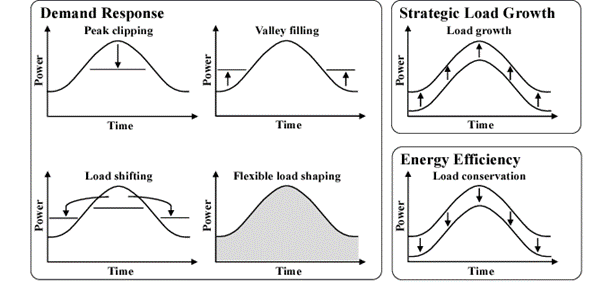
Schematic representation of demand-side management techniques. Source: History of demand side management and classification of demand response control schemes
As already indicated, battery systems or newly built biogas plants can also support flexibility in the daily balancing of electricity generation and consumption. Their development can be expected, among other things, in connection with the planned end of landfill disposal of mixed municipal solid waste. However, these plants should be optimised for peak output instead of the baseload operation common today. The specific differences between the two options are described, for example, in this older article on the TZB-info website.
Biomethane produced in upgraded and newly built biogas plants can also be injected into the gas network. According to data from the CZBiom association, up to 500 million cubic metres of biomethane can be produced annually in this way, equivalent to just under a quarter of natural gas consumption in Czech households.
Hydrogen, specifically green hydrogen, is one available solution for complementing generation from domestic renewable sources through seasonal storage, or for replacing natural gas in industrial processes. Green hydrogen is produced through electrolysis using renewable sources, which need not be located within Czech territory. Its transport across Europe should be provided by the newly built European Hydrogen Backbone hydrogen pipeline network. At a length of 40 000 km, it is intended to connect 21 European countries. Green hydrogen could therefore reach Czechia, for example, from solar power plants in southern Spain or wind farms in the North Sea, where conditions for their operation are significantly better than in the Czech Republic.
Like biogas, hydrogen can be injected into the existing gas network. Existing cogeneration units already allow combustion of blends with hydrogen concentrations of up to 20 %. Technologies are under development that will allow this share to be gradually increased to 100 %.
According to a recent study by AURORA, green hydrogen will reach price parity with hydrogen produced from natural gas in selected European countries by 2030. Imports from regions outside Europe are also an option. An advantage in this case is that areas suitable for green hydrogen production are geographically distributed much more evenly than fossil fuel deposits. This also allows greater flexibility in selecting potential suppliers.
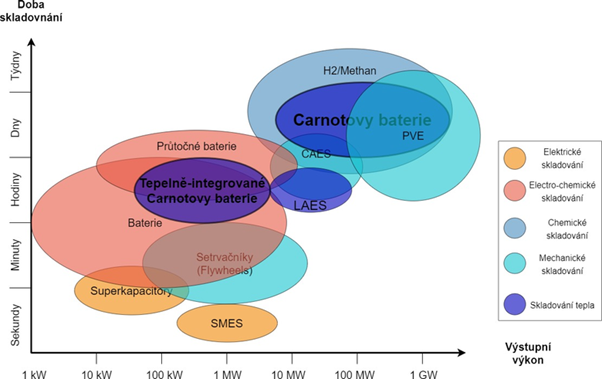
Comparison of technologies used for electricity storage. Source: TZB-info/Czech Technical University
Because hydrogen generally has certain problematic properties affecting its transport and storage, the use of other synthetic gases or liquid fuels produced from renewable sources can also be considered in certain cases.
However, this by no means exhausts the possible alternatives for long-term energy storage. Another option is so-called Carnot batteries. These use the principle of storing energy in the form of heat. While they have lower efficiency, they can offer lower costs. A detailed description of this technology is provided, for example, in this text by authors from the Czech Technical University in Prague.
Cost is crucial for energy storage systems. Generation from renewable sources is already cheaper than fossil alternatives, including natural gas, but the problem lies precisely in the availability of energy produced this way over time.

Comparison of levelised electricity generation costs between 2009 and 2020. Source: Fakta o klimatu
In this area, we could take inspiration from the United States, specifically its Department of Energy. This year, it launched a programme seeking to reduce the cost of long-duration energy storage by 90 % by 2030. The fact that similar potential exists in the Czech Republic is demonstrated, among other things, by domestic development of extremely cheap batteries for stationary applications.
Agriculture
It is important to realise that natural gas is used not only for heat and electricity generation, but also to produce fertilisers. While these can theoretically be imported from countries where Russian natural gas was not used in their production, reduced availability or higher prices could subsequently be reflected in higher food prices.
In this case, as in the previous ones, it is again necessary to follow the outlined sequence of measures. Savings come first. These can be achieved, for example, through precision farming techniques. These enable fertiliser savings by applying fertilisers using satellite data, in precisely the required quantities and only where needed. This approach not only brings financial savings, but is also much more environmentally friendly, as it reduces the risk of excessive eutrophication of water caused by runoff of surplus fertiliser from agricultural land.
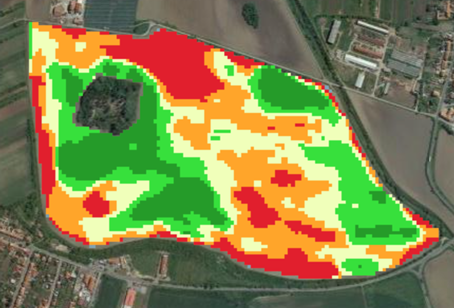
Example visualisation of satellite data showing differences in yields from a specific plot. Source: World from Space
Industrial fertilisers can also be partially replaced, especially at smaller farms, by biochar produced from waste biomass. Its advantages include not only local availability, but also improved soil properties when applied. Unlike burning biomass, biochar also makes it possible to safely store atmospheric carbon dioxide that was previously captured by the plants used to produce it.
Another interesting option is to produce mineral fertilisers using renewable sources. Since they can be stored for long periods, the disadvantage of variable renewable generation does not arise as it does in the case of electricity. Fertilisers could also be produced directly at agricultural facilities. Pilot projects of this type are now being prepared in Australia and East Africa. The first pilot operations in Europe should also be launched within a few years.
Conclusion
As is clear from the above, there are many options available to replace natural gas. The list did not include many other measures concerning, for example, the replacement of natural gas in plastics production using plant starches and so on. A large proportion of the proposed measures bring not only greater energy security, but also other benefits in the form of financial savings or reduced environmental impacts. Despite the associated challenges, the current crisis paradoxically offers us an opportunity to develop smart solutions from which society as a whole can benefit. It will now depend, among other things, on the approach of the ministries concerned in updating the relevant policy documents and subsequent legislation, which should support the implementation of these solutions.
The author is an analyst at the Association for International Affairs
Translation disclaimer
This article is a machine translation of the Czech original and has not yet been fully reviewed. In case of any doubt, please refer to the Czech version.
Sdílejte článek prostřednictvím:
Topics:Opinion
You might also like
23 October 2026, 11:01
23 October 2026, 06:34