23 October 2026, 14:38
Loading...
Scenarios for non-fossil electricity generation in the Czech Republic (Part 2)
Jan Horáček, Slavomír Entler
12 November 2021, 13:35
This article is a continuation of the first part of the Study of scenarios for non-fossil electricity generation in the Czech Republic.![Fit for 55 scenario [GWe], situation for January 2030 if we fully phase out coal within 9 years.](/_next/image?url=https%3A%2F%2Foenergetice.cz%2Fwp-content%2Fuploads%2F2021%2F11%2Fstudie-scenaru-nefosilni-elektroenergetiky-CR_obr2.png&w=1536&q=75)
![Energy mix [GWe] under the 2043 State Energy Policy: 52 % nuclear + 31 % renewables + 10 % gas + 6 % coal.](/_next/image?url=https%3A%2F%2Foenergetice.cz%2Fwp-content%2Fuploads%2F2021%2F11%2Fstudie-scenaru-nefosilni-elektroenergetiky-CR_obr3.png&w=1536&q=75)
![Scenario: 62 % nuclear + 35 % renewables [GWe].](/_next/image?url=https%3A%2F%2Foenergetice.cz%2Fwp-content%2Fuploads%2F2021%2F11%2Fstudie-scenaru-nefosilni-elektroenergetiky-CR_obr4.png&w=1536&q=75)
![Scenario: 37 % nuclear + 49 % renewables [GWe].](/_next/image?url=https%3A%2F%2Foenergetice.cz%2Fwp-content%2Fuploads%2F2021%2F11%2Fstudie-scenaru-nefosilni-elektroenergetiky-CR_obr5.png&w=1536&q=75)
![Scenario: 93 % renewables without nuclear or coal [GWe].](/_next/image?url=https%3A%2F%2Foenergetice.cz%2Fwp-content%2Fuploads%2F2021%2F11%2Fstudie-scenaru-nefosilni-elektroenergetiky-CR_obr6.png&w=1536&q=75)

![Scenario: 96 % from renewables [GWe].](/_next/image?url=https%3A%2F%2Foenergetice.cz%2Fwp-content%2Fuploads%2F2021%2F11%2Fstudie-scenaru-nefosilni-elektroenergetiky-CR_obr7.png&w=1536&q=75)
EU Fit for 55 scenario
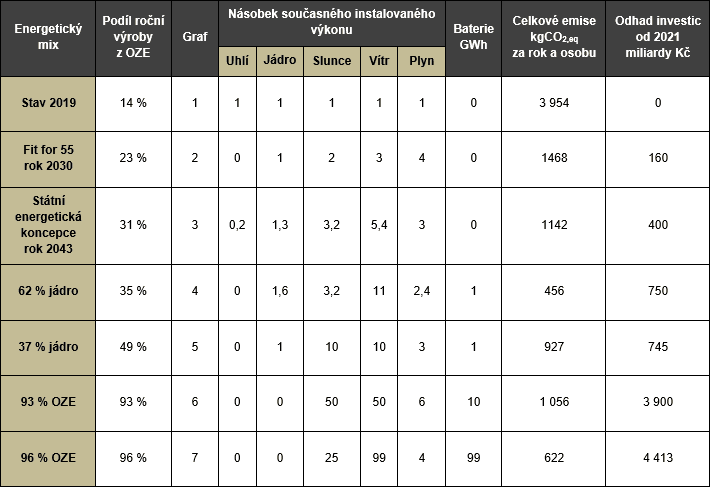
Under the Green Deal, the European Union has set a binding target of achieving climate neutrality by 2050. This requires a significant reduction in greenhouse gas emissions over the coming decades. An intermediate step towards climate neutrality is the commitment to reduce emissions by at least 55 % by 2030, known as Fit for 55. Fig. 2 shows the situation if, in line with this commitment, we were to phase out coal entirely by 2030. While we would eliminate the most polluting sources of emissions, within a short period we would, for example, have to increase PV capacity by more than 2×, wind power capacity by more than 3×, gas-fired power plant capacity by 4×, and arrange an adequate increase in gas imports, thereby deepening our energy dependence on Russia. The scenario described would reduce the carbon footprint by 63 % and ensure that the Fit for 55 target is met in the electricity sector.
Fig. 2 - Fit for 55 scenario [GWe], situation for January 2030 if we fully phase out coal within 9 years.
State energy policy
The 2015 State Energy Policy set out the state's main priorities and strategic intentions in the energy sector for the following 25 years. Based on this policy, which aims to achieve carbon neutrality in line with the Paris Climate Agreement, we are targeting an energy mix of 52 % nuclear + 31 % renewables in 2043, shown in Fig. 3. Implementing the policy and the related changes in the energy mix will reduce Czech greenhouse gas emissions to 1142 kg CO2,eq/person/year.
Fig. 3 - Energy mix [GWe] under the 2043 State Energy Policy: 52 % nuclear + 31 % renewables + 10 % gas + 6 % coal.
62 % nuclear + 35 % renewables
The Czech Coal Commission's 2020 recommendation is to eliminate all coal by 2038. If we modify the State Energy Policy scenario and replace coal-fired power plants with nuclear power plants, Czech greenhouse gas emissions will fall to 456 kg CO2,eq/person/year. This means increasing installed nuclear power plant capacity 1.6× compared with today, PV capacity 3.2× and wind power capacity 11×, with total investment worth CZK 750 billion. To cover shortfalls in renewable generation, we would increase gas-fired power plant capacity 2.4×, the least among all the energy mixes analysed. The scenario is shown in Fig. 4.
Fig. 4 - Scenario: 62 % nuclear + 35 % renewables [GWe].
The scenario will deliver an 88 % reduction in emissions compared with today with affordable investment, while also saving CZK 40 billion annually in emission allowances at a price of EUR 40/tonne CO2,eq. The energy mix of 62 % nuclear + 35 % renewables is therefore close to the optimal scenario in terms of climate commitments and is also efficient from the perspective of energy-mix economics. IPCC scenarios and the EU Green Deal call for climate neutrality, or net zero. Reducing CO2,eq emissions under this scenario will provide sufficient time—several centuries below the +2.5 oC temperature-rise threshold still considered safe—for the development and deployment of new low-emission energy sources enabling electricity generation with minimal environmental impacts.
37 % nuclear + 49 % renewables
An alternative to the previous scenario is to freeze nuclear power plant capacity at its current level and replace retired coal-fired power plants with massive renewable build-out, increasing PV and wind power capacity by up to tenfold. This scenario is shown in Fig. 5, which indicates that despite raising installed renewable capacity to 1,000 % of the current level, up to 5.3 GW of electric power would be lacking on some winter nights. We would therefore have to increase gas-fired power plant capacity by at least 3×.
Fig. 5 - Scenario: 37 % nuclear + 49 % renewables [GWe].
In summer, electricity-generation shortfalls would be covered by battery farms, whose current purchase price would be approximately CZK 11 billion (8 battery farms). In winter, however, these farms would last only half an hour of Czech electricity consumption on a January night (the purple areas on the chart), and gas-fired power plants would have to make up the generation shortfall. Batteries would reduce Czech spending on emission allowances by CZK 0.2 billion, but an investment in batteries with a payback period of 11/0.2 = 55 years would be loss-making given the batteries' ten-year lifespan.
Total Czech greenhouse gas emissions under this scenario would reach 900 kg CO2,eq/person/year, almost twice the level of the previous scenario. The main reason is that 14 % of electricity would have to be generated from gas. Batteries costing CZK 100 billion would reduce expenditure on CO2,eq emission allowances by CZK 1 billion/year, resulting in a loss-making investment payback period of 100 years with a battery lifespan of 10 years.
Due to their uneven output, the lack of efficient energy storage and the associated need for backup from gas-fired power plants, PV and wind power plants are not an equivalent replacement for nuclear power plants and cannot reduce greenhouse gas emissions as effectively.
93 % renewables
Part of the population in a number of countries rejects nuclear power because of concerns about potential nuclear power plant accidents and radioactive waste. This led the German government in the past to decide to shut down all nuclear power plants under the Energiewende project, with the final three due to close by the end of 2022. Yet despite almost EUR 1 trillion already invested in Energiewende, Germany's per-capita greenhouse gas emissions are 10× higher than those of, for example, France, where nuclear power plays the leading role in the energy mix.
Under the 93 % renewables scenario (Fig. 6), virtually all electricity generation in the Czech Republic would come from photovoltaic and wind sources with fluctuating output. Since the potential of biomass combustion and hydropower is at the limit of its capabilities, renewable electricity generation would decline significantly in winter, to be compensated by gas-fired generation, whose capacity would have to be increased substantially.
Fig. 6 - Scenario: 93 % renewables without nuclear or coal [GWe].
The environmental impact of photovoltaic and wind power plants themselves is also not negligible. The effects of the low energy density of renewables, primarily their high consumption of construction materials and the extensive natural land area they occupy, are not yet apparent because there are relatively few renewables. Wind and photovoltaic plants reaching the end of their service lives today generated at the time (at the turn of the century) only 0.01 % of global consumption. Implementing the 93 % renewables scenario would increase the annual amount of waste from renewable installations being decommissioned by approximately 10,000×.
For these reasons, the 93 % renewables scenario is not emissions-free and is accompanied by greenhouse gas emissions of 1,056 kg CO2,eq/person/year, consisting primarily of emissions from backup gas-fired power plants (400 kg CO2,eq/person/year) and the life cycle of renewables (636 kg CO2,eq/person/year).
The 93 % renewables scenario requires:
- building 50× more PV and wind power plants than exist today, requiring investment of CZK 2,685 billion in PV and CZK 929 billion in wind power. Photovoltaic panels would cover 2 % of the Czech Republic's territory, the same as the country's entire built-up area today, including all cities. In addition, approximately 8,222 Vestas 2 MW wind turbines, 100 metres high (equivalent to a 40-storey building), would be built. Because the Czech Republic does not have enough suitable windy sites and wind turbines would operate with lower efficiency, their number would probably have to be even higher.
- installing storage worth CZK 115 billion in the form of 77 battery farms, each covering the area of a village. These farms would save CZK 1 billion annually in emission allowance costs (mainly thanks to PV in summer), with an investment payback period of 115 years. Battery life is typically around 10 years, after which they will constitute hazardous chemical waste requiring environmentally sound disposal. Each day, approximately 1 truckload of batteries would have to be disposed of and replaced at the same time. An alternative to battery farms is the construction of pumped-storage hydropower plants. If they had the capacity of the Dlouhé stráně hydropower plant, only three would suffice and their lifespan would be approximately a century.
- increasing gas-fired power plant capacity 6×. The chart in Fig. 6 shows that the above storage capacity (see the purple areas) would not suffice in winter, and the shortfall would have to be covered by backup gas-fired power plants. These plants would operate only on winter nights, on average 10 % of nights per year, which would multiply the price of the electricity generated.
- accepting the depletion of mineral resources such as steel, cement, neodymium and indium. As the following table shows, when constructing capacity, PV uses 140× more steel and 28× more concrete per GWh generated than a nuclear power plant.
Comparison of construction material consumption by nuclear power plants and wind power plants per 1 GWh generated
The construction of PV plants would involve installing an estimated half a billion 200 Wp photovoltaic panels weighing 16 kg, made of glass, aluminium, silicon, silver and other materials. With a typical panel lifespan of 20 years, in a sustainable economy we would have to environmentally dispose of and install 70,000 such panels every day—approximately 1,120 tonnes of a mixture of glass, aluminium, silicon, lead, copper and silver daily.
From spring to autumn, we would not use 61 % of the total electricity generated, and would very likely be unable to export it either, as neighbouring countries would have a similar surplus of renewable capacity at the same time. We could store this energy as hydrogen, but that would require further major investment in large-scale production and liquefaction facilities or storage infrastructure.
96 % renewables
With half the PV capacity of the previous scenario and, conversely, doubled wind power capacity, we would achieve a 96 % renewable share in electricity generation. In that case, emissions would fall to 661 kg CO2,eq/year/person and the energy mix would be significantly more balanced than the previous 93 % renewables mix (Fig. 7). However, this path is not suitable for the Czech Republic because we do not have enough windy locations to build tens of thousands of wind turbines.
Fig. 7 - Scenario: 96 % from renewables [GWe].
Conclusion
The analysis of real data shows that the 62 % nuclear + 35 % renewables scenario offers the lowest greenhouse gas emissions. This scenario is close to the State Energy Policy scenario and would reduce the carbon footprint of Czech electricity generation ninefold compared with today. While current emissions stand at 3,954 kg CO2,eq/person/year, implementing the 62 % nuclear + 35 % renewables scenario would reduce Czech emissions to 456 kg CO2,eq/person/year. The analysis demonstrates that this scenario is also far more environmentally friendly and cheaper than scenarios with a higher share of renewables, which would cause greater environmental damage both in terms of CO2,eq emissions and intensive extraction of mineral resources and production of large volumes of e-waste.
As the renewable share rises above 35 %, emissions will increase to more than one tonne of CO2,eq/person/year because the amount of fossil natural gas burned, consumption of primary raw materials and the volume of waste will all grow proportionally with the increasing renewable share.
Battery storage farms with short battery lifespans are highly uneconomic and demanding to recycle in an environmentally sound way. Due to a lack of information, the associated emissions from battery production, operation and recycling were not included in this analysis. The use of pumped-storage hydropower plants would be much more suitable, but their construction is not currently being considered.
The 62 % nuclear + 35 % renewables scenario, which is the most effective in combating climate change and protecting the environment, requires construction to begin as soon as possible not only on replacements for ageing nuclear units but also on new units. Most coal-fired power plants cannot be shut down before they enter operation without risking winter blackouts.
At the same time, it is desirable to invest substantially more funding and human resources in research into new low-emission energy sources such as nuclear fusion, deep geothermal drilling or efficient energy storage.
Overview of analysed Czech electricity-sector scenarios
Note:
All prices stated are for comparison only, calculated at current prices and excluding future developments, inflation and the recycling of materials from renewables and batteries. We assume constant electricity consumption at the 2019 level, while economic growth, the forthcoming expansion of electric mobility and the phase-out of coal for heating will, according to forecasts, increase future electricity consumption by up to 2 %/year despite energy savings such as insulating homes, using public transport, heating with wood, etc. Hydropower and biomass power plant capacity is kept at the same level as today.Translation disclaimer
This article is a machine translation of the Czech original and has not yet been fully reviewed. In case of any doubt, please refer to the Czech version.
Sdílejte článek prostřednictvím:
You might also like
23 October 2026, 11:01
23 October 2026, 06:34