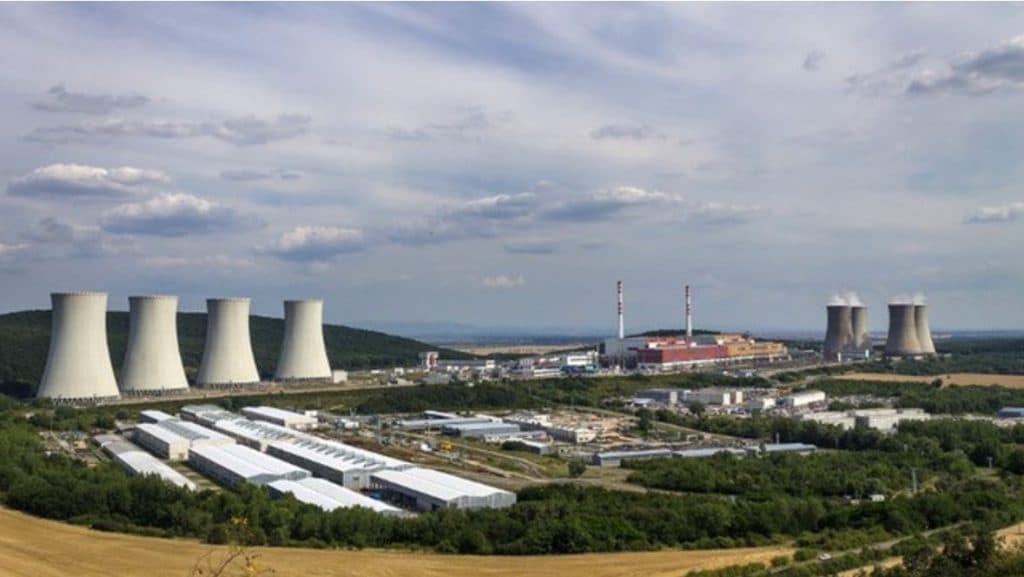
Russia to build Kazakhstan's first nuclear power plant, with Russian loan covering most of the $16.5 billion cost

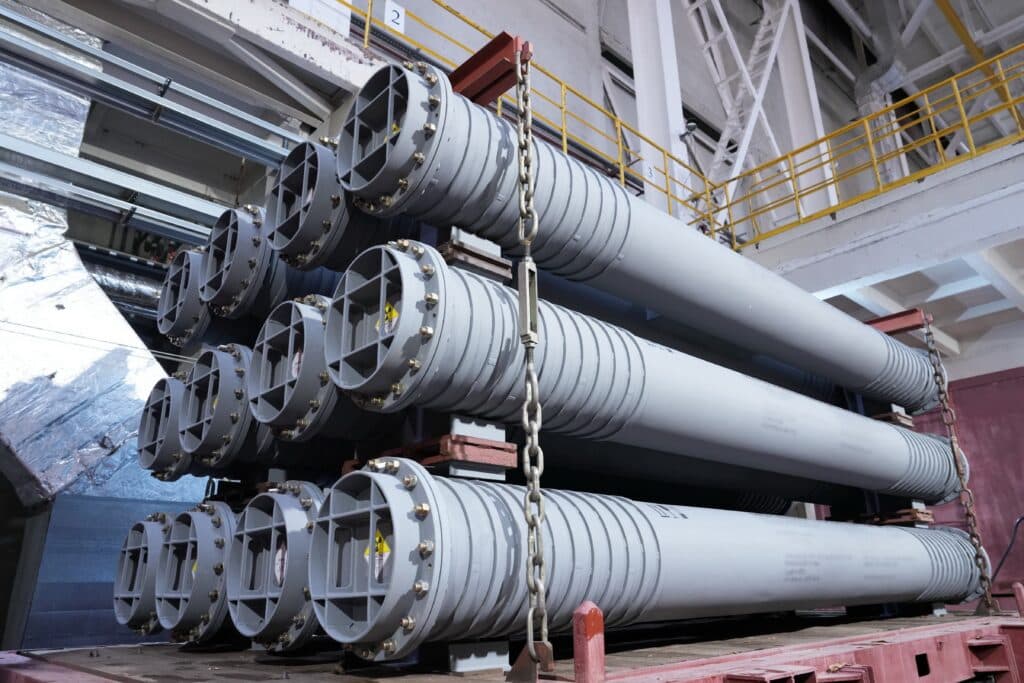
Russia and Kazakhstan have signed an intergovernmental agreement to build the first nuclear power plant on Kazakh territory. The two-unit facility, equipped with Russian VVER-1200 reactors, will be built near Lake Balkhash and led by Russian state-owned company Rosatom. Construction is due to start in 2027, with the first unit expected to enter service in the mid-2030s.
A substantial portion of the estimated cost of around $16.5 billion (approximately CZK 345 billion) will be financed by a Russian state export loan. The documents were signed on 28 May during Russian President Vladimir Putin's state visit to Kazakhstan.
The agreement was signed by Rosatom CEO Alexey Likhachev and Almasadam Satkaliyev, chairman of Kazakhstan's Agency for Atomic Energy, in the presence of both presidents—Vladimir Putin and Kazakh leader Kassym-Jomart Tokayev. It was not the only document: three nuclear agreements were concluded at the same time—on the basic principles and terms of cooperation on the project, the provision of a Russian state export loan to finance construction, and an action plan for interdepartmental cooperation on nuclear and radiation safety for 2026–2030.
According to Rosatom, the intergovernmental agreement sets out the key parameters of the project: the construction of two power units with Russian-designed VVER-1200 reactors, each with a capacity of around 1200 MW. The document also covers cooperation throughout the plant's operating life, including maintenance and fuel supplies, tying Kazakhstan to Russian nuclear technology for decades.
Project parameters and timeline
The plant will be built in the village of Ulken on the shore of Lake Balkhash, in Zhambyl District in the southeast of the country. Initial preparatory work—in the form of engineering surveys to select the site and prepare project documentation—began in August 2025. According to Rosatom, more than 90 percent of the geological field surveys had been completed by May 2026.
The estimated cost is reported to be around $16.5 billion. According to the Kazinform news agency, about $14.4 billion of that is for the two units themselves, with a further approximately $2 billion for physical security systems and social infrastructure.
Satkaliyev previously said that Russia would provide a loan covering 85 percent of the total cost. Official statements after the signing did not specify the exact share, but the Kazakh side described the terms as “very favorable.” Construction is due to begin in 2027, with the first unit scheduled to start up in 2034.
Why Russia is financing the construction
Financing is key to the entire agreement. An export loan covering a large share of the cost means Moscow is financing its own project—a common model through which Rosatom has long secured contracts abroad. For Russia, this is a significant geopolitical and commercial success. Despite Western sanctions against a range of Russian sectors, Rosatom's nuclear exports remain largely exempt from restrictions, and the corporation retains its position as one of the world's leading suppliers of new reactors. The loan, fuel supplies and servicing will tie Kazakhstan to Russia throughout the plant's lifetime, or for decades.
Rosatom did not secure the contract automatically, either. It was selected to lead the international consortium building Kazakhstan's first nuclear power plant in June 2025, beating China's CNNC, France's EDF and South Korea's Korea Hydro & Nuclear Power.
A sensitive issue with historical baggage
The shift towards nuclear power is exceptionally sensitive for the Kazakh public. During the Soviet era, the country was the site of hundreds of nuclear tests. Tests were conducted at the Semipalatinsk test site alone from 1949 to 1989, leaving serious health and environmental consequences. Distrust was also heightened by the 1986 Chernobyl disaster, whose cleanup involved tens of thousands of Kazakh workers.
The proposal therefore had to go to a referendum. Held in 2024, it approved construction, with more than 70 percent of the 7.8 million voters in favor. Kazakhstan is the world's largest uranium producer, but it has no nuclear power plant of its own, although it does have nuclear experience.
The country operates three research reactors, and a sodium-cooled BN-350 fast reactor operated for 26 years in Aktau on the Caspian Sea coast before being shut down in 1999. Today, the country relies primarily on coal for electricity generation, supplemented by hydropower and growing renewable sources, and has long faced aging energy infrastructure and electricity shortages.
Broader strategy and China's role
Balkhash is only the first step. Kazakhstan's strategy envisages up to four nuclear power plants, with a target of generating around 5% of its electricity from nuclear power by 2035. The second unit—or rather, the second plant—is to be built at a neighboring site in Zhambyl District by Chinese state-owned corporation CNNC. Earlier reports have also mentioned a possible third plant.
The division of roles between Russia and China reflects Kazakhstan's foreign policy, which seeks to balance the influence of the two powers. The fact that the Russian agreement was signed during Putin's state visit underscores its symbolic significance: alongside the nuclear documents, the two countries also formalized other areas of cooperation, including, according to news agency reports, a currency swap agreement between their central banks and a broader declaration of strategic partnership.
Translation disclaimer
This article is a machine translation of the Czech original and has not yet been fully reviewed. In case of any doubt, please refer to the Czech version.