7 November 2026, 17:23
Loading...
Carbon pricing: A key tool or a brake on the transition to low-carbon energy?

Marek Kršák
8 August 2023, 13:14
Carbon pricing is increasingly being presented as a key decarbonisation tool for achieving carbon neutrality. According to BloombergNEF, however, carbon pricing can have very different impacts on investment, inflation and price volatility depending on how these tools are applied.
Analyst Claudio Lubis compared the two most frequently cited scenarios for achieving carbon neutrality, both of which limit global warming to 1.5 °C. The first scenario was developed by the International Energy Agency (IEA), while the second was developed by the Network for Greening the Financial System (NGFS). According to him, the two organisations offer diametrically opposed perspectives on the issue. One assumes high carbon prices, while the other advocates lower prices combined with targeted policy measures.
How does the Network for Greening the Financial System see it?
In both the orderly and disorderly carbon-neutrality scenarios developed by the NGFS, rising CO2 prices lead to rapid decarbonisation and reduce demand for fossil fuels. Carbon prices are defined as the marginal cost of abating an additional tonne of greenhouse gas emissions, which means that regions and sectors will decarbonise only when the carbon price matches the cost of reducing emissions.
Prices rise to astronomical levels in different regions to reflect varying marginal abatement costs. Under the orderly scenario, carbon prices in Europe will exceed 1,000 USD/t CO2e by 2050, followed by China at more than 640 USD/t CO2e.
The disorderly scenario assumes that the pace and nature of decarbonisation will be uneven, meaning that different sectors reduce emissions at different rates. The construction and transport industries in particular will see prices rise to more than 950 USD/t CO2e by the middle of the century.
An extremely high carbon price could signal to policymakers that they should introduce stricter regulatory measures, since it would indicate that the market alone is not enough.
The graph below compares carbon prices in different parts of the world with the global average. It shows that under this scenario, the carbon price in Europe would rise to more than twice the global average.
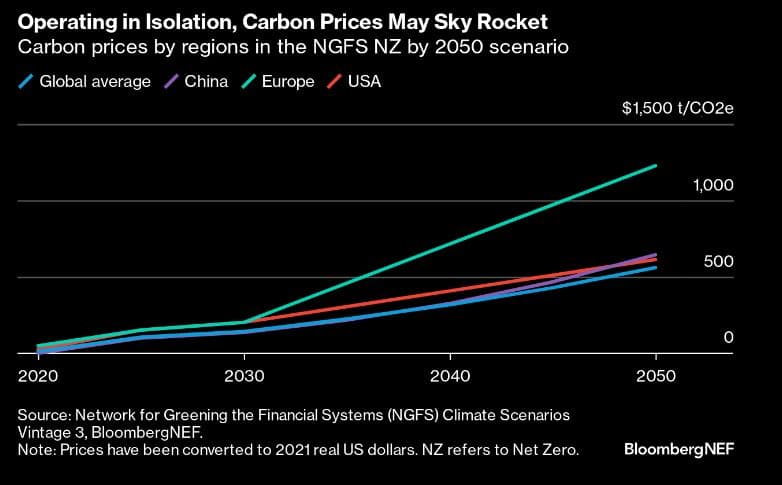
Carbon price trajectory under the NGFS decarbonisation scenario
And what does the International Energy Agency say?
The IEA scenario, called Net Zero Emissions (NZE), views carbon pricing as a less decisive factor and instead places greater emphasis on policy measures, which play a more significant role on the path to carbon neutrality.
Carbon prices are used as a decarbonisation lever alongside the introduction of energy and technology policy mechanisms (and other accompanying measures, such as a ban on the sale of new cars with combustion engines by 2035) and do not reflect marginal abatement costs. As a result, carbon prices are significantly lower than those seen in the NGFS scenarios.
By 2050, the price paid by "developed economies" will rise to 250 USD/t CO2, while the price will be lower in emerging economies, hovering around 180 USD/t CO2. These regions are expected to pursue more direct policy approaches to decarbonising their energy systems. For context, BloombergNEF expects carbon prices in the EU ETS to be around 170 USD/t CO2 in 2030, slightly above the 140 USD/t CO2 level set by the IEA for the same year.
The graph below shows more favourable carbon prices than those in the NGFS scenario. According to it, the price of an allowance in Europe will be around 250 USD/t CO2 in 2050, approximately three times higher than it is today.
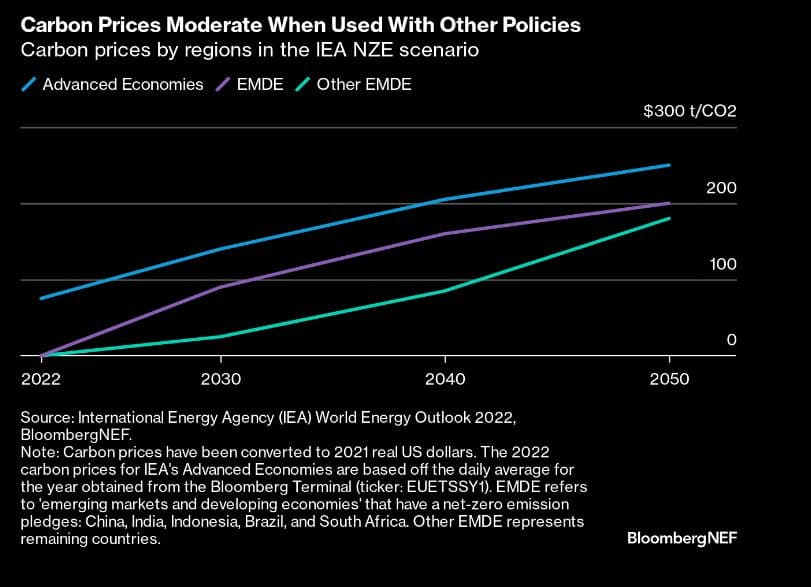
Carbon price trajectory under the IEA decarbonisation scenario
So what is the conclusion?
Despite reaching very similar end points, the methodologies used by these two organisations could lead to significantly different dynamics in capital investment, inflation and energy commodity price volatility.
The IEA’s approach, which is based on replacing demand, is likely to lead to a gradual decline in prices for traditional fossil fuels, thereby reducing the likelihood of inflationary pressures on high-carbon commodities.
In the NGFS scenarios, the central role played by carbon prices could keep fossil fuel prices elevated, causing energy price inflation to persist for longer.
Translation disclaimer
This article is a machine translation of the Czech original and has not yet been fully reviewed. In case of any doubt, please refer to the Czech version.
Sdílejte článek prostřednictvím:
You might also like

7 November 2026, 13:37

6 November 2026, 14:13