
23 October 2026, 14:38
Loading...
China holds the cards: the West faces a tough choice in the copper supply chain

Libor Láník
20 August 2024, 16:23
Western countries will find it difficult to break free from China’s dominance across the copper supply chain, warns data analytics provider Wood Mackenzie. With demand for this critical raw material expected to grow, and copper a key component of electrification and the energy transition, Western countries face the reality that they may have no choice, despite stepped-up efforts to diversify.
We have reported here on China’s dominance of global clean technology supply chains. Other global powers, led by the US, are aware of this and are trying to take steps to change the current balance. The Inflation Reduction Act and strategic investments in mining in Europe, Australia and Canada are examples of such efforts. Mining alone, however, will not reverse the bleak outlook.
In the specific case of copper, the entire supply chain must be taken into account. In addition to mining, it includes smelting and refining, semi-fabrication and the manufacture of finished copper products.
While China is not as dominant in copper mining as it is in the rest of the world’s supply chain, it is the decisive player in the other three segments. China should not be overlooked even in mining, although its domestic production accounts for roughly 8 % of the global total. Including its overseas mining assets, the Asian hegemon accounts for 20 %.
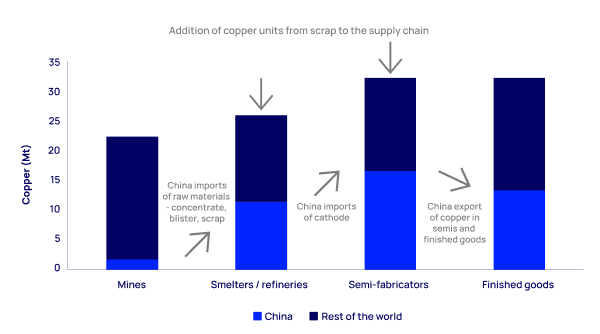
China’s role in the copper supply chain, 2023
In the other parts of the supply chain, China is the biggest investor and is expanding its capacity the most.
“In smelting and refining, China added 97 % of global capacity, representing more than 3 Mt of output and nearly 25 billion dollars in investment. Since 2000, China has accounted for 75 % of the total growth in global smelting capacity,” WoodMac research said. The same is true of the growth in manufacturing capacity.
If Western countries want to diversify away from China’s dominant position, they must invest enormous sums, close to one hundred billion dollars, to build their own processing and manufacturing capacity. Such investment would, however, mean economic inefficiency, higher prices for end products and, ultimately, increased energy transition costs—not to mention delays.
Under current conditions, the goal of decarbonization conflicts with the goal of reducing dependence on China. As global demand for copper and copper products continues to grow with the transition to clean energy, Western countries may find themselves in a situation where they have to confront this dilemma.
They will either have to accept an even greater degree of dependence on China, along with the associated geopolitical risk, or opt for drastic measures to diversify, even at the cost of economic and technological disadvantages. The choice between these two scenarios will be one of the key factors shaping the future of global energy infrastructure and strategic relations between the great powers, the study concludes.
Translation disclaimer
This article is a machine translation of the Czech original and has not yet been fully reviewed. In case of any doubt, please refer to the Czech version.
Sdílejte článek prostřednictvím:
You might also like


23 October 2026, 11:01


23 October 2026, 06:34