23 October 2026, 14:38
Loading...
Czechia at centre of new hydrogen initiative: New corridor to link Balkans with Germany
Klára Čeperová
30 September 2024, 10:18

Czechia is involved in another hydrogen initiative. This is the South-East European Hydrogen Corridor (SEEHyC), which aims to build a hydrogen connection between the Balkans and Central Europe.
The South-East European Hydrogen Corridor is an initiative of seven gas transmission system operators. In addition to Czech NET4GAS, which is a founding member, the Greek transmission operator DESFA, Bulgaria's Bulgartransgaz, Romania's Transgaz, Hungary's FGSZ, Slovakia's Eustream and Germany's OGE are involved in preparing the hydrogen corridor.
From the Balkans to Central Europe
The partners plan to connect areas with high hydrogen supply potential in Balkan countries with expected high-demand clusters in the EU, particularly in southern Germany and northern Czechia. In addition, it will connect local suppliers and consumers along the corridor.
The pipeline is expected to be more than 3,000 km long and enable the transport of renewable and low-carbon hydrogen. According to an ongoing preliminary feasibility study, the project is expected to enter operation around 2030 and have a minimum transport capacity of up to 80 GWh of hydrogen per day, equivalent to approximately 0.8 million tonnes per year. Total costs are expected to range between EUR 4.8 billion and EUR 6.8 billion.
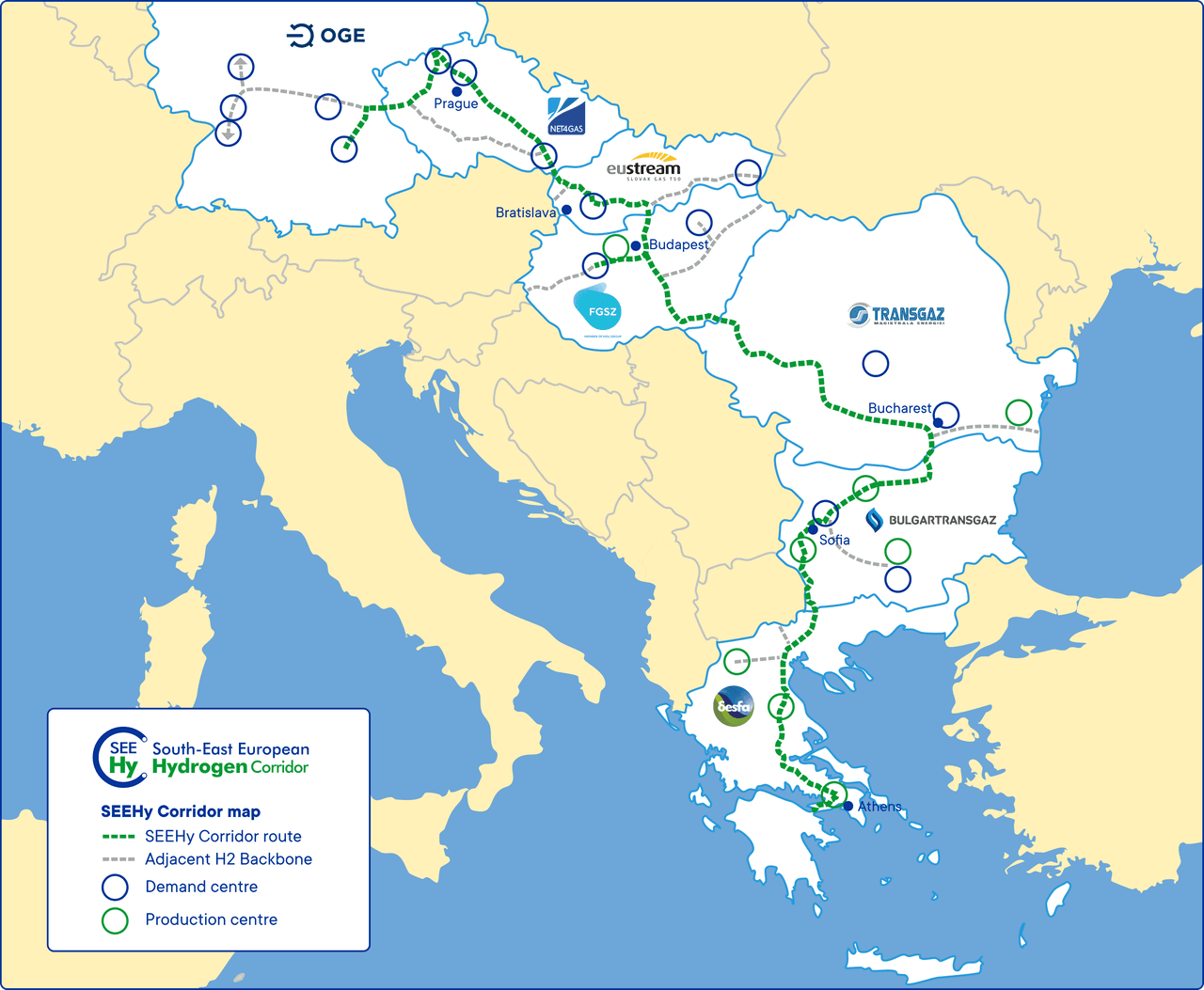
South-East European Hydrogen Corridor. Source: SEEHyC
This is the fourth hydrogen corridor for which NET4GAS is a founding partner. The Czech-German hydrogen interconnector (CGHI), the SunsHyne Corridor and the Central European Hydrogen Corridor (CEHC) have already been presented. Our aim is to ensure maximum flexibility in access to locations favourable for hydrogen production and thereby secure our future role in hydrogen transport. For this corridor too, we would use existing routes, specifically the northern and western branches.
Hydrogen economy in Czechia
As regards the hydrogen economy, Czechia sets out its plans in the updated Hydrogen Strategy approved this summer. Czech infrastructure is to become a key link for hydrogen imports that will support decarbonisation. The strategy focuses primarily on imports in the second phase of hydrogen economy development, stating that adapting Czech transmission infrastructure will enable the country to become part of the European hydrogen ecosystem. Imports of renewable hydrogen will also make it possible to significantly reduce its price.
The largest Czech gas distributor, GasNet Group, now owned by the ČEZ Group, is also planning to use hydrogen and is working on a hydrogen city project in Czechia. Hranice, near Aš in the Karlovy Vary region, is set to become the first municipality where GasNet will distribute a blend of natural gas and hydrogen through its pipelines. The aim is to gradually blend up to 10% hydrogen produced from renewable energy sources in the vicinity of the town into natural gas.
The development of renewable hydrogen consumption also concerns industrial companies, which under the revised Renewable Energy Directive (RED) will have to increase their use of energy from renewable sources by 1.6% per year. In the case of hydrogen, this target must be met by 2030. The target then rises to up to 60% of hydrogen consumed in industry by 2035.
Translation disclaimer
This article is a machine translation of the Czech original and has not yet been fully reviewed. In case of any doubt, please refer to the Czech version.
Sdílejte článek prostřednictvím:
You might also like

23 October 2026, 11:01

23 October 2026, 06:34