23 October 2026, 14:38
Loading...
Germany sees the impact of its Energiewende this year
Vladimír Wagner
20 December 2024, 06:36
Germany has felt the impact of its Energiewende sharply this year. In summer, the number and duration of periods with negative prices increased significantly. At that time, Germany did not know what to do with its surplus electricity. Conversely, in winter we experienced two longer periods without wind, with minimal sunshine and very high electricity prices, when Germany imported everything that was available.
The second Dunkelflaute this year – a period when there is neither sunshine nor wind in our region – is another major warning. It shows where reliance purely on renewable sources and the phase-out of fossil-fuel sources before their low-emission replacement is completed will lead us. And it must be a truly equivalent replacement, one that ensures the necessary capacity in the grid at every moment of its operation.
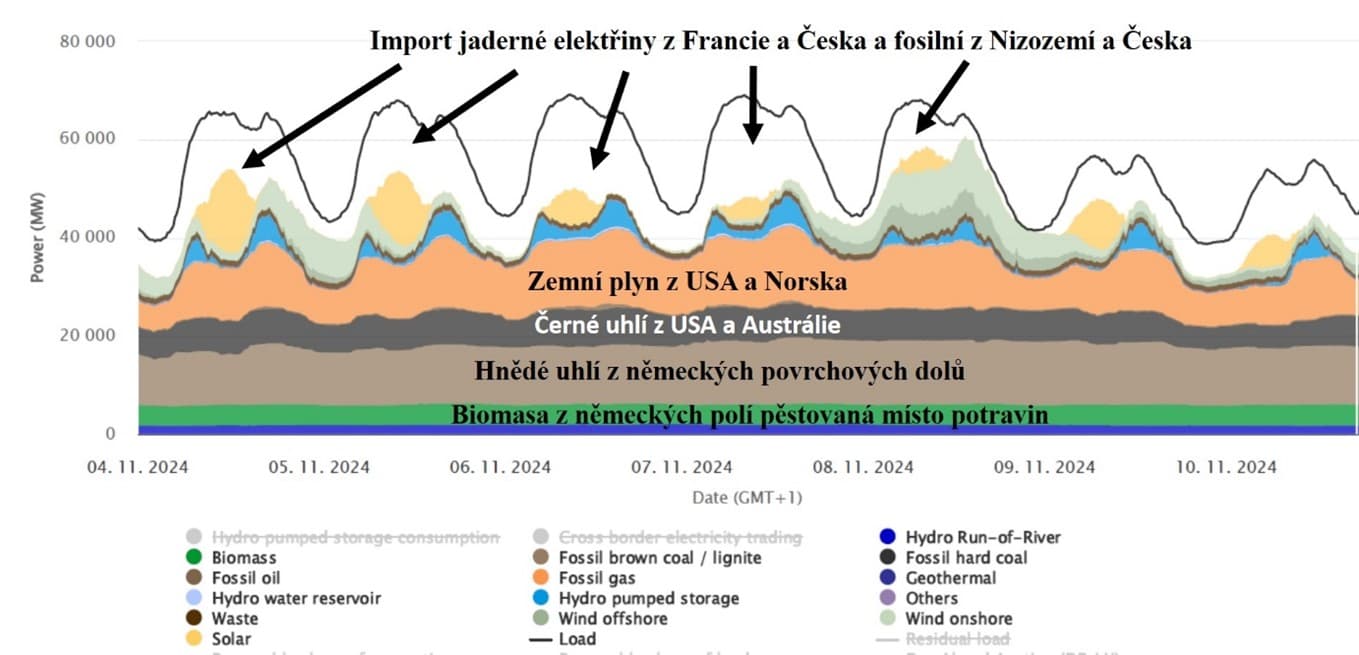
Electricity generation in Germany during the first week of the Dunkelflaute, which took place from 4 November to 16 November. During this period, wind and solar sources supplied minimal electricity. Almost all electricity was supplied by fossil-fuel sources (domestic lignite and hard coal, and imported natural gas) and biomass from German fields. Germany had to import a large share of its electricity from French and Czech nuclear sources. The individual colours indicate different sources (dark blue – hydro, green – biomass, light brown – lignite, dark brown – hard coal, orange – natural gas, light blue – pumped-storage plants, different shades of grey – wind sources, yellow – solar PV), while the black line is consumption (source: Energo-chart).
“Huge success” of Germany’s green transition
Germany shut down its last nuclear power plants last year. At the beginning of the century, they still generated around 156 TWh of electricity, or around 30% of German production. Bavarian industry in particular thus lost the dominant share of its reliable electricity sources. Several large modern nuclear reactors were located there. It should be recalled that intensive nuclear energy development began in Germany during the oil crises of the 1970s. Had the intensive campaign by green anti-nuclear activists not halted the development of nuclear energy in Germany, the country could long ago have had a low-emission energy mix similar to France’s.
At the end of the last century, moreover, the coalition of the Greens and the SPD announced the Energiewende, including a nuclear phase-out. When the CDU/CSU came to power, it attempted to delay the shutdown of nuclear units. However, the Fukushima I nuclear power plant accident occurred shortly before the election. To avoid losing it, Angela Merkel returned to the original nuclear phase-out timetable.
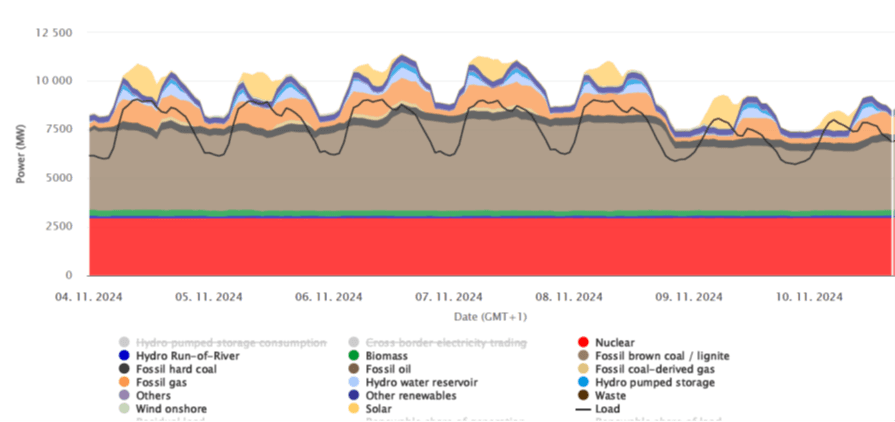
Electricity generation in the Czech Republic during the first week of the Dunkelflaute, which took place from 4 November to 16 November. During this period, Czechia was able to meet not only its own needs with its nuclear and fossil-fuel sources, but also exported nuclear and fossil-fuel electricity to Germany. The individual colours indicate different sources (as above, red – nuclear sources), while the black line is consumption (source: Energo-chart).
Germany has built very large installed capacities of renewable sources. Solar PV sources have total installed capacity of more than 90 GW, while wind power now has installed capacity of more than 70 GW. Ideal conditions for wind farms are found in northern Germany on the coast. Bavaria is in the south, and there was also considerable opposition to the construction of wind turbines there, so solar plants were built there on a large scale.
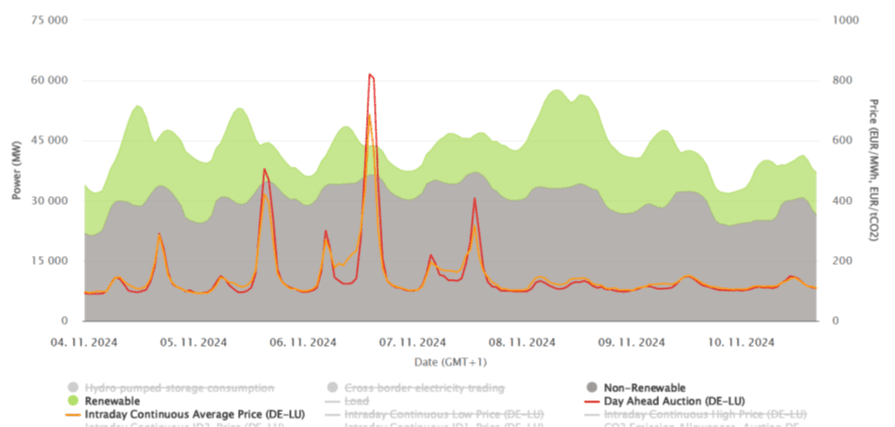
Spot market price in Germany during the Dunkelflaute. It is clear that a shortage of sources leads to very high spot market prices (red and orange lines – spot market prices, grey – fossil-fuel sources, green – renewables) (source: Energy-chart).
It should be recalled that German consumption peaks at over 70 GW and can approach 80 GW in extreme cases, though it usually ranges between 50 and the aforementioned 70 GW. Consumption is slightly higher in winter and, above all, peaks are greater. However, unlike France, Germany uses electricity for only a minimal share of heating. It is therefore clear that the installed capacity of both solar PV and wind turbines exceeds demand. If ideal conditions occur for both sources simultaneously, the surplus over required capacity is even several-fold. It is true that not all solar PV sources face the same direction and reach peak output at the same time, and not all wind sources operate at installed capacity at the same time either. Even so, there are already periods when Germany has huge surpluses of wind and solar electricity, does not know what to do with them, and causes negative prices on its own day-ahead market and in neighbouring countries.
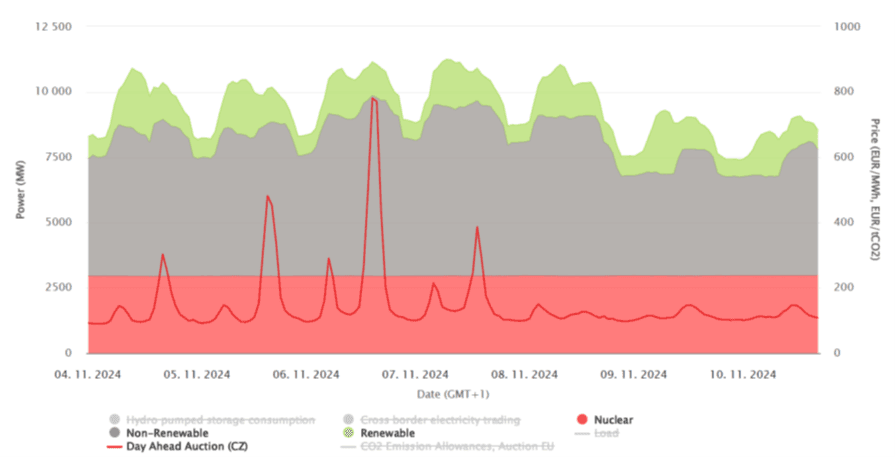
Spot market price in Czechia during the Dunkelflaute. There is no shortage of generation in Czechia, and high spot prices spill over from Germany (red and orange lines – spot market prices, grey – fossil-fuel sources, green – renewables, red – nuclear) (source: Energy-chart).
Conversely, in winter, when the aforementioned Dunkelflaute sets in, wind and solar sources provide almost nothing. At such times, as witnessed between 4 and 16 November and between 10 and 15 December, Germany starts all its fossil-fuel sources, including those fuelled by fuel oil, and still imports more than 10 GW of capacity from its neighbours. This dramatically raises spot market prices in those countries. Near Germany, they can then reach as much as 900 EUR/MWh, as was seen, for example, on 12 December 2024. Germany thus exports its extreme spot market prices to surrounding countries from which it imports electricity. Nordic countries, including Sweden and Norway, have recently objected strongly to this.
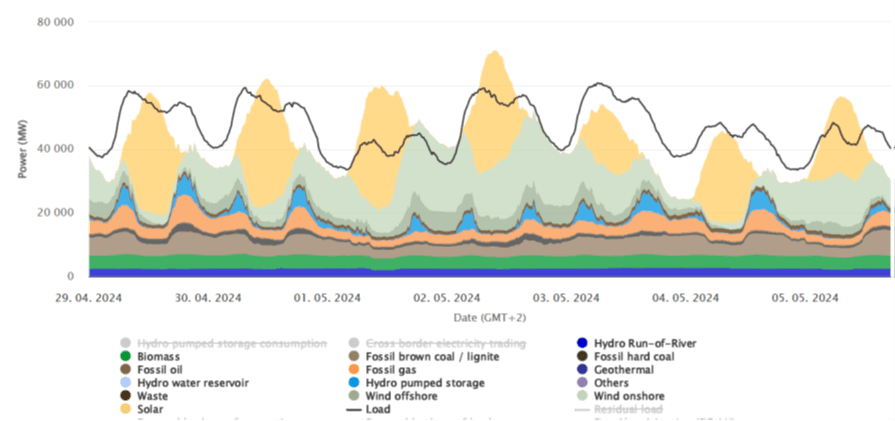
Electricity generation in Germany during a period of very favourable solar and wind conditions. Surplus generation leads to excess capacity not only in Germany, and therefore to negative prices. Even at this time, however, Germany cannot do without fossil-fuel sources and imports. The individual colours indicate different sources, while the black line is consumption (source: Energo-chart).
Germany has built very large renewable energy capacities at enormous cost and with subsidies. Yet it has not achieved the low-emission electricity generation that operates in France, Sweden, Switzerland and Slovakia thanks to nuclear sources. According to Energy-charts data, Germany generated 37% of its electricity from fossil-fuel sources in 2024 and 63% from low-emission sources. However, it also had to import a large share of fossil-fuel electricity. It was a net importer. The Czech Republic generated 41% of its electricity from fossil-fuel sources and 58% from low-emission sources (of which 41% was nuclear). The Czech Republic was also a net exporter, and part of its fossil-fuel generation was exported precisely to Germany. If this is taken into account, it is clear that, in emissions terms, Germany is in the same position as Czechia despite the extreme costs. I described the problems outlined above and the fact that the German Energiewende is heading in the wrong direction long ago, see for example in this article from autumn 2016 or an article from 2014.
How do negative electricity prices arise?
The question may arise as to how negative prices can occur, when electricity consumers are paid for taking power. This increasingly frequent situation leads to absurd outcomes. Energy dissipators are being built which can waste power without any useful purpose; they offer their services precisely when there is overproduction of electricity from wind and solar sources, and make very good money from it.
Negative prices can arise because in many cases it is difficult to shut down fossil-fuel power plants completely, as they must remain in hot standby until weather conditions deteriorate, while ideal conditions for renewables last only for a limited period. Nuclear units likewise cannot easily be shut down and started up. At present, however, operating subsidies for renewable sources are the main source of negative electricity prices on the spot market. Both solar PV and wind sources can easily be switched off when necessary. But if they receive a subsidised price of 100 EUR/MWh, it pays them to operate even at a negative price of -90 EUR/MWh.
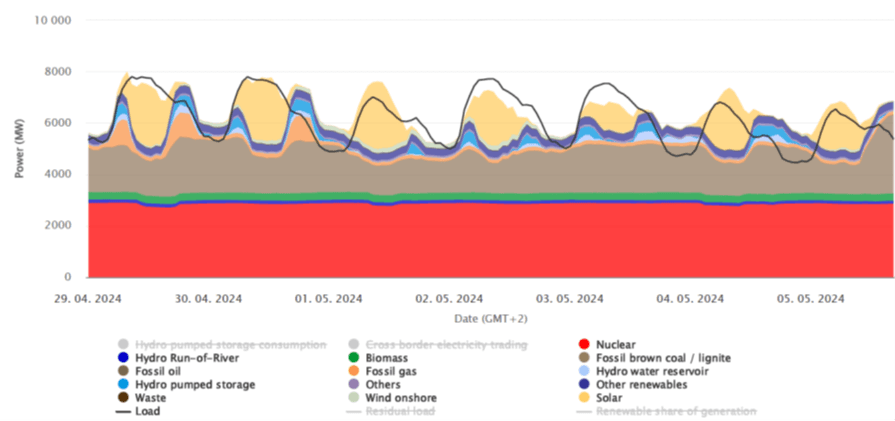
Electricity generation in Czechia during a period of very favourable solar and wind conditions. Czechia covers its needs very well with its generation, and its solar sources help to cover daytime peaks very effectively. Surplus generation in Germany leads to excess capacity, and therefore to negative prices, not only there but also in Czechia. The individual colours indicate different sources, while the black line is consumption (source: Energo-chart).
In such a case, it pays us to import electricity from German renewable sources and be paid for it with German taxpayers’ money. The situation is different when it concerns our own solar PV, for which our state must pay the subsidised price. This was also why LEX OZE III sought to establish a rule that subsidies for solar PV sources would not be paid during negative-price periods. However, following pressure from solar PV lobbyists and green activists, this provision was not included in the recently approved version of LEX OZE III.
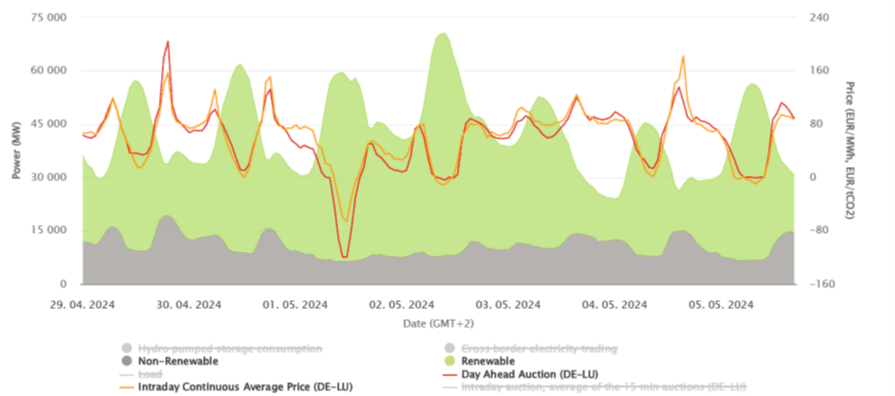
Spot market price in Germany during large surpluses of wind and solar generation. The spot market price can fall to negative values. (red and orange lines – spot market prices, grey – fossil-fuel sources, green – renewables) (source: Energy-chart).
As periods of negative spot market prices become increasingly frequent, the problem of cannibalisation of unsubsidised sources is growing. It should be stressed that this concerns only solar PV and wind sources. Negative prices arise only on the spot market. However, most electricity from nuclear sources is sold months or even years in advance. This is because outages can be planned, so it is certain that a power plant will be able to generate the electricity sold at the given time. Weather cannot be forecast months or even years ahead. It is therefore impossible to know whether there will be clear skies and wind at a given time or whether a Dunkelflaute will occur. Renewable sources can thus sell only a limited share of their output in advance. During periods of negative prices, nuclear plants can also offer output reductions and use renewable electricity bought at a negative price to cover their contracted deliveries. This can generate additional profit for them.
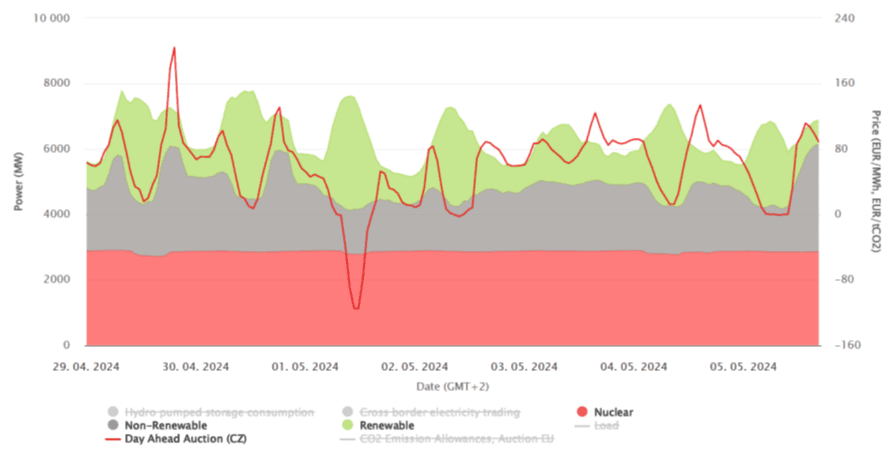
Spot market price in Czechia during a surplus of wind and solar electricity in Germany. There is no surplus generation in Czechia and negative prices spill over from Germany (red and orange lines – spot market prices, grey – fossil-fuel sources, green – renewables, red – nuclear) (source: Energy-chart).
Will we learn from Germany’s mistakes?
Fortunately, green anti-nuclear activists have not managed to push through an end to nuclear energy in the Czech Republic, although they tried hard to do so. It is now clear that we will seek to operate both Dukovany and Temelín for as long as possible. This is also included in ČEZ’s vision, as I described in a recent article. ČEZ also wants to build new large reactors at Dukovany and Temelín, as well as small modular reactors at the sites of existing coal-fired sources. However, these should only gradually become available in the second half of the 2030s and in the 2040s.
It is therefore necessary to ensure sufficient electricity until the aforementioned low-emission sources are built. This is also why it is important to keep our coal-fired power plants in operation for long enough. Germany was aware of the need for fossil-fuel sources to maintain secure electricity supplies, and German politicians negotiated capacity payments for their coal-fired plants. Poland likewise has capacity payments for coal-fired sources. Unfortunately, our politicians did not negotiate the option of capacity payments for our coal-fired power plants.
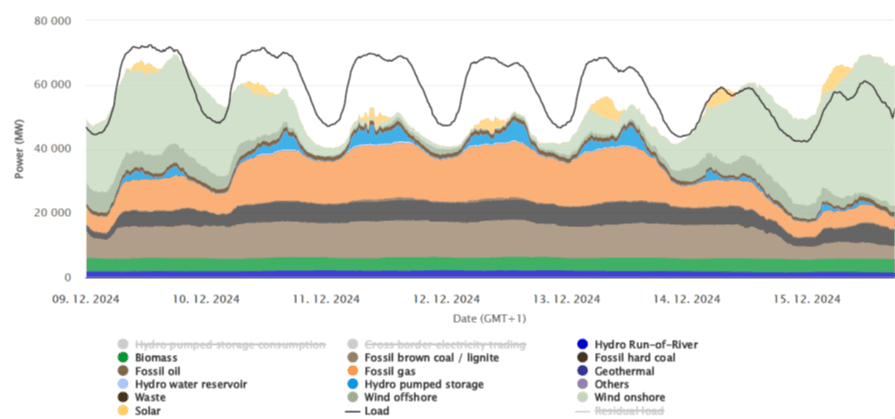
Electricity generation in Germany last week, when there were three days of Dunkelflaute, during which electricity in Germany was supplied by domestic fossil-fuel sources and imports of nuclear and fossil-fuel electricity. Towards the end of the week, the situation reversed and Germany had a large surplus of wind electricity. The individual colours indicate different sources, while the black line is consumption (source: Energo-chart).
The need for capacity payments or another solution is driven by the deteriorating economics of electricity generation from coal-fired sources due to rising emissions allowance prices. Gas is cited as a suitable replacement for coal. However, several reasons make this option highly problematic. Building the corresponding capacity of combined-cycle gas plants would not be quick. At the same time, investors will not build them for economic reasons without capacity payments or other guarantees. Emissions allowances must also be paid for natural gas, and the situation in this area may worsen in future if methane leaks during gas extraction and transport are included. The price of gas itself is also highly volatile and may be very high in the future. It is also a question whether we will be able to transport sufficient gas to our country. The main routes run through Germany, which will have extreme demand for this commodity. It is therefore uncertain whether the necessary volume will reach us.
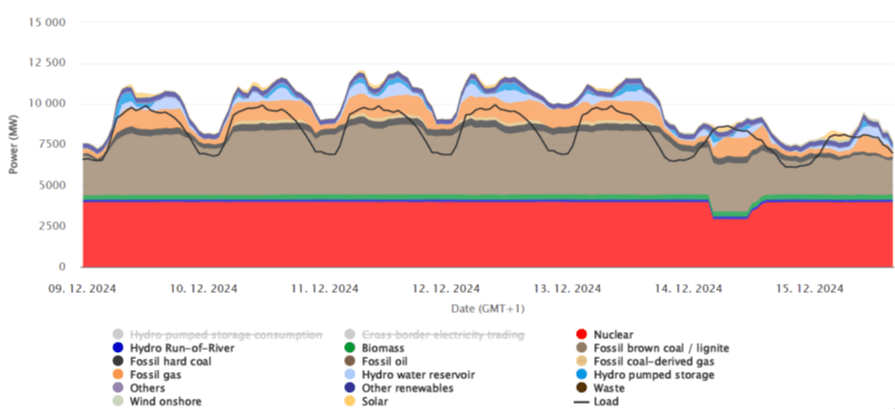
Electricity generation in the Czech Republic last week, when there were three days of Dunkelflaute. Unlike Germany, Czechia still had sufficient domestic sources and even exported its nuclear and fossil-fuel electricity to Germany. Towards the end of the week, the situation reversed and Germany had a large surplus of wind electricity, so Czechia reduced output. The individual colours indicate different sources, while the black line is consumption (source: Energo-chart).
In my view, replacing coal with gas for the period until nuclear reactors or other low-emission sources are built does not make much sense. Especially given the risk that the European Union could ban all fossil-fuel sources at any time. ČEPS’s resource adequacy study also clearly shows that if coal-fired units are shut down, the Czech Republic will change from an electricity exporter into a net importer. If it needs to import when the sun is shining and the wind is blowing, this will probably not be a problem. We will import electricity from solar plants in Bavaria or wind power in other parts of Germany. However, ensuring the required capacity when there is no wind and no sunshine will be a major problem. At that time, most of our neighbours will face shortages, and Germany a very large one, as this year’s Dunkelflaute episodes show. The claim by the Fakta o klimatu organisation that we can easily manage without coal-fired sources and import electricity from neighbours if necessary is far from reality. I described in detail the risks associated with accepting the Fakta o klimatu organisation’s recommendations in recent articles (here and here). In my view, which is also supported by developments in Germany, the Czech Republic should not shut down its coal-fired sources before their equivalent low-emission replacement is completed. And it must be one that can ensure the required capacity even when there is no wind and no sunshine.
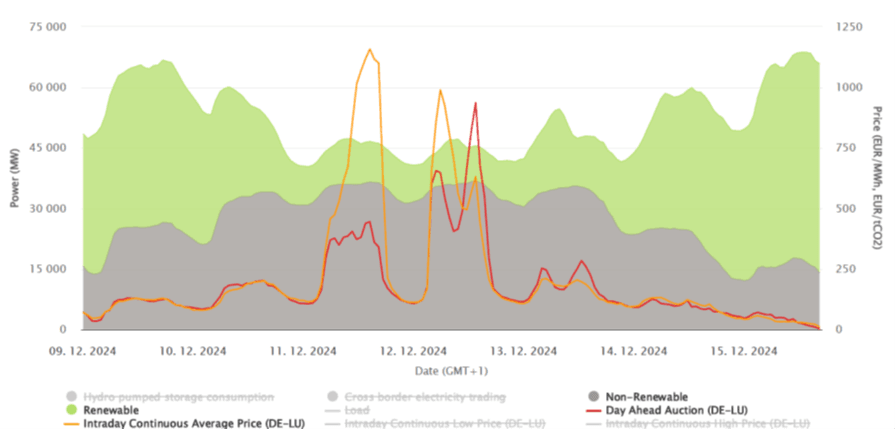
Spot market price in Germany during the Dunkelflaute last week, when spot market prices exceeded 800 EUR/MWh. Towards the end of the week, a very windy period began, during which wind farms created large electricity surpluses in Germany and the spot market price fell to zero (red and orange lines – spot market prices, grey – fossil-fuel sources, green – renewables) (source: Energy-chart).
Will Germany return to using nuclear energy?
The question is not entirely correctly framed. As mentioned, when there is no sunshine and no wind, Germany makes intensive use of electricity imports from existing French and Czech nuclear power plants. However, this may soon not be enough.
Even some German politicians are beginning to realise the impending disaster caused by shutting down their own nuclear plants. Bavaria is particularly strongly affected. Its industry needs reliable supplies of large volumes of electricity. At the same time, industry is what creates Bavaria’s standard of living. More than ten years ago, I wrote that if Bavaria completed its nuclear phase-out while pressure against the use of fossil-fuel sources continued, it would be forced to import most of the electricity it needed from elsewhere. It has built large solar PV capacities. In summer, these produce far more than is needed at midday and the electricity must be sold outside Bavaria, but they supply almost nothing during winter. Bavaria is thus highly dependent on supplies of wind electricity from northern Germany and, when there is no wind, on other sources outside the state. Even then, I warned that this would lead to industry leaving Bavaria for places where electricity is available. And it will have dramatic consequences for the living standards of this federal state.
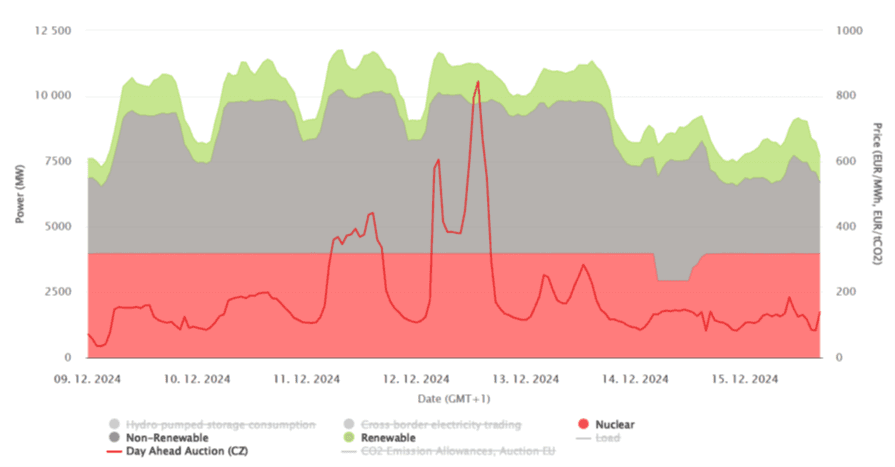
Spot market price in Czechia during the Dunkelflaute last week. There is no shortage of generation in Czechia, and high spot prices spill over from Germany (red and orange lines – spot market prices, grey – fossil-fuel sources, green – renewables, red – nuclear) (source: Energy-chart).
Bavarian Minister-President Markus Söder therefore discussed opportunities for cooperation in the use of nuclear energy during his visit to the Czech Republic last week. Bavaria would cooperate with the Czech Republic on research into nuclear energy and safety, while also using the possibility of secure supplies of nuclear electricity from Czechia.
Personally, I believe that this understanding among Bavarian political and industrial elites could be very useful to us. It would help ensure less opposition in Germany and at European level to our nuclear projects. Bavaria’s interest in electricity from nuclear units will contribute to raising its price, but on the other hand it will contribute to increasing Czech state revenues. If the financial model for the new unit provides that value above a certain reference price goes to the state, a higher price benefits the state budget. ČEZ’s taxes and a large share of its profits also go to the state budget. It may sound like fantasy today, but it is not impossible that Bavarian capital could become involved in building two new units at Temelín in the future.
In a recent article, I discussed ČEZ’s vision for nuclear energy. If Rolls-Royce small modular reactor manufacturing can be launched in the Czech Republic, it is not inconceivable that we will export them to Bavaria. It is unlikely that German politicians will be willing in the foreseeable future to admit their catastrophic mistake and begin building large nuclear units again. However, it is conceivable that they will start deploying small modular reactors. They can justify this by saying that these are different from the large ones and are safe. Therefore, they made no mistake in shutting down the large ones.
My personal view is that Europe cannot do without intensive development of nuclear energy if it truly wants to achieve low-emission energy and industry. Germany, as a major European Union economy, will inevitably return to building nuclear sources on its territory. However, this will take longer. The current generation of German politicians, which pushed through the shutdown of nuclear plants that could have supplied electricity for decades more, cannot admit such a catastrophic mistake. Hopefully, they will at least stop placing obstacles in the way of nuclear energy development among their neighbours, and perhaps even start supporting it, as the aforementioned Bavarian leader is considering. We should support them in this.
Appearance in the High Voltage energy reflections series.
Analysis of the Czech energy sector for STANDASHOW.
Translation disclaimer
This article is a machine translation of the Czech original and has not yet been fully reviewed. In case of any doubt, please refer to the Czech version.
Sdílejte článek prostřednictvím:
Topics:Opinion
You might also like
23 October 2026, 11:01
23 October 2026, 06:34