French government seeks to accelerate renewable energy development. A new law is expected to help

France has long lagged behind Europe’s leaders in developing solar and wind power. Criticism of the country for failing to meet its commitments, along with last year’s energy crisis, nevertheless prompted the government to take the helm and set a clear direction. The result is a number of initiatives, especially a new law aimed at removing barriers in the current system. The Macron government hopes the changes will accelerate the development of renewable energy sources on land and at sea.
In previous years, renewable energy development in France fell far short of government plans. Although installed wind and solar capacity grew steadily year on year, the country has long struggled to significantly accelerate the pace of development. The French government’s inconsistent approach did little to reverse this situation.
As a result of the state’s unclear position, excessive bureaucracy and other factors, the country was previously unable to meet the commitment set out in its 2019 National Energy and Climate Plan: to cover 23% of gross final energy consumption with renewable sources.
There was also growing concern that the country was falling behind on its 2030 target of covering at least 32% of its consumption with renewable energy. This target was set by the European Directive 2018/2001/EU on the promotion of the use of energy from renewable sources.
France was criticised by European institutions for failing to meet its commitment. Critics began pointing to the lack of clear policies and legislation to eliminate risks and barriers to further renewable energy development.
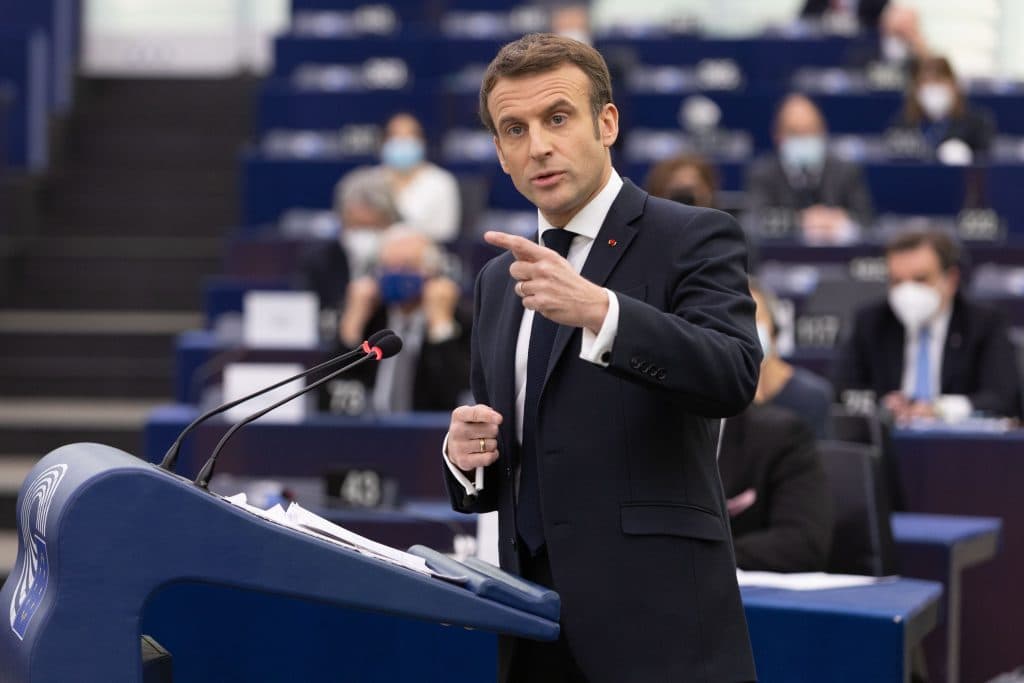
In response, the French parliament approved the so-called Renewable Energy Acceleration bill (Renewable Energy Acceleration bill) at the beginning of this year. The bill was put forward by the government under President Emmanuel Macron, which set about drafting it in earnest after the energy crisis.

Acceleration zones aim to cut permitting processes from years to months
The law has two main objectives: to simplify and speed up the process of obtaining construction permits, and to clearly identify preferred sites for solar panels and wind turbines. President Macron himself highlighted the lengthy permitting processes and extensive bureaucracy when the government discussed the bill.
One of the key tools for achieving these aims is the creation of acceleration zones in areas with high potential due to abundant sunshine or favourable wind conditions. They will still not be allowed in national parks or nature reserves, but local authorities—most often municipalities—will decide where to designate them.
Under the new law, the time required to assess permit applications for projects in acceleration zones will be significantly reduced. In France, it currently takes an average of 5 years to complete the administrative process for a solar farm, 7 years for an onshore wind farm and 10 years for an offshore wind farm. Under the new rules, most permits for projects in acceleration zones should be issued within 3 months.
Solar panels on fields, rooftops and car parks
The law also introduces a definition of “agrivoltaics”—solar power plants installed on agricultural land and operated in a way that is compatible with farming. Today, the law in many European Union countries does not allow this. Until recently, development was also challenging in France. Around 52% of French territory is agricultural land. Establishing a level playing field will therefore make it possible to build solar power plants on previously inaccessible land covering an area more than 3.5 times larger than the entire Czech Republic. The potential is therefore enormous.
In addition to agricultural land, the law also introduces measures to support photovoltaic panels on building rooftops and car parks. These are to become mandatory rather than optional. Commercial, industrial, craft or administrative buildings with an area of at least 500 square metres will now have to include some form of renewable energy generation. Car parks larger than 1 500 square metres will have to install solar thermal or photovoltaic energy-generation equipment across at least half of their area.
Government hopes for an offshore wind farm construction boom
Offshore wind is one of the main areas where the new law and increased government support are expected to rapidly boost annual installed capacity growth. Construction in French waters has stagnated for a long time. Despite a coastline of around 3 500 kilometres, just 480 MW of capacity is currently in operation—around 30 times less than the UK had in 2022. However, given the number of projects announced in recent years, it already seems that investors are responding to the government’s proactive policies.

France has set an ambitious target of reaching 18 GW of offshore wind capacity by 2030, including both fixed-bottom and floating turbines. Reaching this level will probably require additional support and changes to the existing system. French officials are clearly aware of this. The new law therefore introduces a range of measures to encourage investors. A 10-year plan for offshore wind development along the French coast is also due to be finalised next year.
- Projects located in the same area will no longer each need to be approved separately through a public consultation.
- The law introduces a single legal framework for French maritime areas, combining the public maritime domain with the larger exclusive economic zone.
- For the first time, the law creates a new legal framework for artificial islands and floating installations and structures. These are key infrastructure for projects farther from the coast.
To support development, the government also held five auctions in 2021 and 2022 for six new wind farms with a total installed capacity of 4,2 GW, including 750 MW of floating wind capacity. Auctions have been held in the country since 2011, and France aims to auction at least 2 GW of new capacity annually from 2025. A total of 7 GW has so far been awarded or is in preparation.
Translation disclaimer
This article is a machine translation of the Czech original and has not yet been fully reviewed. In case of any doubt, please refer to the Czech version.




