Record-low Danube takes more than 3 GW of nuclear capacity offline in Central Europe. Drought is becoming a risk to the market and security of supply

The Danube’s record-low water level has taken Hungary’s Paks power plant and Romania’s Cernavodă plant offline — together accounting for more than three gigawatts of low-cost, steady baseload capacity, at the peak of a heatwave. The governments of both countries have called on industry to curb consumption and are preparing emergency measures. For the interconnected Central European market, this could mean more expensive imports, greater electricity price volatility and further evidence that extreme weather is becoming one of the main risks to security of supply.
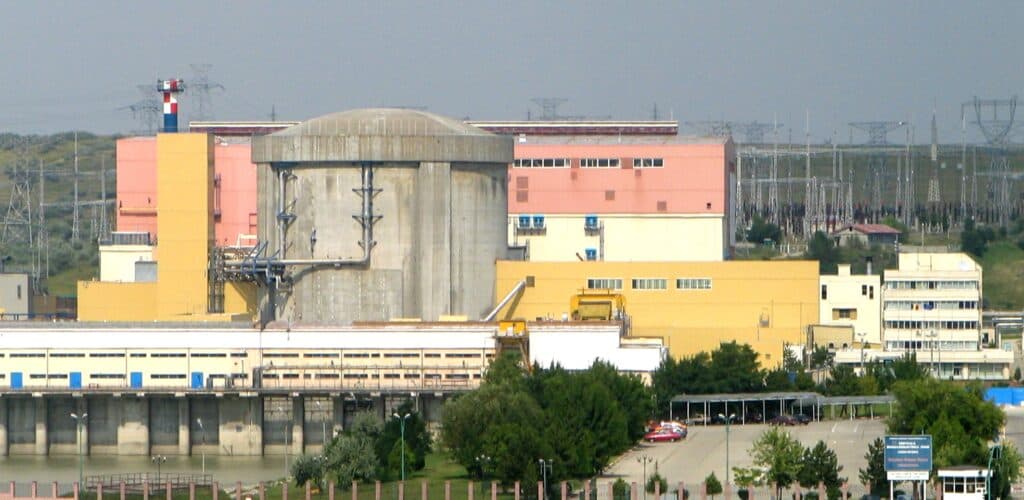
Hungary’s Paks power plant, with four reactors and installed capacity of around 2,000 MW, normally covers roughly 45 to 50% of Hungary’s electricity generation. Due to the Danube falling to a historic low, it had to gradually reduce output before proceeding to a full shutdown — for the first time in 44 years of operation. In neighbouring Romania, the country’s only nuclear power plant, Cernavodă, shut down one unit initially and, after a further decline in water levels, the second unit as well. The two reactors provide approximately one-fifth of Romania’s electricity generation.
The loss of more than three gigawatts of reliable capacity cannot go unnoticed in the interconnected European market. Hungary and Romania had to replace the missing generation with more expensive gas-fired sources and electricity imports, which has begun to feed into prices, particularly during evening hours, when solar generation declines after sunset while consumption remains high due to air conditioning.
Nuclear power plants have long been among the lowest-cost sources of baseload power on the market. Their outage therefore not only raises the risk of capacity shortfalls, but also changes the merit order of generators setting prices. More expensive gas-fired power plants more frequently set the market price, leading to higher wholesale prices.
Spot price developments show that prices in Central Europe began to rise after the nuclear units were shut down, while differences between individual markets also widened. The most significant impacts emerged in Hungary and Romania, from where the pressure was transmitted to neighbouring countries through cross-border flows.
Countries began curbing consumption
Governments have therefore turned to demand-side measures. Hungarian Prime Minister Péter Magyar called on large consumers — carmakers, chemical plants and cement works — to voluntarily reduce consumption between 5 p.m. and 10 p.m. At the same time, the state is preparing emergency legislation allowing the controlled disconnection of large industrial loads. Romania declared a state of alert and likewise requested voluntary reductions in consumption during evening peaks.
This is a textbook example of how a hydrological problem can become an economic problem for the entire interconnected European energy market within a few days. From a security-of-supply perspective, the most serious aspect is that individual events are not independent. Heat simultaneously increases electricity consumption and reduces generation capacity. In addition to Paks and Cernavodă, France also reduced output during heatwaves this year, Serbia reported lower generation from hydropower plants, and Bulgaria faced similar problems.
Rivers do not serve solely to cool power plants. They are also important transport routes for coal, biomass and other commodities. Low water levels therefore also complicate fuel logistics. This concurrence is precisely what poses the greatest risk. Traditional power-system planning is based on the assumption that nuclear units are a stable source of capacity available almost continuously. Extreme drought, however, shows that even this part of the generation mix can be constrained at the very moment when demand is highest.
Czech Republic: Limited direct risk, but market exposure remains a question mark
For the Czech Republic, the current situation does not represent an immediate operational threat. The Dukovany and Temelín nuclear power plants use a closed cooling system with cooling towers, which significantly reduces their dependence on instantaneous river flows.
Cooling water is drawn from the Mohelno and Dalešice reservoirs in the case of Dukovany and from the Hněvkovice waterworks on the Vltava River in the case of Temelín, while the decisive share of heat is discharged through a recirculating cooling circuit. Unlike once-through cooled plants such as Hungary’s Paks, short-term declines in water flows therefore do not threaten Czech nuclear units to the same extent.
This does not mean that the Czech Republic is immune to similar events. The Czech electricity system is part of the synchronous Continental European grid and is commercially integrated into the single European electricity market through coupled day-ahead and intraday trading. The Czech market is physically interconnected with four neighbouring countries — Germany, Slovakia, Austria and Poland — and these cross-border interconnectors facilitate daily electricity trading and the balancing of differences between generation and consumption.
The loss of more than three gigawatts of reliable nuclear generation in Hungary and Romania therefore does not remain a local problem. Higher demand for imports is transmitted to neighbouring countries through the interconnected market, altering cross-border electricity flows.
Although the Czech Republic has no direct transmission-line connection with either Hungary or Romania, the commercial impacts are transmitted through the Slovak and Austrian transmission systems and subsequently affect the entire Central European region. As a result, wholesale prices may rise, price volatility may increase, and both the direction and volume of cross-border electricity flows at Czech borders may change.
Translation disclaimer
This article is a machine translation of the Czech original and has not yet been fully reviewed. In case of any doubt, please refer to the Czech version.