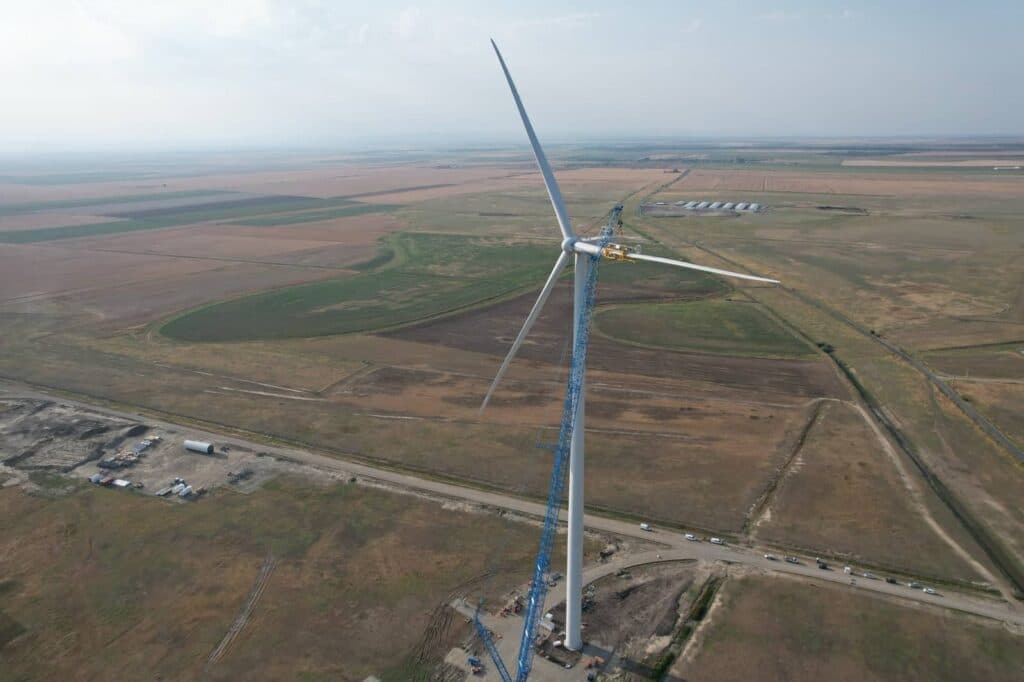
Wind power in the Czech Republic is treading water. Its development is being held back by lengthy permitting processes and concerns among local residents. Marek Lang, representing the JRD development and investment group, which also operates a wind farm in Václavice, discusses how to find common ground with municipalities, combat disinformation and advance green energy.
Neighbouring Poland is building wind farms at a solid pace, but since the wind farm in Václavice in the Liberec Region was built, no comparable source has been added in the Czech Republic. The Václavice wind farm consists of thirteen wind turbines with a total capacity of 26 megawatts, generating energy for around 21,000 households. In an interview with Ekonews, Marek Lang of the Czech JRD Group, which focuses on sustainable development and the construction of renewable energy sources, discusses the experience of operating the wind farm, new projects and the obstacles his company faces.
“Wind power will never become a dominant source in the Czech Republic; suitable locations cover only around two per cent of the country. That is one reason why we should appreciate the fact that we have such places at all. We need to find common ground with municipalities and try to deliver projects sensitively and through open communication with local communities,” adds the head of JRD Group’s energy division.
“You have to talk to the municipality and listen to it”
JRD has been operating the Václavice wind farm for nine years. Have the original expectations for output and returns been met?
We started operating the wind farm in November 2017. It has an installed capacity of 26 megawatts and generates 60 gigawatt-hours of electricity a year. It is a fairly significant source in the Czech wind power sector. We produce around a tenth of all wind-generated electricity in the country. It is also the largest wind farm owned entirely by Czech interests.
This summer, we completed the acquisition of the wind farm. We had a 50 per cent partner there until then, but over the summer we agreed to buy out their share. That may in itself show how satisfied we are with its performance. The project has certainly met expectations, which is good news for us, the financing bank and our other partners. But a lot has happened that we did not anticipate at all at the outset. Reality always brings a few surprises.
What kind of surprises?
For example, the manufacturer of the turbines at the wind farm became insolvent about a year and a half after it began operating. It was a situation we had to deal with, but fortunately everything worked out well. Life is full of surprises.
The location of the wind farm is interesting, too.
The borders of three countries meet there, so the differences between them are easy to see. It offers a striking contrast between modern and old energy. The Turów open-pit mine in Poland, which looks like a lunar landscape, stands in sharp contrast to the greenery and the wind farm on our side.
Since the wind farm was built, wind turbines have begun to appear on the Polish side as well. They were already there on the German side from the beginning. It is telling that no other major wind farm has been built in the Czech Republic since Václavice. We have made no progress in this area in nine years, while development in Poland has gathered considerable pace in recent years.
What have you learned during the operation of Václavice about the relationship between a wind farm and local residents and the municipality?
It helped that a poll was held at the outset, and the proposal received majority support. The entire project was then built on that basis. Local residents’ attitudes towards the wind farm have naturally evolved. When construction began in 2016 and 2017, people took notice and there was some nervousness. When the equipment began arriving, they were curious. I think people gradually got used to the wind farm. I would not claim that it has unanimous support, of course it does not. But I would say that most people in the area accept its presence. Some are bothered by it, and we need to communicate with them.
What does that communication look like?
Regular open days are an important tool for us. This year, we held a larger event to mark Global Wind Day. We arranged a demonstration by firefighters, who showed how they abseil down the towers, and prepared a range of other attractions. Around 400 people came, so attendance was quite high. At the end of the summer, we also had a stand at the festivities in Hrádek nad Nisou, where we presented what we have brought to the area.
What do municipalities receive each year from the operation of the wind farm?
We pay Hrádek several million crowns a year. In total, it has received more than 20 million crowns since the wind farm began operating. The municipality decides how to use the money. That is up to them; they receive it from us without having to worry about operations. We provide them with an overview of electricity generation and the corresponding financial contribution.
Right at the outset, they decided that roughly two-thirds of the funds would go to the so-called Fund to Support Václavice and Uhelná, directly benefiting the areas near the wind farm. This year, we asked the mayor for a list of what had been supported or built with the money. I was surprised by how long it was. It included bus stops, repairs to a small chapel in Uhelná, a water supply system and a bus turning area. There are many projects that are very beneficial to local residents and help improve their quality of life.
Have the things you offer municipalities changed over the years?
They are definitely evolving. We have to be resourceful and look for new ways to find common ground with them. We also have more options now. In addition to financial contributions, these include community energy and lower electricity prices for both municipal buildings and residents.
It always comes down to dialogue. You have to talk to the municipality, listen to it and find out what might benefit it. Some are also interested in specific investments. For example, in talks with one municipality, we were asked to build a cycle path.
Is there interest in community energy?
Generally, yes. But the specific terms are usually negotiated only when the wind farm is close to starting operations. Only then does it become clear how much of the original plans can actually be delivered. Setting up and managing an energy community is not entirely straightforward either. I expect this to continue evolving and similar offers to become increasingly common. It seems logical to me that a community with an energy source right on its doorstep should have the opportunity to benefit from it.
“What is not unfamiliar does not inspire fear”
What are people most concerned about when it comes to wind turbines?
If I had to mention the two issues that come up most often in discussions, they would be the impact on the landscape and noise. In recent times, infrasound has also become a topic. Let’s be honest: a wind turbine has an impact on the landscape and becomes a dominant feature of it. Sometimes it can be positioned so that it is hidden behind a hill, but it is often visible. When preparing projects, we can produce very high-quality visualisations. For example, we can show the view from a square or village green in a specific municipality and insert the planned wind farm into it.
Adding wind turbines to a photograph is relatively easy today thanks to AI, but creating a visualisation that accurately reflects reality is not so simple. We can do that. When it comes to noise, personal experience is what matters most. When people see wind turbines with their own eyes, they realise that they can barely hear them.
Have you also noticed an increase in disinformation?
The situation has definitely become more heated. It escalated when acceleration areas began to be discussed. Suddenly, the idea took hold that a decision would be made and a wind farm would immediately be built in the designated location. The problem was that the state was slow to communicate. There was no information campaign and, in my view, the affected municipalities were not consulted enough. The result was a degree of panic, and a lot of disinformation then grew out of that fear and uncertainty.
A similar situation unfolded at the same time in Slovakia, where a fairly radical disinformation scene emerged. Its influence and material then began to spill over into the Czech Republic. Local communities picked up its content, and an interconnected social media bubble gradually formed in which this disinformation reinforced itself. The whole thing grew.
What has proved effective in debunking it?
I do not want to trivialise the issue, because everyone has the right to protect their personal space and express their views about what should be built there. That is entirely right and legitimate. That is precisely why open discussions and transparent communication should take place. The problem arises when the disinformation scene takes hold of the issue and deliberately starts sowing fear, making false claims or distorting reality. That is wrong. In my view, the only solution is to provide information. We try to explain everything and set the record straight. What is not unfamiliar does not inspire fear. In short, we want to bring the debate back to a rational footing.
Wind turbines will never become a dominant source in the Czech Republic, accounting for 100 per cent of the energy mix. They will always make up only a certain share. In my view, suitable locations for building them cover only around two per cent of the country. It is not as if they could be built everywhere. We should approach the issue with that in mind: appreciate that we have such locations, find common ground with municipalities and local communities, and try to deliver projects sensitively and through open communication with them.
You mentioned that today’s wind turbines are larger and more powerful. Is that a significant change?
The technology has advanced considerably. When we built Václavice and installed two-megawatt turbines there, that was already essentially at the lower end of the capacity commonly installed. But we had a permit for specific turbine types, so we did not have much choice. Today, it would be quite difficult to buy such turbines at all. Onshore wind turbines now typically have a capacity of between four and seven megawatts.
So we can expect new turbines to have taller towers and larger rotors. But their dimensions will not keep growing indefinitely. A turbine’s output depends on the area swept by its rotor. In Václavice, our rotors have a diameter of 100 metres, whereas today’s standard turbines have rotors of around 150 to 170 metres. Our towers are 80 metres tall; today, they are typically between 120 and 150 metres.
How does this affect the economics of new projects and their returns?
One advantage is that you get more capacity from a single tower, so you do not have to build as many. On the other hand, the cost of the technology per unit of capacity has not fallen. At certain times, it has actually increased, partly because of material shortages and other crises.
Another factor is the cost of money. When we built Václavice in 2017, interest rate conditions were completely different. For example, 10-year interest rate swaps are now roughly three times the level at which we fixed them in 2017. So construction is more expensive today in terms of financing costs.
What stages of development are your other projects currently at?
We are focusing primarily on the Czech Republic and Slovakia. We have several hundred megawatts of projects under development between the two countries. The question, of course, is how many of them will actually obtain permits. Most are still at a fairly early stage. Once the biological surveys and wind measurements are complete, we will move on to environmental impact assessments (EIAs) and the permitting process itself will get underway. I estimate that we could start bringing the first projects online within three to five years. If everything went exceptionally smoothly, we also have projects in the Czech Republic where construction could theoretically begin in about two years.
Is permitting getting faster?
To put it simply, the permitting process for Václavice took ten years, from the start of project preparation to the beginning of construction. In some respects, things are certainly speeding up. I would not say that nothing is happening; legislation is gradually changing. So I think there is a chance that preparation will take less time, and we hope it will. On the other hand, there has been little progress in talks with municipalities, building consensus and communicating with local residents. That remains a long-term process. We expect that preparing a wind project should now take around five years at most.
Wind power development has been discussed for a long time, yet new capacity is being added slowly. What could help?
We currently have around 400 megawatts of installed capacity, while government plans call for 1.5 gigawatts. So there is ambition to develop the sector. What could the state do? Communication is fundamental, in my view. It should be consistent and persistent, and continually explain that this is an established target. Unfortunately, that often does not happen in the Czech Republic. When you listen to politicians, you find that they sometimes conceal the target or use it as a political issue.
And in terms of the rules?
The permitting process needs further work. It is not sufficiently predictable who can intervene in it, what the deadlines are and how enforceable they are. As a developer, you therefore do not know in advance how long the process will take or when you will actually be able to move on to construction. Acceleration areas are one attempt to bring about change.
The other key issue is grid connections. This affects not only wind farms, but also other energy sources and battery storage. We are running into a lack of connection capacity. If the state could communicate more clearly where it expects development to take place, distribution system operators could build the necessary infrastructure in those areas more effectively.
“You cannot build the entire energy system on nuclear power”
You mentioned that you are focusing on the Czech Republic and Slovakia. How do the countries differ in their development of renewable energy sources?
Historically, the two countries have had fairly similar legislation. But one significant difference is that there are practically no wind turbines in Slovakia; development is only just beginning. At the same time, there is considerable demand for electricity there. Some of our projects are near Nitra, where there are industrial zones with carmakers. These companies have a strong interest in green electricity. This could create an interesting opportunity to conclude PPAs (power purchase agreements, long-term commercial contracts under which a buyer purchases electricity directly from a producer at a price agreed in advance, editor’s note). This has not really taken off in the Czech Republic yet.
What stage are you at there?
For now, there is significant potential, but its actual scale remains to be seen. We are currently conducting biological surveys and measuring wind speeds there. We should have the results in about three months. Then we will see what potential the location really has.
I was also interested in the PPAs. So you are not seeing much interest in them in the Czech Republic yet?
They are certainly worth paying attention to. But in talks with potential buyers so far, there has been a considerable gap between their expectations and what we can realistically offer as an electricity producer. When you finance a project such as a wind farm, you typically think in terms of a period of up to 20 years. You need to secure a buyer for the electricity produced for a similarly long period, and the bank sets the loan terms accordingly. It would therefore help if the state could provide certain guarantees for PPAs. For us as investors in wind power, participating in an auction is currently a more viable option: we compete on price and receive a price guarantee from the state.
Besides wind power, JRD also builds solar power plants. What role does solar power currently play in the energy sector?
This year, we completed a project in Český Těšín that is technically one of the first of its kind in the country. It combines a solar power plant with battery storage. The solar plant has a capacity of 1.5 megawatts and the battery has a capacity of 4.5 megawatt-hours. The facility receives no support and operates purely on a market basis. We trade the electricity freely on the market, and the battery allows us to shift solar power deliveries over time. That is important today, because market prices are very low during some hours. Solar power plants essentially cannibalise their own revenues, and in the summer, around midday, electricity prices can fall to zero for some hours. That is why the battery is important. We are also currently preparing to provide balancing services.
Where do you see further opportunities for development in this area?
From an energy perspective, I think there is still room for further development. Government plans envisage around 10 gigawatts of installed solar capacity and about 1.5 gigawatts of wind power in the Czech Republic by 2030. We are significantly behind in both categories. Experts say that the optimal energy mix for the Czech Republic should be based roughly half on renewable sources and half on nuclear power. I think that is the direction we should be heading in.
Some people argue that renewables are unstable and put too much strain on the electricity grid. But we need to realise that the entire energy sector is undergoing a transformation. The same argument could also be made against nuclear power. You cannot build the entire energy system on it either, because demand on the other side is not constant. It fluctuates throughout the day, between weekdays and weekends, and over the course of the year. That is why we need a certain degree of flexibility.
Solar and wind power complement each other well over the course of the year. If sized appropriately, they can create a well-balanced generation mix. This of course needs to be complemented by sufficient storage, while flexibility on the demand side must also be developed.