2 November 2026, 06:19
Loading...
Batteries on the rise: large-scale storage drives growth in Germany and Czechia
Barbora Zimová
2 November 2026, 06:19
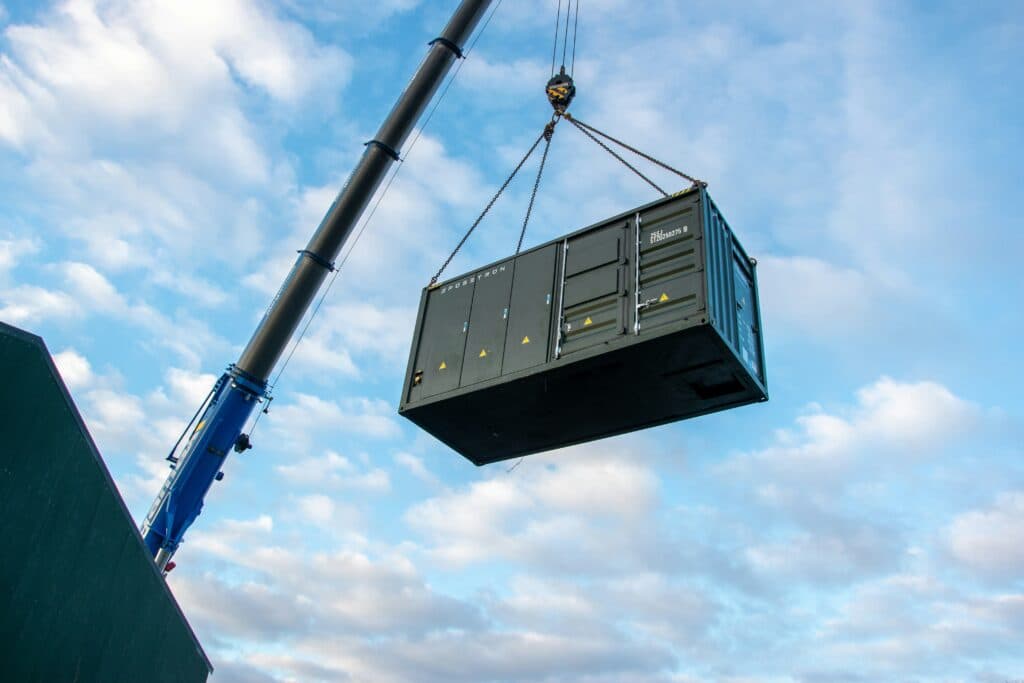
Newly connected battery storage capacity is rising sharply in both Germany and Czechia. In Germany, additions over nine months were up 91% year on year, while in Czechia they rose 83% in the first half of the year. Large-scale systems accounted for half of the additions in both countries. The German Solar Industry Association, however, warns that growth will slow without changes to permitting and grid connection procedures. Analysts also warn that as more batteries enter the market, investor returns may decline.
The German Solar Industry Association BSW-Solar reports that battery storage expansion has gathered pace. More than 2 gigawatt-hours (GWh) of new capacity was added in the first quarter of this year alone, an increase of around 67% year on year. More than half a million new battery storage systems were commissioned in the first nine months of the year. That equates to approximately 1,800 newly connected systems per day.
Newly installed capacity from January to September amounted to around 8.2 gigawatt-hours (GWh), up 91% year on year. Large-scale storage systems accounted for 3.8 GWh, or around half of installed capacity, and the association described them as the main drivers of current market growth. This segment more than quadrupled year on year. Battery storage used by households grew by 20% to 3.2 GWh.
Installed capacity to nearly sextuple by 2030
Although the association expects capacity to increase by more than 10 GWh over the full year, it also warns that this pace may not be sustainable. The industry group, which brings together more than 1,000 companies active in solar and storage, is therefore calling for faster battery storage development. The goal is to commit to installing at least 50 gigawatts (GW) of power and 200 GWh of storage capacity by 2030.
According to data from the Energy-Charts platform, operated by the Fraunhofer Institute for Solar Energy Systems ISE, total installed battery storage capacity stands at 34.4 GWh, with a power capacity of 22 GW. The association wants to increase capacity to at least six times that level over the next three to four years.
Association lays out a plan to speed up development
To effectively integrate planned renewable energy growth into the power system, the country needs to install storage with a power capacity of at least 8 GW each year, according to an analysis by the Fraunhofer research institute. Additions between January and September 2026 amounted to around 5 GW.
The 15-point plan to accelerate development presented by BSW-Solar is aimed primarily at the German government. BSW-Solar sees untapped potential among households, which are currently unable to participate in the electricity market due to the lack of standardised processes.
The association is proposing a one-off subsidy to retrofit batteries at around 1.4 million older rooftop solar installations that do not yet have them. Owners would then use more of the electricity they generate themselves and sell less to the grid, reducing state spending on the feed-in tariffs guaranteed to these installations.
Another key pillar of the plan is integrating storage into the grid. Installing battery systems that serve grid needs at electrical substations would free up capacity to connect a further 150 GW of photovoltaics—more than the current installed capacity—without the need to immediately reinforce the distribution grid.
BSW-Solar is therefore proposing that distribution system operators be required to hold tenders for such storage systems. It also argues that when the grid is overloaded, redispatch should take place at the point of connection, rather than directly at the generating facility. This would allow surplus electricity to be stored instead of curtailing generation.
The association also wants uniform, faster permitting with fixed deadlines and clearer rules for building storage systems in open areas. According to the International Energy Agency (IEA), construction itself is usually the shortest part of the process for a battery storage system. Much more time is spent obtaining permits, securing financing and, above all, waiting for a grid connection.
In Europe, the period from project conception to commissioning typically takes two to two and a half years. The United States and Japan are similar, while China and some Middle Eastern countries can complete projects more quickly. Other sources of flexibility, such as pumped-storage hydropower plants or new gas-fired units, take significantly longer to develop, according to the IEA.
Lex OZE III ushers in a boom in Czechia
The Czech Solar Association reported this year that battery storage systems with a total capacity of 318 MWh were connected in the first half of the year. That represents an 83% increase year on year. As in Germany, large-scale storage accounted for nearly half of the total, with capacity amounting to 143 MWh.
The Czech Association for Energy Storage AKU-BAT previously reported that large storage systems above 1 MWh had so far been relatively rare in Czechia. They lacked a legislative framework, rules and financial support. As a result, they primarily operated as part of district heating plants, gas-fired power sources or solar parks. Investors in Czechia are now preparing projects with several times higher power capacities and storage volumes, worth billions of crowns.
“The Czech market has shown that demand for battery storage is enormous, less than a year after the Lex OZE III amendment came into force. Further development will logically be limited by the distribution and transmission grids’ restricted capacity. The regulatory environment and tariff design will have a particularly significant impact on investor interest. These will determine whether batteries are used where they deliver the greatest value—to households, industry and the electricity system as a whole,”said Jan Fousek, chairman of the board of the Czech Solar Association and director of the AKU-BAT Association, commenting on this year’s data.
Economic conditions are favourable for batteries and, in turn, for investors in storage systems. The gap between the electricity price in the cheapest and most expensive hour of the day on the Czech spot market has widened significantly since 2022. However, experience from more mature markets shows that this gap quickly narrows as more batteries come online.
Analysts at Aurora Energy Research warn that the rapid increase in large-scale battery installations could lead to market saturation and falling returns in Germany, for example, by 2030. They point to developments in the British market, where storage operators’ profits are falling significantly.
Translation disclaimer
This article is a machine translation of the Czech original and has not yet been fully reviewed. In case of any doubt, please refer to the Czech version.
Sdílejte článek prostřednictvím:
You might also like

1 November 2026, 21:20

1 November 2026, 16:09
1 November 2026, 07:59

31 October 2026, 12:55