
23 October 2026, 14:38
Loading...
The largest Alpine glacier is shrinking, but its disappearance is not inevitable
Klára Čeperová
23 March 2025, 08:33
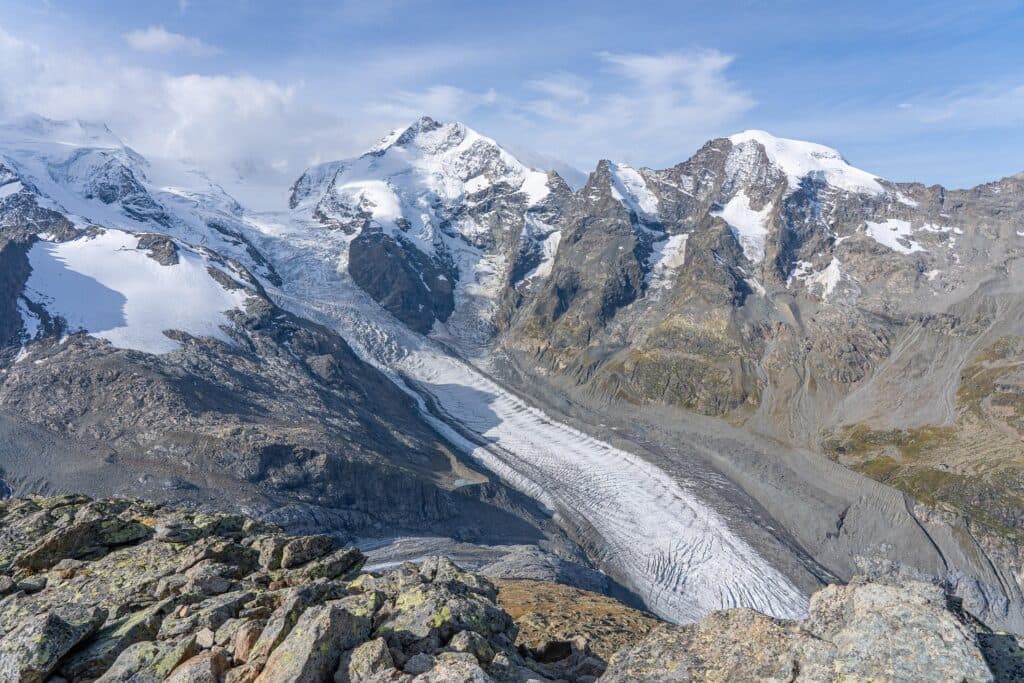
The loss of ice from the largest Alpine glacier is inevitable. However, if global warming can be kept below two degrees Celsius, it may be possible to save part of it, Swiss scientists said.
2024 was officially the hottest year on record, extending the extraordinary run of temperature records set over the past decade. The situation is accelerating the loss of glaciers and sea ice, raising sea levels and bringing the world closer to a critical warming threshold, the UN said.
The Great Aletsch Glacier in the Bernese Alps was 24 kilometres long and covered an area of 129 km² in the early 1990s. It is now reported to be between 20 - 22 kilometres long, to weigh 10 billion tonnes and to cover an area of 79 km2.
“It is very likely that almost all glaciers will disappear, and I sincerely hope that, at the Aletsch Glacier’s high altitude, we might be able to preserve some of the ice,” Matthias Huss, director of GLAMOS (Glacier Monitoring Switzerland), told Reuters at the summit of Jungfraujoch.
A grey valley will remain after the glacier
In a scenario with no climate action, its three prominent tributaries, which merge into a huge river of ice, would disappear, leaving behind a deep grey valley, an illustration by the Swiss Academy of Sciences showed.
But if global warming were kept below two degrees, it would survive, although much shorter and thinner, and “the alarming rise in sea levels would be significantly reduced”, according to the document, reported by Reuters.
“Glaciers above 3,000 metres above sea level in particular could be preserved over the long term,” the Swiss Academy of Sciences said of the second scenario.
Switzerland – a glacier powerhouse
The study, published to mark the first World Day for Glaciers, does not say which scenario is more likely, but Swiss glaciologist Andreas Linsbauer said it was “probably somewhere in between”.
More than half of the glaciers in the Alps are in Switzerland, where temperatures are rising as a result of climate change at roughly twice the global average rate. Their total volume has already fallen by almost 40 percent since 2000.
Translation disclaimer
This article is a machine translation of the Czech original and has not yet been fully reviewed. In case of any doubt, please refer to the Czech version.
Sdílejte článek prostřednictvím:
You might also like


23 October 2026, 11:01


23 October 2026, 06:34