10 September 2026, 15:21
Loading...
Czech industry ministry faces criticism after unveiling energy law amendment aimed at limiting power producers’ revenues
Daniel Grecman
9 November 2022, 11:17
The Ministry of Industry and Trade (MPO) sent draft amendments to the Energy Act (Act No. 458/2000 Coll.), which define “excess revenues” and set out their levy, for interministerial consultation on Friday afternoon. However, it faces criticism from all sides. In particular because it effectively allowed only half a day for comments, the measures contained in the draft are insufficiently justified in the explanatory memorandum, their compatibility with EU law has not been adequately assessed, their impacts have not been evaluated, and more.
Comments to be submitted immediately
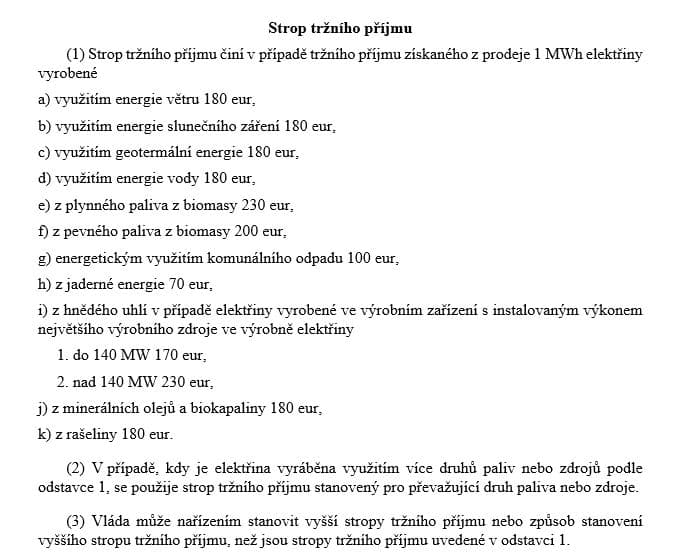
On Friday afternoon, when the tax package including the so-called windfall tax affecting the energy sector was also adopted, the MPO submitted the draft amendment to the Energy Act for interministerial consultation. The draft contains caps on the market revenues of electricity producers according to the type of generating plant. However, ministries and other entities had only until Monday at 14:00 to submit comments, which, given the impacts of the amendment and the submitted explanatory memorandum (discussed below), is wholly inadequate according to those commenting.
Unorthodox interpretation of the European regulation
Despite the tight deadline, the MPO received almost 20 documents containing comments. According to their authors, many of these were fundamental to the amendment. According to comments from the Compatibility Department, which is part of the Office of the Government, the submitted document failed to meet the formal requirements concerning the demonstration of compatibility with EU law. The explanatory memorandum is said to be misleading and wholly inadequate, while also referring to irrelevant EU legislation.
“A dual tax/levy burden on the same thing is very difficult to defend. Moreover, if the Czech windfall tax is intended to be an adaptation of the solidarity contribution under Article 14 of Regulation 2022/1854, it must be noted that, in the case of electricity generation subject to this so-called windfall tax, it goes beyond the European framework, since the solidarity contribution applies only to crude oil, natural gas, coal and refining, not electricity generation,” the comments from the Compatibility Department of the Office of the Government state.
Gaps in the explanatory memorandum
The caps for individual generating plants were set on the basis of a “qualified estimate”. However, for some generating plants, this is the only justification.
“In substantive terms, the justification is very brief, among other things, for electricity generation from lignite, while for nuclear energy it is entirely absent, etc.,” the Compatibility Department comments.
Extension of the European regulation
According to the Compatibility Department, the European regulation cannot be extended either.
“Although the proposer seeks to justify such an arrangement in the explanatory memorandum (pp. 17 and 18), doubts remain as to its compatibility with Regulation 2022/1854, which does not explicitly permit a derogation here. After 30 June 2023, the regime of such a levy would become purely national, which would require an entirely different and new assessment in terms of compatibility with EU law.”
The Ministry for Regional Development, led by Ivan Bartoš, will not agree with it. It asks why the price caps are not being introduced for the whole of 2022 (they are to apply from December 2022).
Caps switched around?
Representatives of the Confederation of Industry and Transport believe that the two price caps for lignite-fired power plants with capacity of up to 140 MW and above 140 MW have been switched around. That is, the higher cap should apply to smaller power plants. However, it cannot be said with certainty that this is an error, as the explanatory memorandum did not provide either the input parameters for the calculation or the calculation itself. The caps are set solely by reference to the already mentioned qualified estimate.
“We propose the same approach to electricity generating plants by setting a uniform cap for all electricity generating plants. At the same time, we point out an obvious error, whereby the cap values have been switched around,” representatives of the Confederation of Industry and Transport state regarding the caps for lignite-fired power plants.
Is it a tax or not?
State representatives cannot agree on whether this is a tax or not. According to the minister for legislation and chairman of the Government Legislative Council, it is a tax regardless of whether it is called a fee or something else.
The Ministry of Finance disputes this, saying it is a certain form of energy market regulation. It subsequently concludes that the excess revenue levy should fall under the remit of the Energy Regulatory Office (ERÚ). It has already rejected the idea that it should be responsible for administering the windfall tax. We wrote about this here.
Summary
There was a whole range of substantive comments, and it is not possible to mention them all here. The most fundamental issue, however, is the compatibility of the Czech version of the price caps with European legislation – their duration and level.
The strictest price cap is set for nuclear power plants – at 70 EUR/MWh. It should be noted that, based solely on the current market price of emission allowances, around 75 EUR/t CO2, the market price of electricity is substantially higher than the set cap, and that emission allowances are an instrument created by the EU itself.
There is also no assessment, even an indicative one, of the impacts of introducing price caps. This is particularly the case in conjunction with the windfall tax, given their proposed simultaneous application. The most significant impact on a company’s finances will occur, to the displeasure of minority shareholders, at ČEZ, in which the state holds an almost 70% stake and which owns the nuclear power plants at Dukovany and Temelín.
Even taking the extraordinary situation into account, the length of the consultation period is very short and does not provide sufficient scope to assess the proposal, especially when the explanatory memorandum is not error-free and fully transparent.
Translation disclaimer
This article is a machine translation of the Czech original and has not yet been fully reviewed. In case of any doubt, please refer to the Czech version.
Sdílejte článek prostřednictvím:
You might also like
10 September 2026, 10:37
9 September 2026, 15:05
9 September 2026, 13:24