
23 October 2026, 14:38
Loading...
Negative spot electricity prices could soon emerge in Sweden, following Germany and Czechia

Jan Budín
16 January 2020, 11:09

Sweden is likely to soon experience, for the first time, a situation in which electricity prices on the day-ahead market fall into negative territory during certain hours due to the rapid expansion of wind power. Negative electricity prices have already occurred for many years on the German and Czech day-ahead markets, for example.
The rapid expansion of wind power in Sweden will according to analysts contacted by international news service Montel likely soon result in the first occurrences of negative electricity prices on the country’s day-ahead market. An additional 3.4 GW of wind capacity alone is expected to start supplying electricity to the power system this year and next.
“If this capacity were already connected to the grid, Sweden would already have negative prices. Despite the gradual closure of nuclear power plants, the likelihood of negative prices is increasing every year,” said Christian Holtz, an analyst at Sweco.
According to international news service Montel, spot electricity prices in the SE3 bidding zone, which includes the Swedish cities of Stockholm and Gothenburg and all Swedish nuclear power plants, were below 2.5 EUR/MWh for 52 hours last year, more than in 2012 to 2018 combined. The lowest price, 0.12 EUR/MWh, was recorded on 2 May between 4 and 5 a.m.
“Negative electricity prices during certain hours will not necessarily mean a lower average price, but rather greater volatility,” said Arne Osterlind, portfolio manager at Shepherd Energy.
Osterlind added that more electricity from solar and wind power plants will lead to lower utilisation of conventional baseload sources, as well as higher electricity prices during periods when the wind is not blowing.
Record number of hours with negative prices in Germany
While negative spot electricity prices are expected to begin appearing in Sweden in the coming months or years, they have been occurring on Germany’s day-ahead market since September 2008 due to the rapid expansion of electricity generation from renewable energy sources.
Since then, their frequency has increased, and last year was a record year in this respect. According to Germany’s network regulator (Bundesnetzagentur – BNetzA), negative electricity prices were recorded on the German day-ahead electricity market for a total of 211 hours in 2019, more than ever before.
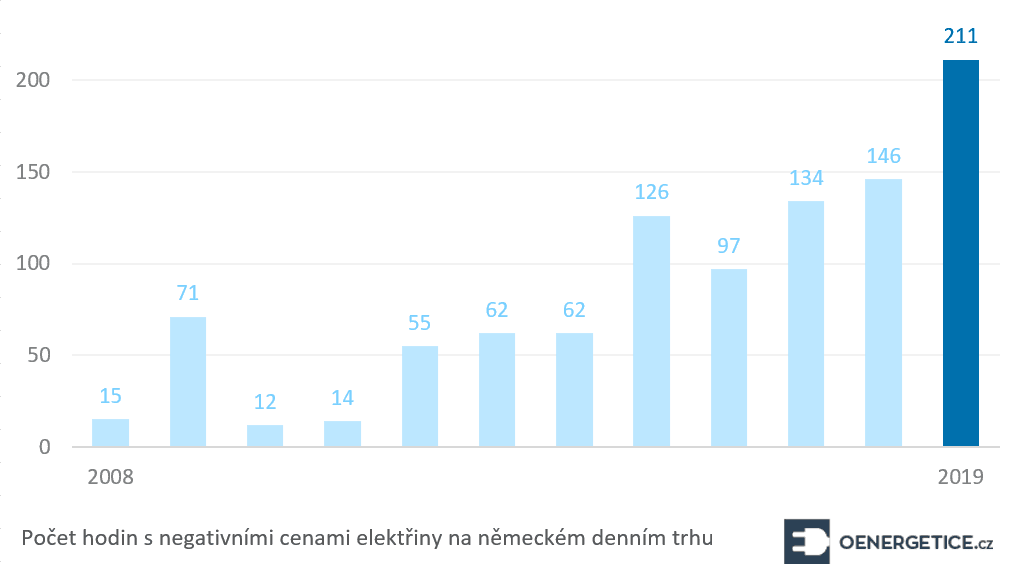
The number of hours with negative electricity prices also rose year on year on the Czech day-ahead market last year, although the number of such hours was substantially lower than in Germany. According to data from Czech market operator OTE, a.s., spot electricity prices fell into negative territory for a total of 58 hours.
Translation disclaimer
This article is a machine translation of the Czech original and has not yet been fully reviewed. In case of any doubt, please refer to the Czech version.
Sdílejte článek prostřednictvím:
You might also like

23 October 2026, 11:01


23 October 2026, 06:34