23 October 2026, 14:38
Loading...
Nuclear energy in Czechia and its future

Martin Voříšek
27 March 2015, 19:48
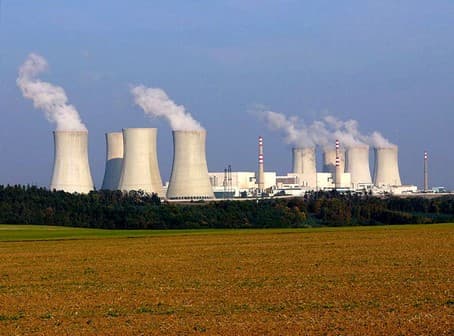
The question of completing nuclear power plants in the Czech Republic has been the number one energy issue for several years. Plans have constantly changed, and more than ten years have passed since 2004, when the idea of completing Temelín was presented in the state energy policy. Over the course of those ten years, construction of a new unit at the Dukovany nuclear power plant also began to be discussed, a tender for completion of Temelín was unsuccessfully held, Areva's bid was rejected, and much more.
The question remains whether it is currently economically advantageous to build a nuclear power plant. Given decentralisation, electricity generation from renewable sources and falling wholesale electricity prices, the return on investment is relatively uncertain. At current prices, which today stand at around 35 € per MWh, the financial situation is very difficult.
Completion of Temelín NPP – Units 3 and 4
The 2004 state energy policy envisaged construction of two or more nuclear reactors, most likely at the Temelín nuclear power plant or alternatively at Dukovany. This policy, which is defined in the Energy Management Act, is „only“ a document setting the direction of the energy sector in the Czech Republic. The main decision rests with ČEZ (even though the Czech Republic is its majority shareholder).
Four years later, in July 2008, ČEZ presented a plan to build two new reactors at Temelín, with capacity of up to 3400 MWe. Under the original plans, construction was to begin in 2013 and the first of the newly built units was to be commissioned in 2020. In mid-2008, ČEZ applied for an EIA for two new units. The next step was a public tender, announced in August 2009. At that time, according to a survey of Czech residents, support for the completion project stood at 77%, while by 2014 it had fallen to 68%.
Negotiations with companies that were to be awarded the completion contract began in March 2010 and involved three candidates:
- The Westinghouse consortium – AP1000 reactors with net capacity of 1140 MWe
- Škoda JS/Atomstroyexport/OKB Gidropress – AES-2006/MIR-1200 with net capacity of 1078 MWe
- Areva – EPR reactor with capacity of 1750 MWe
ČEZ officially invited bids for two complete reactors in October 2011. The bid was also to include the supply of nuclear fuel for 9 years of operation. The proposed reactor design had to be licensed in the candidate's home country or in a European Union country and had to comply with Czech and European safety requirements under IAEA parameters and those of the Western European Nuclear Regulators Association.
Bids were officially submitted in July 2012 and the contract was to be signed at the end of 2013, but the final decision was ultimately postponed by 18 months until mid-2015, when the new government's energy strategy was expected to be clear. In the meantime, Rosatom offered full financing for the project. Westinghouse and Areva, meanwhile, initially had no interest in financing the completion project in any way. This changed in mid-2013, when a US bank offered ČEZ a loan covering half of the required funds. However, this applied only if it used technology from US company Westinghouse. The loan was to be provided for 25 years at an interest rate one percentage point higher than that on US government 10-year bonds. ČEZ had previously stated that it was seeking a strategic partner with whom it could share the project's financial risk.
One of the key moments of the entire tender was the exclusion of French company Areva. According to ČEZ, Areva was disqualified because it failed to meet all requirements under the Czech Public Procurement Act and also failed to meet certain significant requirements specified in the tender documentation. Areva challenged the decision, but its motion was rejected by the Office for the Protection of Competition.
In November 2012, ČEZ applied to the State Office for Nuclear Safety for permission to build two new nuclear reactors at Temelín, and in January 2013 the two new units were granted a favourable EIA opinion (a total of 5,000 pages of text, submitted to the government in May 2010).
Contract for difference for Temelín?
The previous government planned to introduce a contract for difference for electricity generated by Temelín Units 3 and 4 in order to ensure the project's economic viability. This would have ensured that prices reflected the costs required to build the nuclear power plant and reduced the project's revenue dependence on current electricity exchange prices. The Ministry of Industry and Trade supported incorporating this support scheme for the completion project directly into the state energy policy, but the Ministry of Finance disagreed. The Ministry of Industry and Trade proposed a price of 60 euro per MWh, while some estimated that as much as 90 euro would be needed. ČEZ itself requested 70 € for the project to be profitable (at that time, electricity prices on the exchange were around 40 €, meaning construction would probably not have been advantageous for the company without support).
A contract for difference is intended to subsidise, for example, the Hinkley Point C nuclear power plant in the United Kingdom.
The new government's stance on support for Temelín
The new government took an unequivocal stance on the issue of completing Temelín. It would not provide state guarantees at the expense of consumers, particularly due to experience with state support for renewable energy sources (especially solar panels), which costs more than CZK 40 billion annually. ČEZ took a clear position on the situation. It needs long-term financial guarantees to complete Temelín, or it will terminate the project and leave electricity consumers facing uncertainty after 2020.
In March 2014, there were even plans for a newly established state-owned company to complete Temelín. The units would subsequently be leased to ČEZ. According to some views, this would be a more practical completion scheme than providing a contract for difference. The problem is that the risk would be transferred to the state.
After the government confirmed its decision that the state would not provide subsidies to ČEZ to finance completion of Temelín, ČEZ decided to halt the project and informed all participants in the tender procedure (Areva, Westinghouse, Rosatom). At the beginning of 2015, three methods of financing the completion of Temelín were published in a draft update of the state energy policy.
Completion of Temelín – Current situation
The first and most likely financing method still assumes that Temelín will be paid for from ČEZ's own financial resources. The second option is financing through an association of private investors. The third option is completion through a state-owned enterprise, but this is highly unlikely due to the considerable burden on the state budget.
Nevertheless, the policy envisages completion of one reactor at Temelín and one at Dukovany, with the possibility of adding one further reactor at each site.
According to information from ČEZ from March 2015, a new tender for construction of nuclear units is to begin within two years. ČEZ will probably use a model under which it establishes a new subsidiary that a potential partner could join and share in its profits. There are currently 5 parties interested in the completion project:
- Areva
- Rosatom in partnership with Škoda JS
- Westinghouse
- KEPCO (author's note: a Korean company)
- According to China's vice-premier, Chinese companies should also participate in the tender
ČEZ had previously announced that the contract should include an option to order up to three additional reactors for other locations in the Czech Republic or another European country.
A feasibility study for a new reactor at Dukovany is already being prepared, and ČEZ intends to submit an EIA application as soon as the feasibility study is complete.
Translation disclaimer
This article is a machine translation of the Czech original and has not yet been fully reviewed. In case of any doubt, please refer to the Czech version.
Sdílejte článek prostřednictvím:
You might also like
23 October 2026, 11:01
23 October 2026, 06:34