Risk of lithium supply disruptions likely to lead to more mergers and acquisitions

Chinese company Tianqi Lithium, one of the world’s largest lithium miners and producers, expects further consolidation across the lithium industry’s value chain. A senior executive at the group said this early in the week, following the $10.6 billion merger announced last week by mining company Allkem Ltd and battery producer Livent Corp.
The combination of the two companies has raised expectations of further mergers and acquisitions between lithium miners and companies focused on manufacturing end products, particularly batteries. Demand for these is expected to increase more than fivefold by 2030 amid the transition to low-emissions energy.
According to many forecasts, the rapid growth in demand will lead to a significant supply deficit, particularly after 2025. This has prompted global companies in recent years to seek to secure supplies of lithium ore to keep the battery industry running smoothly. The battery industry is the main consumer of lithium.
"For at least the past three years, it has all been about our uncertainty over material availability. If we cannot reduce this uncertainty, this trend will continue,"said Yasmin Liu, executive vice president and head of integration at Tianqi Lithium, at a seminar hosted by the London Metal Exchange in Hong Kong.
According to an analyst at Rystad Energy, lithium carbonate processing capacity has expanded significantly, especially in China, while growth in lithium ore supply has been limited. Mergers and acquisitions across the lithium value chain have allowed companies to save on capital expenditure and accelerate project development.
“This is particularly important for lithium producers at a time when prices are falling and a lithium supply deficit remains a risk in the long term,” Zou said.
Growing demand from electric vehicle battery manufacturers is also affecting commodity prices. They rose more than tenfold from the end of 2020 to the end of 2022. This was followed by a sharp decline from the beginning of this year, and price volatility looks set to continue.
China and automakers are expanding their involvement in the lithium industry
Despite the lithium sector’s high valuations in recent years, companies continue to look for transaction opportunities. The main players are multinational mining companies and the automotive industry. Given forecasts for lithium use in battery production and the number of companies involved, M&A activity in the sector is generally expected to remain strong.
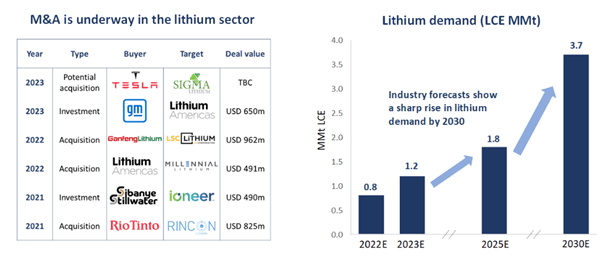
For example, multinational mining company Rio Tinto has identified lithium assets as priority acquisition targets. It has already demonstrated this with the largest completed transaction in the lithium industry to date, buying the Rincon Lithium project in Argentina last year for $825 million.
Chinese companies have also accounted for a large share of recent lithium mining and processing deals. They were behind the second- and third-largest transactions, with Zijin Mining Group Co. Ltd. acquiring companies in the Chinese and Argentine markets.
Another significant development for the lithium industry has been the entry of automakers seeking to secure their battery-metal supply chains. Although automakers entering the mining industry are likely to face a range of technical challenges, owning stakes in lithium mining eliminates the risk of supply disruptions, which they are likely to face more frequently in the future.
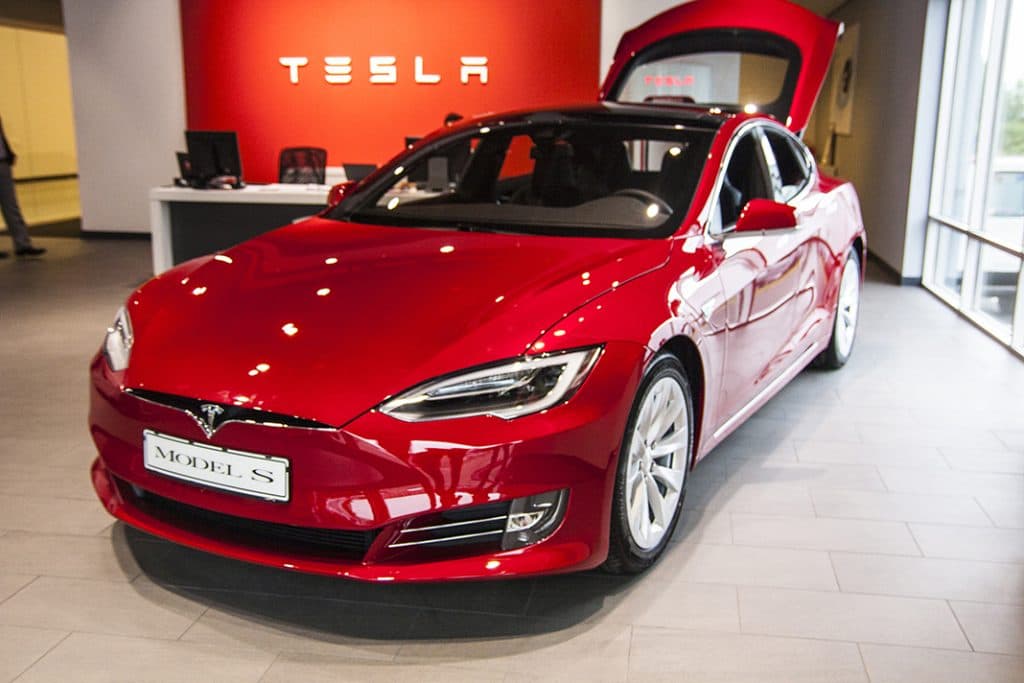
One of the most widely reported deals in this area was Tesla’s entry into lithium mining in 2020, through the acquisition of lithium-rich clay deposits in Nevada. There is also speculation that the company is considering acquiring Brazil-based Sigma Lithium.
In addition to Tesla, another US company, General Motors, announced an investment in the development of the Thacker Pass mine in Nevada in January 2023. The deposit is the largest known source of lithium in the United States.
The question is whether oil and gas companies, which have internationally integrated supply chains, will also decide to enter the sector over time. So far, however, their activity has been relatively insignificant compared with that of traditional players and automakers.
Translation disclaimer
This article is a machine translation of the Czech original and has not yet been fully reviewed. In case of any doubt, please refer to the Czech version.




