Capacity mechanisms already used by 8 EU countries; Czech Republic now opens path to introduction

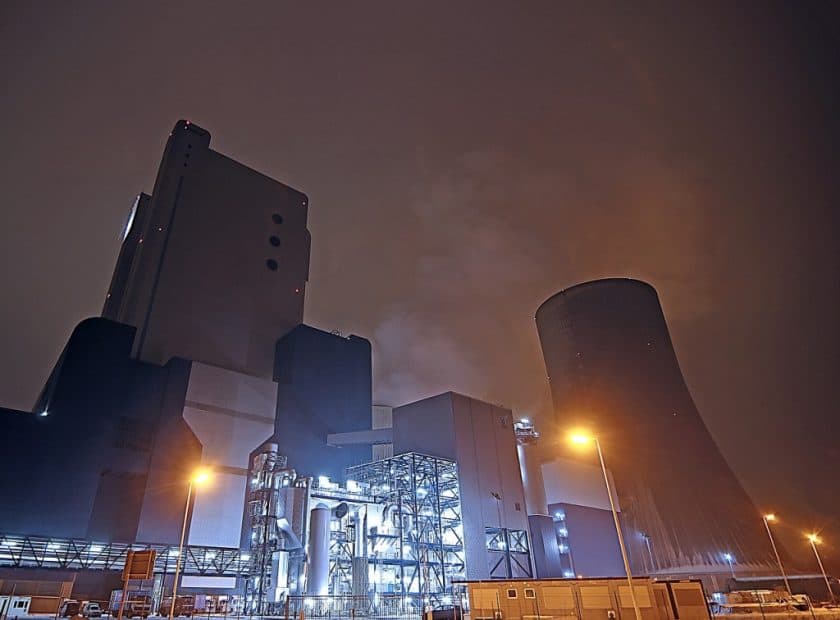
Through an amendment to the Energy Act, which the Ministry of Industry and Trade (MPO) submitted for consultation on 21 September 2023, the Czech Republic is opening the way for the introduction of a capacity mechanism. Eight EU Member States currently have various forms of capacity mechanisms in place, which are necessary to keep selected dispatchable sources in operation and, above all, to build new dispatchable sources. Neighbouring Germany, for example, is currently seeking to add auctions for the construction of gas-fired power plants to its existing strategic reserves. However, it has not yet secured approval from the European Commission.
There is increasing discussion in the Czech Republic about introducing capacity mechanisms in connection with the approaching closure of coal-fired power plants and concerns over ensuring security of electricity supply. The debate intensified following the publication of another amendment to the Energy Act, which, among other things, proposes the possibility of introducing capacity mechanisms.
For this to happen, cooperation will be needed between the MPO, which may introduce a capacity mechanism under the proposed legislation, and transmission system operator ČEPS, a.s., which is responsible, among other things, for determining the required availability of regulating capacity from electricity generating plants or other energy facilities.
However, as demonstrated, for example, by Germany's current effort to introduce support payments for new gas-fired capacity, a key step in introducing a capacity mechanism will be its notification to the European Commission.
The European Commission will assess any such measure under the rules set out in the Regulation of the European Parliament and of the Council on the internal market for electricity. Under these rules, capacity mechanisms must, for example, be open to all technologies and to foreign resources. A Member State seeking to introduce a capacity mechanism must also demonstrate its necessity and precisely quantify the dispatchable capacity required.
These rules also significantly limit the possibility of supporting coal-fired sources. Sources emitting more than 550 g CO2/kWh that entered operation after 4 July 2019 may not be supported through capacity payments. Sources exceeding the stated emissions limit and at the same time producing more than 350 kg CO2 per installed kW of electrical capacity annually, which entered operation before 4 July 2019, may, no later than from 1 July 2025, "neither participate nor receive payments or commitments for future payments" under a capacity mechanism.
Capacity mechanisms in place in the EU
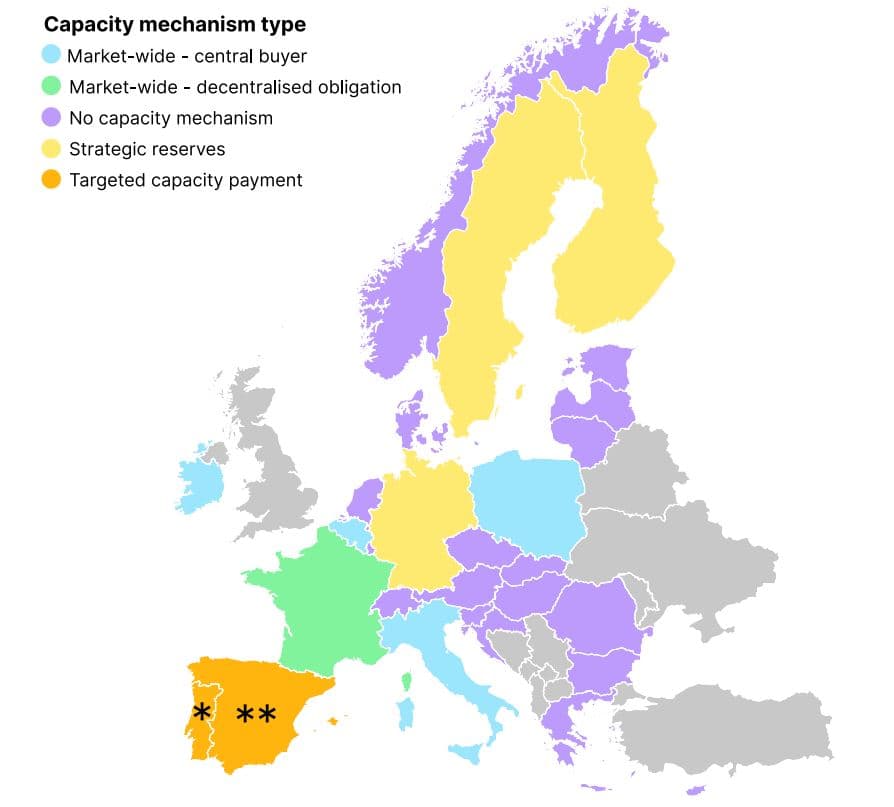
In the European Union, according to a report by the Agency for the Cooperation of Energy Regulators (ACER), eight Member States currently have some form of capacity mechanism in place. Germany, Finland and Sweden have so-called strategic reserves. Belgium, France, Ireland, Poland and Italy use so-called market-wide capacity mechanisms.
In addition to the eight countries above, ACER also lists Spain and Portugal, which do not have a capacity mechanism in place but still support certain sources under legacy long-term capacity contracts.
"In 2022, developments were observed in national capacity mechanisms. In Finland, the original strategic reserve scheme expired in July 2022 and was therefore replaced by a new scheme. The first auction under the new scheme was held in summer 2022, but no capacity was contracted in it (the resources that participated in the auction nevertheless remained available to the electricity market). In Italy, capacity delivery began under a new capacity mechanism that replaced the previous scheme in force until 2021," ACER stated.
Costs to exceed EUR 7 billion this year
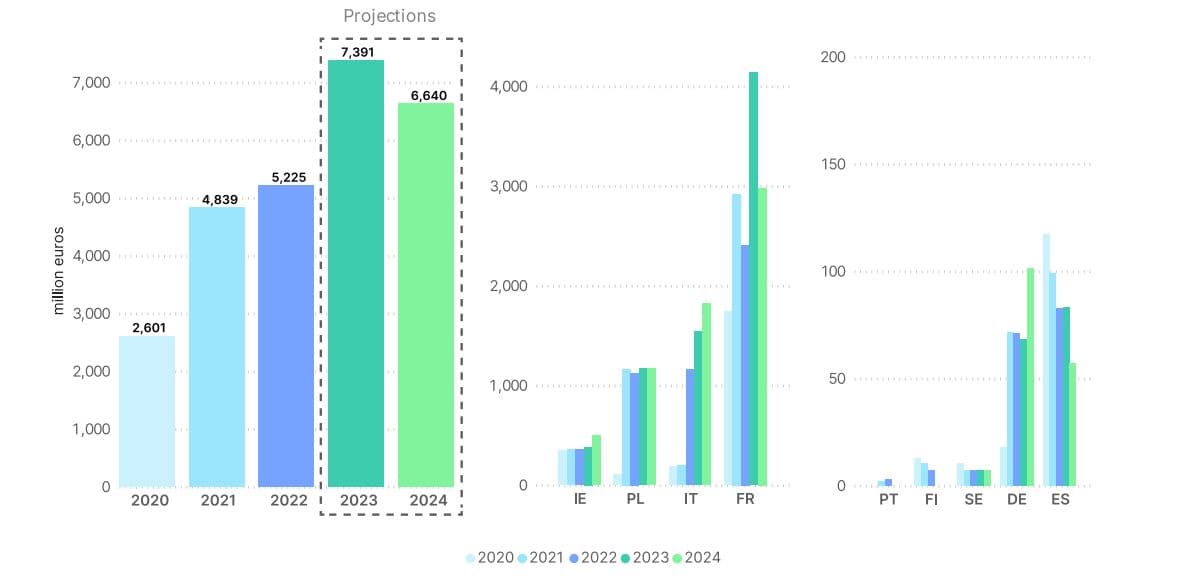
Capacity mechanisms are financed by final electricity consumers. ACER therefore analyses the costs associated with these support schemes in its report on ensuring security of electricity supply. While total costs exceeded EUR 5 billion for the first time last year, they are estimated to rise to EUR 7.4 billion this year.
More than half of this amount is accounted for by France. Italy, Poland and Ireland are other countries with high absolute costs for capacity mechanisms. These are therefore countries that use market-wide capacity mechanisms.
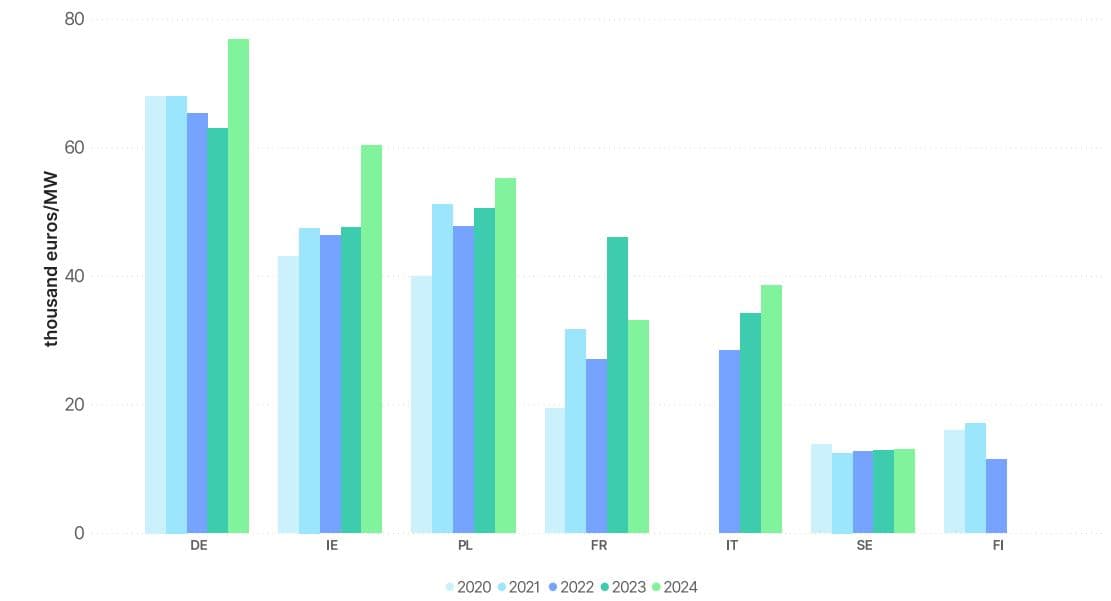
For a better comparison of support through capacity payments, it is useful to compare unit costs per MW of secured capacity. In this comparison, Germany records the highest values, providing operators of resources in its strategic reserves with more than EUR 60 thousand/MW/year.
Operators of resources in Ireland and Poland receive unit payments of around EUR 50 thousand/MW/year. Resources included in strategic reserves in Sweden and Finland receive the least.
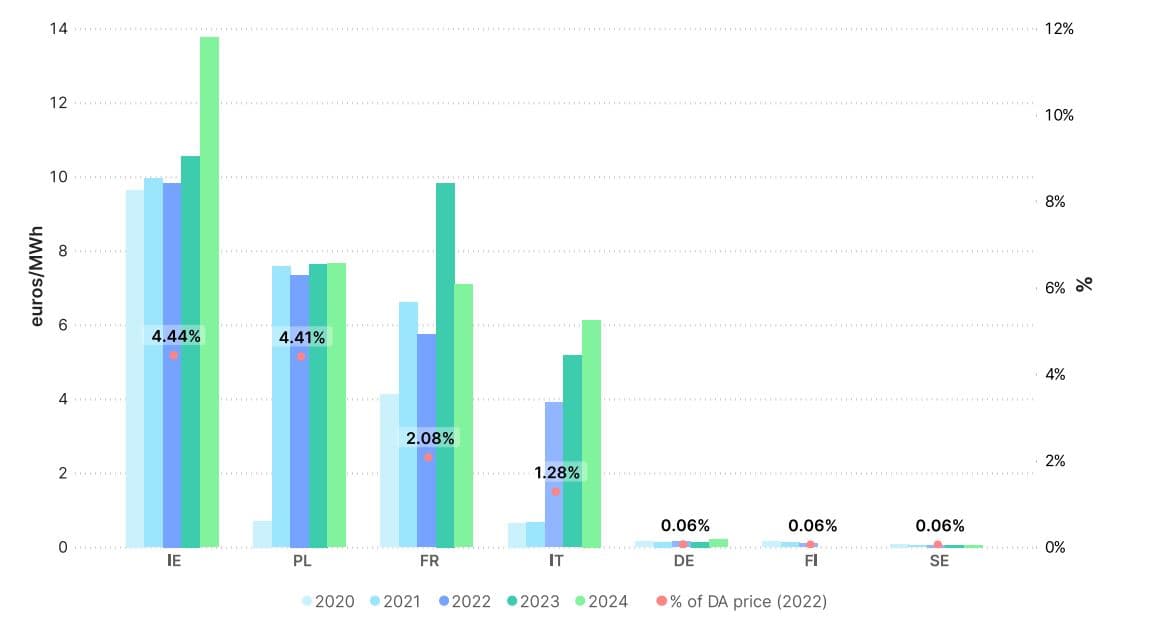
The following chart shows another important comparison of capacity mechanism costs, this time expressed per MWh of electricity consumption in the respective country. Ireland ranks highest in this statistic, where capacity payments exceed EUR 10/MWh. They are around EUR 8/MWh in Poland and France, and just under EUR 6/MWh in Italy.
The chart also compares unit costs of capacity mechanisms in 2022 with the average electricity price on the spot market in the respective country. However, thanks to high wholesale electricity prices last year, driven by sharply rising prices of natural gas and other energy commodities, this share reaches a maximum of just under 4.5 %.
Primarily conventional sources
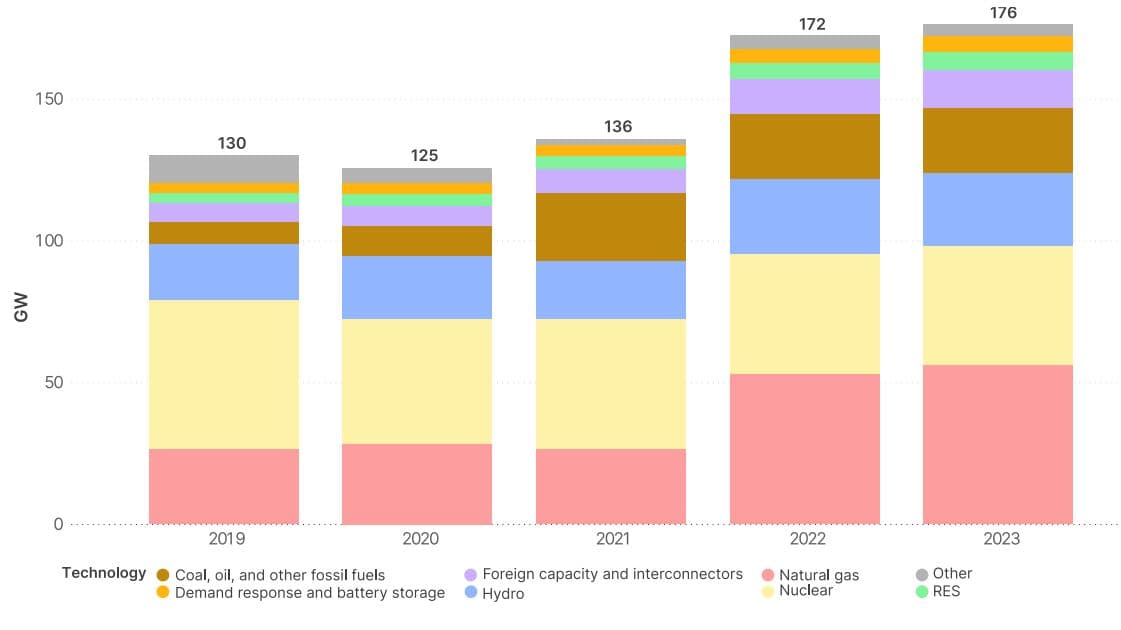
As the following chart shows, support through capacity mechanisms is directed primarily to operators of conventional power plants (gas-fired, coal-fired, nuclear and hydroelectric). In recent years, however, the volume of foreign resources and cross-border interconnectors able to compete with conventional sources in the respective country has grown.
"The increase in gas-fired resources receiving capacity payments in 2022 and 2023 is mainly due to the introduction of the new capacity mechanism in Italy," ACER explains.
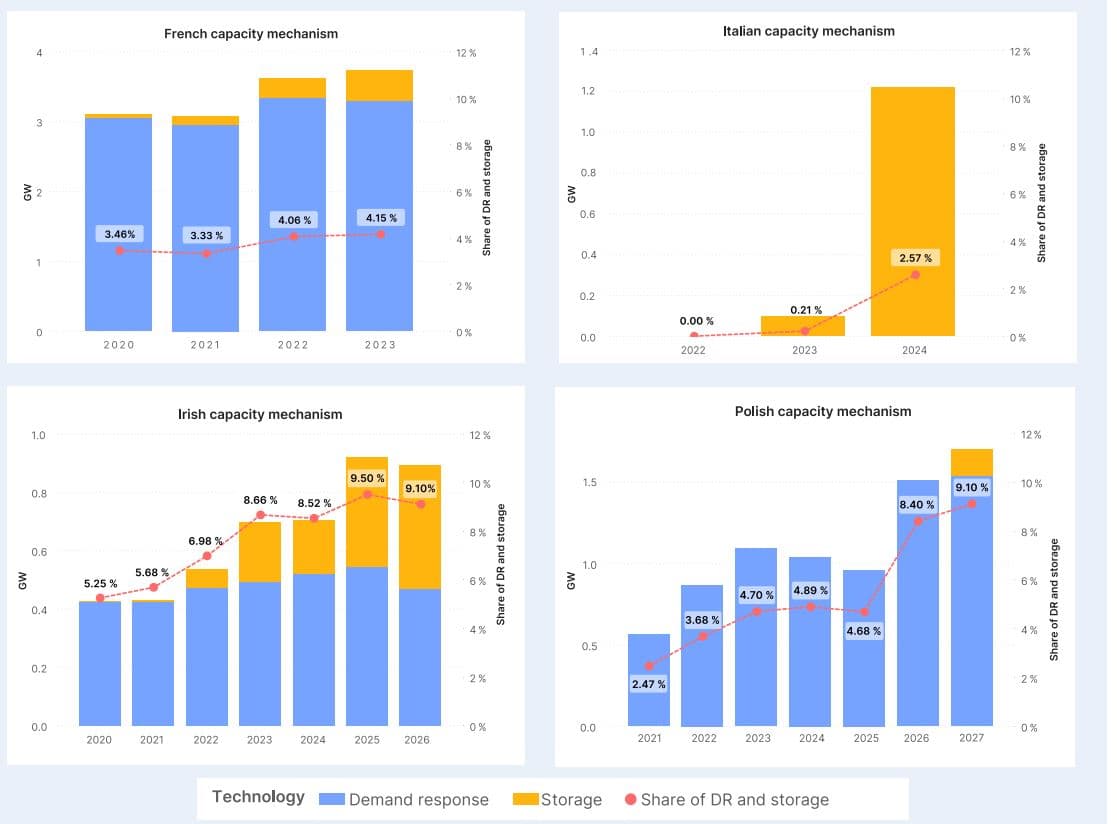
ACER further highlighted the low share of demand response and electricity storage in total contracted capacity during the period under review. However, according to ACER, the share of these flexibility resources should grow in coming years and, for example, should reach almost 10 % in Poland and Ireland in 2026.
Polish coal-fired power plants until 2035
An important role of capacity mechanisms is to ensure the construction of new dispatchable sources. Long-term capacity contracts, typically concluded for around 15 years, play a key role in this.
"On the one hand, long-term contracts can enable the commissioning of new capacity and increase competition by reducing investment risk and financing costs. On the other hand, they may create a barrier to the entry of new types of dispatchable capacity providers if they are directed at conventional sources," ACER warns.
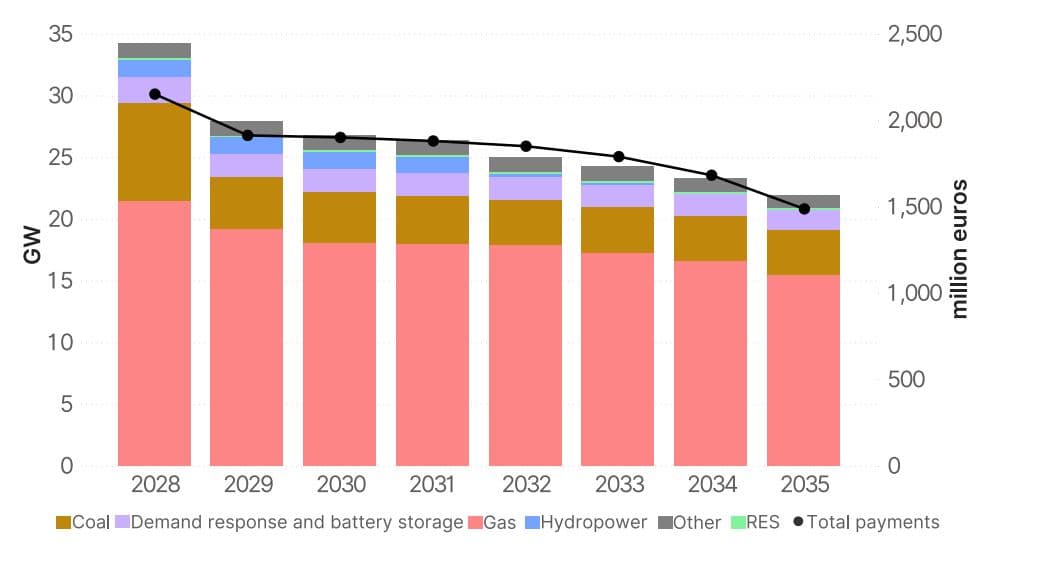
The chart above shows that gas-fired sources account for the overwhelming majority of long-term secured capacity. More than 20 GW of these sources are to receive capacity payments in 2028, and more than 15 GW in 2035.
Until 2035, capacity payments will also be paid to Polish coal-fired power plants with total capacity of 3.6 GW, which, as new sources, secured long-term capacity contracts in auctions before the end of 2019 in line with European regulation. By contrast, support will end in 2028 for Polish coal-fired power plants that secured five-year capacity contracts in the last auction for existing coal-fired power plants, held in December 2019. The operator of Europe's largest coal-fired power plant, Bełchatów, was also successful in this auction, obtaining a capacity contract for several units for the 2024-2028 period.
The Polish capacity market is examined in detail in the following article.
Translation disclaimer
This article is a machine translation of the Czech original and has not yet been fully reviewed. In case of any doubt, please refer to the Czech version.