European Union increased its dependence on fossil fuels again in 2022

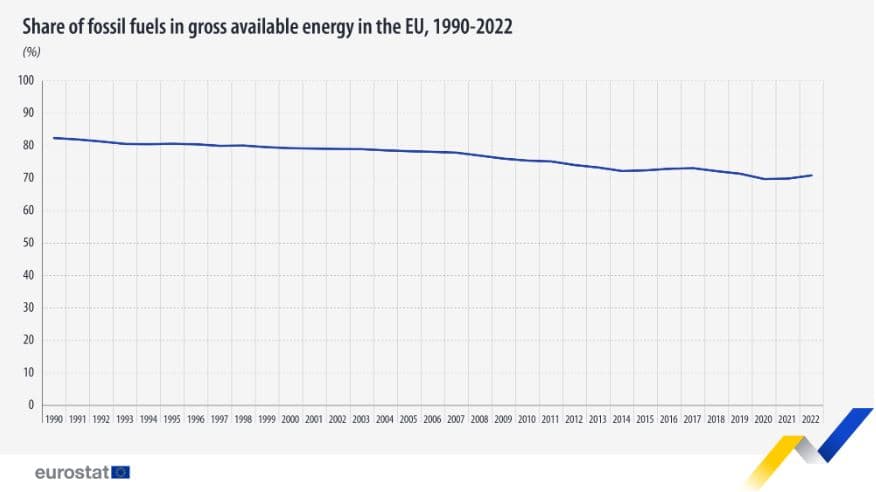
The European Union’s dependence on fossil fuels increased for the second year in a row in 2022. While 2021 saw only a slight rise of 0.1 percentage points (p. p.), the share of fossil fuels in gross available energy increased by 1 p. p. in 2022. This is according to data published by Eurostat.
The share of fossil fuels in gross available energy rose to 70.9% in 2022, returning to approximately its pre-pandemic level. Nevertheless, since this indicator began to be tracked in 1990, it has fallen by 11.5 p. p. According to Eurostat, the main reason is the increased use of energy from renewable sources.
Eurostat noted that 2022 was an exceptional year in terms of developments in energy markets. On the one hand, it was the first full calendar year after the lifting of the main restrictions imposed in response to the COVID-19 pandemic. On the other, it was a year significantly marked by Russia’s invasion of Ukraine, which began on 24 February 2022 and led to an unprecedented increase in energy commodity prices.
Eurostat identified the decline in nuclear power generation as a significant factor contributing to the EU’s increased dependence on fossil fuels. Although the growth in renewable electricity generation offset the shortfall in nuclear power, it did not fully erase the negative effect.
Malta has the highest dependence, Sweden the lowest
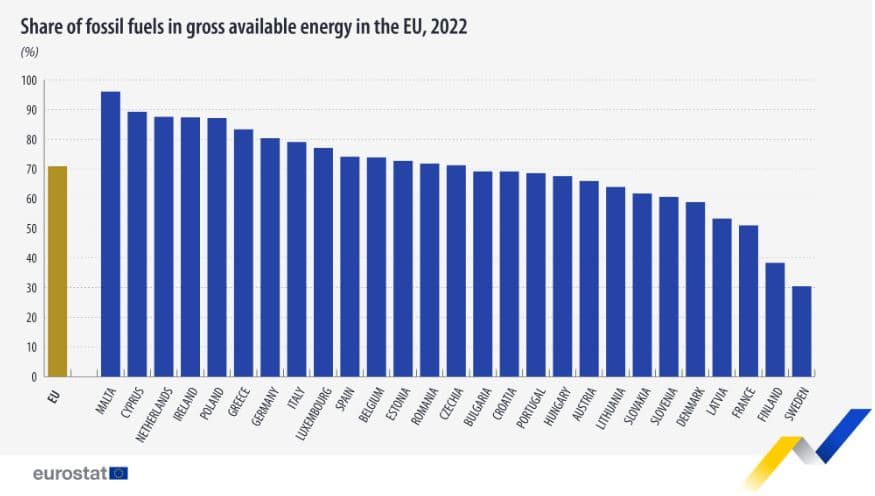
Around half of the EU member states, including Czechia, recorded a share of fossil fuels in gross available energy above the European average in 2022. Malta has by far the highest dependence on fossil fuels over the long term (96% in 2022).
Finland (38%) and Sweden (30%), by contrast, have the lowest dependence on fossil fuels. These are countries that lead in the use of renewable energy sources (RES). In 2022, RES accounted for 48% of Finland’s gross final energy consumption, while Sweden reached a share of 66%.
According to Eurostat’s methodology, gross available energy is the amount of energy needed to meet all energy demand from entities in a given country. In addition to fuels consumed in the energy sector, it includes fuel consumption for non-energy purposes (for example, in the chemical industry) and transport, including fuels purchased in that country and used elsewhere (e.g. in international aviation or maritime transport).
Translation disclaimer
This article is a machine translation of the Czech original and has not yet been fully reviewed. In case of any doubt, please refer to the Czech version.




