
23 October 2026, 14:38
Loading...
Ursula von der Leyen does not change her approach to energy policy
Klára Čeperová
24 July 2024, 10:59
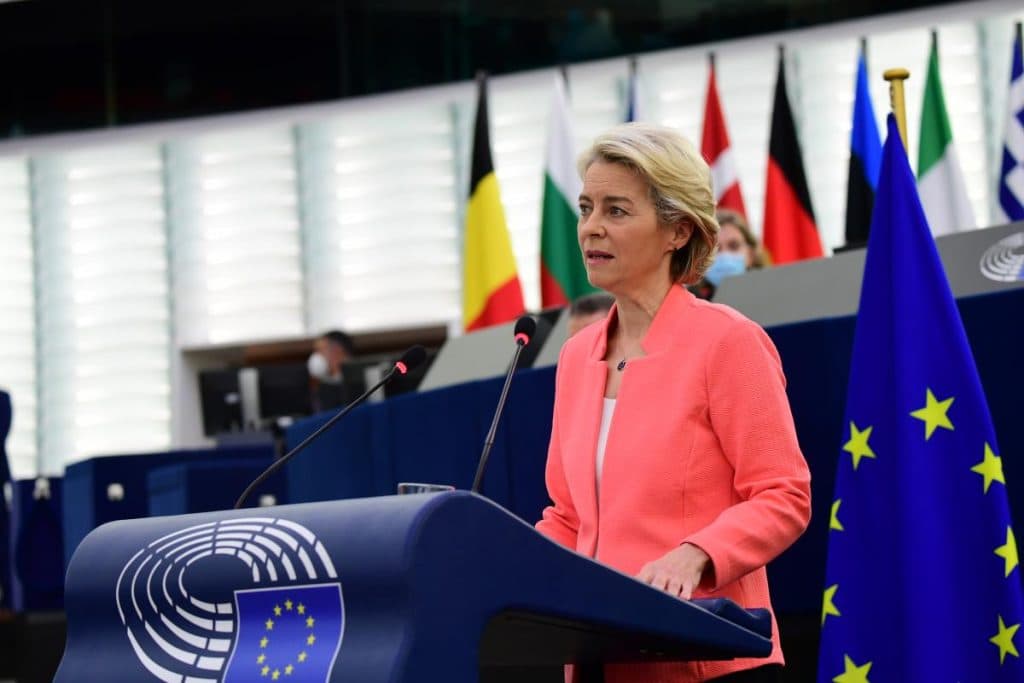
Re-elected European Commission President Ursula von der Leyen once again committed to climate action and clean industry in her so-called “political guidelines” ahead of the vote on her re-election. She also addressed agriculture.
Von der Leyen’s speech at the plenary session in Strasbourg began last Thursday shortly after 9 a.m. The speech, based on the “political guidelines”, according to Euractiv, was the result of several weeks of discussions with the Parliament’s main political groups. It was tailored to persuade MEPs across the political centre to support her bid, which they ultimately did.
Von der Leyen once again committed to the bloc’s climate goals, including the yet-to-be-agreed target of cutting emissions by 90% by 2040, saying that the EU is in a global race “that will determine who is first on the path to climate neutrality and who is first to develop the technologies that will shape the global economy in the decades to come”.
Ambitious plans for clean industry
As expected, von der Leyen focused heavily on supporting European industry. She also explicitly linked its decarbonisation efforts to the continent’s economic competitiveness.
She promised a new “Clean Industrial Deal” within 100 days of taking office.
Funding for it would come from an “Industrial Decarbonisation Accelerator”, which would direct investment into infrastructure and energy-intensive industries, and from a Competitiveness Fund, which would invest in a broader range of strategic technologies—including clean technologies.
However, questions about how much funding there will be and where it will come from remain unanswered. Her document states that the Competitiveness Fund will be proposed as part of negotiations on the next EU budget, which will cover 2028–2035. Elsewhere, it says the EU will need more own resources.
In her speech, the president also mentioned that climate action should ensure “intergenerational justice”.
Agriculture and climate
On agriculture, von der Leyen explicitly linked rural interests with the impacts of climate change in her speech. She referred to the “changing face of Europe’s rural landscape” and said her planned “climate adaptation plan” would be developed “together with farmers”.
Otherwise, von der Leyen’s speech and guidelines were marked by positive environmental rhetoric but included few concrete commitments. Her guidelines state only that her Commission will “provide clarity” on PFAS regulation. PFAS are also known as “forever chemicals”.
More specifically, von der Leyen is proposing a Circular Economy Act. It would put waste products, such as critical raw materials, to economic use, thereby incentivising more recycling.
Transition to renewables
On energy security, von der Leyen continued to emphasise phasing out imported fossil fuels. She is focusing on renewable energy, which she considers “clean and homegrown”.
Both von der Leyen’s speech and the political guidelines mentioned the need to reduce energy prices, but gave no details on how this should be achieved.
Von der Leyen did not mention the controversial 2035 ban on combustion engines in her speech, although her opening remarks referred to “technological neutrality”.
Vote result
The speech may have helped von der Leyen win around 56% of the vote in the secret ballot. That is five percentage points more than five years ago.
She relied on the support of the European People’s Party (EPP), to which she herself belongs politically, the Socialists and Democrats (S&D), and the liberals of Renew Europe. The Greens also backed her.
The Patriots for Europe and the Left in the European Parliament (GUE/NGL) did not support von der Leyen. Nor did the ECR conservative group.
Translation disclaimer
This article is a machine translation of the Czech original and has not yet been fully reviewed. In case of any doubt, please refer to the Czech version.
Sdílejte článek prostřednictvím:
You might also like


23 October 2026, 11:01


23 October 2026, 06:34