24 September 2026, 11:23
Loading...
Will decarbonisation bring more profit and less risk? A look at the Czech EGÚ Brno conference

Jakub Malý
24 September 2024, 11:58
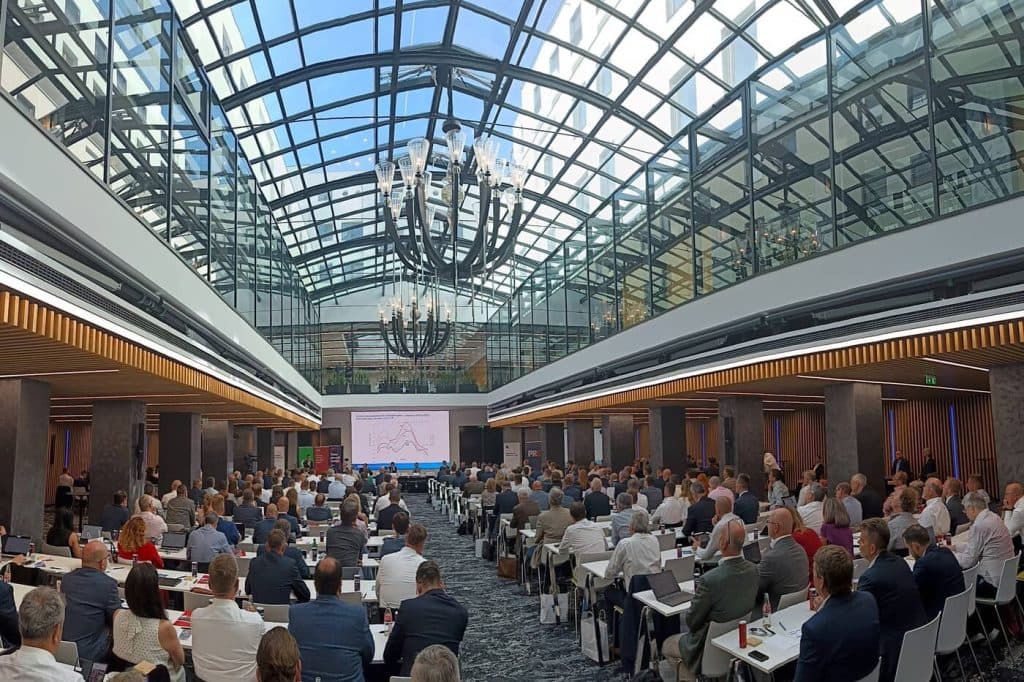
Energy 2024 conference: Decarbonisation – less risk, more profit! This was the title of the annual conference organised by EGÚ Brno at Hotel Passage. Several speakers sought to answer the question of whether decarbonisation will bring less risk and more profit. Decarbonisation was therefore a theme running through all 4 thematic blocks and the discussion panel at the end of the conference.
In addition to conventional presentations by individual speakers, the conference also included interactive elements, with participants able to answer a question via a QR code at the beginning of each block. Interestingly, one question asked whether the riskiness of investments in energy is increasing, decreasing or stagnating. The option that received the most votes from those present in the hall was that the riskiness of energy investments is increasing.
First block: Decarbonisation – less risk, more profit!
The conference was opened by Michal Macenauer, EGÚ Brno’s strategy director, with a presentation on stagnant economic growth in Europe. In the name of climate protection, consumer lifestyles are being curtailed, leading to lower demand for products, while production is also being relocated. The Draghi report was also mentioned in this context, noting the need for increased investment due to the EU lagging behind the US and China.
Huge investments will be needed in the energy sector and new energy sources, as well as in reinforcing existing infrastructure. These investments also represent an opportunity for industry.
“The energy transition requires replacing the vast majority of fossil primary energy sources, especially coal and oil fuels. The costs of the required decarbonisation for companies need not be so painful, as public funds should be able to cover almost half of the financing needed. Supporting investment in the energy sector is an effective brake on rising energy prices and is in the state’s interest. For industry, the wave of investment in the energy sector will be a significant opportunity,” said Michal Macenauer.
Second block: What energy sources will we have in 2030?
The second block began with a presentation by Milan Ščasný, head of the Environmental Economics and Sociology Department at Charles University’s Environment Centre, on modelling the impacts of decarbonisation scenarios in the Czech Republic under SEEPIA. The presentation showed what the energy mix could look like under the implementation of various environmental policies and stirred considerable emotions among the audience.
The block also discussed the coal phase-out and its impact on the Czech energy mix, opportunities for developing cogeneration technologies and combining different energy sources. In a similar vein, namely through combining multiple sources, the second block was concluded by Petr Fajmon, CEO and board member of Teplárny Brno.
Third block: What flows and imports can the grids handle?
The third block focused primarily on distribution grids, both gas and electricity. An interesting point raised regarding electricity distribution grids was that the two distributors together have recorded more than 40 GW of applications to connect solar generation sources. However, a large proportion of these will never be built and merely block other projects. Growing requirements and the associated costs for the distribution grid were also mentioned.
The gas distribution grid discussion, meanwhile, covered the possibility of blending in hydrogen, the need for growing investment in existing infrastructure and the potential for biomethane development. The block was concluded by René Neděla, director general of the Energy and Nuclear Sources Section at the Czech Ministry of Industry and Trade, with an overview of forthcoming legislative acts, energy flows into the Czech Republic and the Ministry’s view on the need to support investment in the energy sector.
Fourth block: How will the market handle decentralised energy?
The fourth panel was opened by Ludvík Baleka, chairman of the board of Pražská plynárenská, who spoke about community energy and the problems associated with it, while also presenting the impact of the new version of the European emissions trading system (EU ETS 2) on end-user gas prices.
Community energy was the main topic of the block, with discussion focusing on the challenges it faces and the related approaches and demands on distribution grids. In connection with distribution grids, changes to the tariff structure and their impacts on end customers were mentioned. According to Jiří Gavor, executive director of the Association of Independent Energy Suppliers, end customers are often sidelined.
Major discussion panel: New energy sources, electricity sharing, impacts of decarbonisation on industry and decentralisation
The final block was somewhat unconventional in that each participant was asked a question by the moderator, which they had to answer within 6 min. This was followed by a discussion of questions from the audience.
There were interesting and often humorous moments arising from the rhetorical skills of the individual presenters. In particular, the presentation by Mirek Topolánek, chairman of the Executive Board of the Czech District Heating Association, drew a loud response from the audience, as geopolitics, EU actions and the very principles underlying decarbonisation were discussed.
The plethora of legislation and regulation flowing from the EU was also mentioned, particularly its major impacts on energy-intensive industry, which is very difficult to decarbonise.
To illustrate where energy investors should focus their attention, EGÚ Brno selected several important examples of the investments needed. According to EGÚ Brno, the Czech energy sector will gradually need, among other things, the following by the middle of the 21st century:
- 2 new large nuclear units (1,200 MW each) for new consumption and 2 as an approximate replacement for the existing Dukovany plant,
- 3 new large gas-fired combined-cycle units (900 MW each),
- 2.5 GW of gas-fired sources in district heating,
- 700 MW of new gas-fired cogeneration,
- 1 GW of new backup sources,
- 20 GW of photovoltaic power plants,
- 6 GW of wind power plants,
- 4 GW of new daily electricity storage,
- 4 GW of demand-side management,
- 5 mil. slow electric vehicle charging points in the public, residential and commercial sectors, and hundreds of thousands of medium- and fast-charging points.
Translation disclaimer
This article is a machine translation of the Czech original and has not yet been fully reviewed. In case of any doubt, please refer to the Czech version.
Sdílejte článek prostřednictvím:
You might also like
24 September 2026, 10:30
24 September 2026, 06:56
23 September 2026, 17:27