Czech heat pipeline from Temelín to Budějovice to deliver 750 TJ a year, cost CZK 1.69 billion

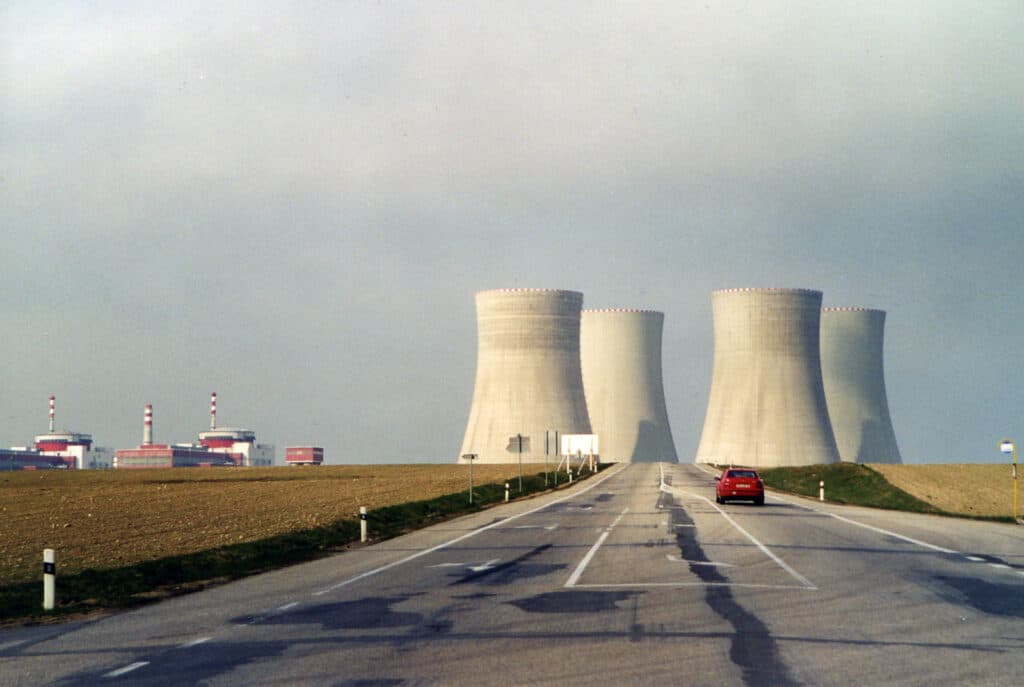
České Budějovice heating plant today began trial operation of a 26-kilometer hot-water pipeline from the Temelín nuclear power plant to České Budějovice. The Temelín heat pipeline will cover 30 percent of the city’s heat demand. It will supply 750 terajoules a year, and is expected to deliver heat for at least 20 years. The city will thus have 30 percent of its heat at stable prices, unaffected by market developments. Representatives of the heating plant, the city and ČEZ told journalists today. ČEZ built the pipeline at a cost of CZK 1.69 billion.
„This is not only the largest district heating project, but also one of the biggest environmental projects of recent decades. If we wanted to produce this heat from coal, we would have to emit more than 80,000 tonnes of carbon dioxide a year. We consider our decarbonization strategy a priority, and this is one example of that,“ said ČEZ CEO Daniel Beneš.
The hot-water pipeline is expected to meet the heat demand of around a third of the heating plant’s customers, with the company supplying the rest from its own sources. Heat from Temelín will mainly supply the Vltava and Máj housing estates. It is the third-longest heat pipeline in the Czech Republic, Beneš said.
The heating plant’s emissions, including greenhouse gases released into the atmosphere, will fall by about a third. The company will thus avoid emitting more than 80,000 tonnes of carbon dioxide a year by not burning coal.
Thanks to the hot-water pipeline, the heating plant will no longer need to buy emission allowances, said České Budějovice Mayor Dagmar Škodová Parmová (ODS). During the current heating season, the company will also start burning wood chips instead of coal in boiler K12. The new wood-chip boiler will reduce coal consumption by about a further third. České Budějovice had relied on coal-fired heating since 1908, when the city’s coal-fired steam power plant was built.
„Thirty percent of our heat (thanks to the hot-water pipeline) is secured at a stable price, but other sources also affect the final price. We are planning a waste-to-energy plant, so some of the heat will come from waste and some from a boiler that uses a mix of wood chips and coal. We can be certain that 30 percent of our heat will be supplied under terms defined in advance, unaffected by what is happening on the market,“ South Bohemian Governor and České Budějovice councilor Martin Kuba (ODS) said in response to a question from the Czech News Agency.
The price of heat should not rise sharply this year, he said. The city-owned company will announce next year’s price by the end of November. This January, it raised the price per gigajoule of heat to CZK 788.59. Last year, customers paid CZK 690.69.
Temelín and České Budějovice are connected by two 26-kilometer pipelines, each with an external diameter of 80 centimeters. Both pipelines are buried at least 1.3 meters underground. In winter, water heated to as much as 140 degrees Celsius will flow to České Budějovice; for the rest of the year, it will be at a temperature of 90 degrees Celsius, ČEZ said.
ČEZ initially announced that the pipeline would start supplying heat to České Budějovice at the turn of 2020 and 2021. Construction began in spring 2019. The project was delayed by about two years. Work stopped for about a year from the end of 2020 after construction company Tenza went bankrupt. At the end of 2021, ČEZ selected the companies that completed the pipeline: Elte and Energie – stavební a báňská.
Temelín is the country’s largest electricity producer, covering about a fifth of domestic consumption. Last year, it generated 16.29 terawatt-hours (TWh) of electricity.
The České Budějovice heating plant supplies heat to around 30,000 apartments and more than 400 businesses, institutions, schools, healthcare facilities and shops. Last year, it sold 1463 terajoules of heat, recorded revenue of CZK 1.3 billion and posted an after-tax profit of CZK 23.1 million. This is according to its annual report.
Translation disclaimer
This article is a machine translation of the Czech original and has not yet been fully reviewed. In case of any doubt, please refer to the Czech version.




