BNEF: Contracted offtake of clean hydrogen is very low, but gradually increasing

Many projects focused on producing "clean" hydrogen have been announced in Europe and around the world in recent months. However, only a fraction of the announced production capacity is backed by contracts to purchase the hydrogen produced. According to BNEF, the figure is around one tenth.
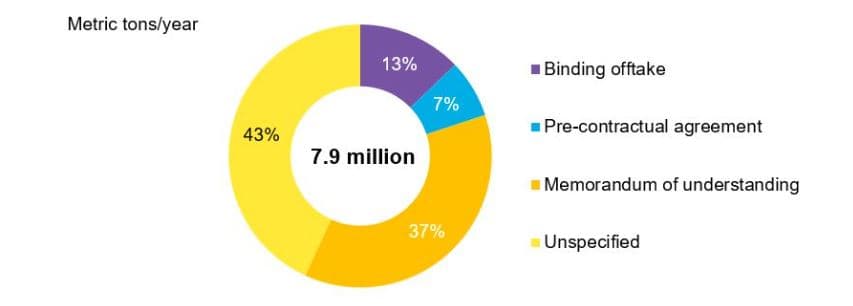
BNEF researchers announced the creation of a database of contracts to purchase "clean" hydrogen or its derivatives, which currently contains 149 contracts. However, according to the published data, only 13% of contracted offtake (around 1 million tonnes/year, or 33 TWh/year) can be considered firmly contracted. BNEF describes around 7% of the contracts recorded as "pre-contractual" agreements, which have a strong chance of progressing to binding contracts. The remaining 80% are either memoranda of understanding or other, unspecified agreements.
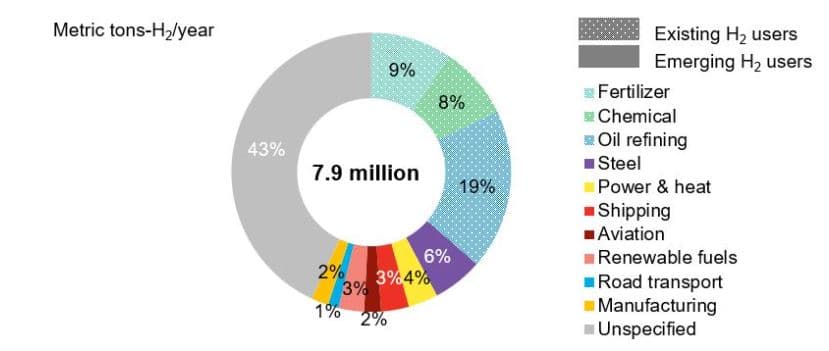
"Almost half of the contracted volume of hydrogen is expected to be delivered in the form of ammonia (NH3), a gas that is easier to transport than hydrogen. Ammonia buyers include fertilizer producers and buyers focused on exporting hydrogen in the form of ammonia," BNEF said.
BNEF added that around one third of the contracted volume will be used to replace emissions-intensive grey hydrogen, which is produced from fossil fuels. New applications, such as using low-emissions hydrogen to produce steel and electricity or in freight transport, account for around one fifth. The remaining 43% of contracted volume has no specified use for now and will be used primarily for export.
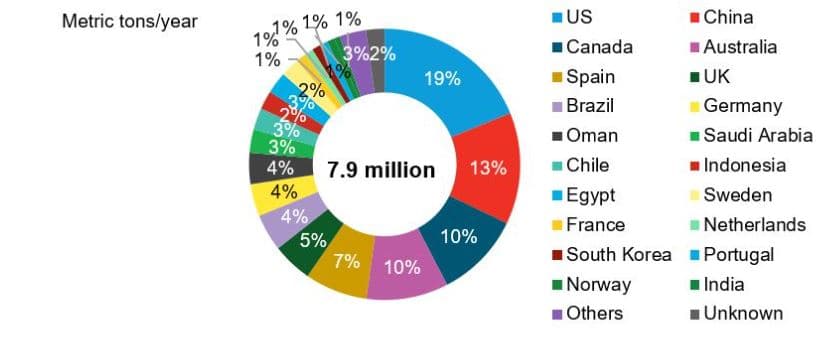
The largest number of projects with secured offtake are in the United States, China, Canada and Australia. According to BNEF, the main destinations for export-focused projects are South Korea and Europe.
"Most contracted offtake is for domestic use, while 36% (or 2.8 million tonnes/year) is destined for export,"Volume of contracted hydrogen by country of production. Source: BNEF
Translation disclaimer
This article is a machine translation of the Czech original and has not yet been fully reviewed. In case of any doubt, please refer to the Czech version.




