
23 October 2026, 14:38
Loading...
GET H2 Nukleus: First steps towards green hydrogen in Lingen, Germany
Veronika Jurcová
20 August 2024, 10:17
RWE has commissioned a 14 MW pilot electrolyser in Lingen, Germany, to optimise green hydrogen production on an industrial scale. The facility is part of the GET H2 project, which aims to create one of the first integrated hydrogen projects, reports H2 news.
In early August, RWE commissioned a 14 MW pilot electrolyser in Lingen, at the site of its Emsland gas-fired power plant in north-western Germany. The facility, which can produce up to 270 kilograms of green hydrogen per hour, marks a significant step forward in RWE’s ambition to become a leader in large-scale green hydrogen production. The electrolyser uses electricity from renewable sources, making it a key element in the decarbonisation of German industry.
The Lingen project combines two different electrolysis technologies: a 10 MW alkaline electrolyser from Sunfire and a 4 MW proton exchange membrane (PEM) electrolyser designed by Linde in collaboration with ITM Power. The technologies are being tested in real operating conditions to assess their efficiency and suitability for large-scale production. The test results will provide valuable insights for optimising future industrial projects.
The project is part of RWE’s wider strategy to strengthen its position in green hydrogen. The pilot plant complements the larger-scale development of the GET H2 Nukleus project, which includes building a 100 MW electrolyser by 2025, with a planned expansion to 300 MW by 2027. These initiatives are supported by public funding, primarily from the German federal government and the federal state of Lower Saxony.
Lower Saxony’s Ministry for the Environment, Energy and Climate Protection has provided around 8 million euros in support of the project. Hydrogen produced at the pilot plant will initially be used to fuel a gas turbine in power plant Unit D as part of a comprehensive testing programme. From 2025, it could also be used to power hydrogen-powered vehicles at a refuelling station that RWE plans to open in partnership with Westfalen.
RWE has also secured more than 490 million euros in funding from the federal government and the federal state of Lower Saxony to build a 300 MW electrolyser as part of the GET H2 initiative.
“Over the coming years, we will continue to expand our green hydrogen production capacity at this site to supply industrial consumers with green molecules and support their decarbonisation efforts,” explained Markus Krebber, CEO of RWE.
The GET H2 Nukleus project
The GET H2 Nukleus project links green hydrogen production facilities in Lingen with industrial consumers in the region. The 130 km network runs from Lingen to Gelsenkirchen and is expected to become the first hydrogen network in the regulated sector, with transparent prices and non-discriminatory access.
The GET H2 initiative, involving partners bp, Evonik, Nowega, OGE, Thyssengas and RWE, aims to create one of the first integrated hydrogen projects with publicly accessible infrastructure in Germany and Europe. The project focuses on developing a high-capacity hydrogen network connecting production, transport and industrial use, with several key milestones:
- 2025: Establishment of the “GET H2 Nukleus”, a 130-kilometre hydrogen pipeline network in Lower Saxony and North Rhine-Westphalia (NRW). Green hydrogen produced from wind power in Lingen will be supplied to industrial consumers. Existing gas pipelines will be converted to hydrogen, and new hydrogen storage facilities will be built. Transmission system operators Nowega and OGE are connecting RWE Gas Storage West’s gas storage facilities in Gronau-Epe with another new pipeline. A new salt cavern hydrogen storage facility will be built there.
- 2026: Expansion of the infrastructure, including additional electrolysis plants (increasing capacity to 200 MW), new pipelines and hydrogen storage facilities. These expansions will support industrial use in areas such as steel production and enable long-term energy storage.
- 2027: Connection of the German hydrogen network to the Dutch network ( HYNETWORK), creating links to the wider European hydrogen infrastructure. This includes commissioning the electrolyser at the Salzgitter AG steelworks and adding further connections for industrial users in the Ruhr region.
- 2030: Completion of cross-network connections, integration of more industrial users and the potential to reduce CO2 emissions by up to 16 million tonnes by 2030. The project will continue to expand, with further partners preparing to connect to the hydrogen infrastructure.
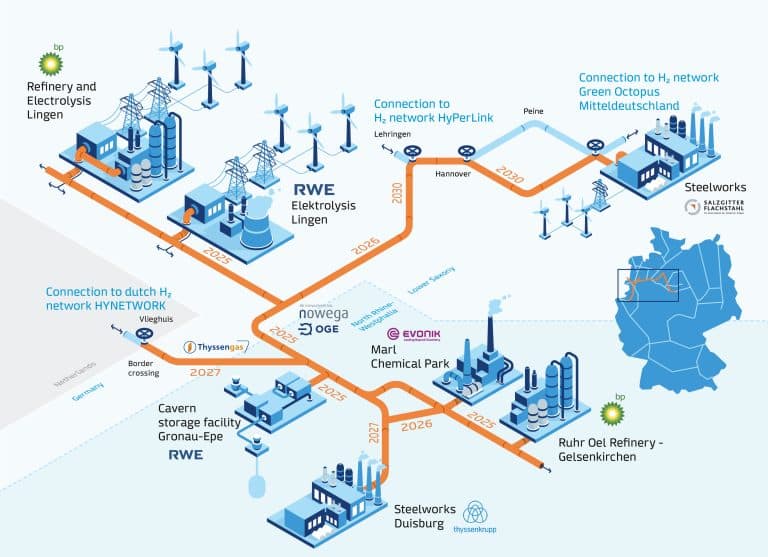
Source GET H2: GET H2 Nukleus project
Translation disclaimer
This article is a machine translation of the Czech original and has not yet been fully reviewed. In case of any doubt, please refer to the Czech version.
Sdílejte článek prostřednictvím:
You might also like


23 October 2026, 11:01


23 October 2026, 06:34