On the road to a greener future, Europe is relying on a transitional fuel—natural gas. But its price is rising, and this is likely to happen again whenever there is a major disruption on the global market. Domestically produced biogas has limited potential, and we will have to wait at least another 25 years for hydrogen, says Lukáš Dobeš, chairman of the Cogen Czech association.
Cogen Czech brings together companies and experts in the field of cogeneration units. These produce electricity and heat together, capturing waste heat and using it for heating or water heating.
Cogeneration units can run on natural gas or biogas. One day, they may also burn hydrogen. “It has a future, but only if there is technological development and progress, and a significant breakthrough in cost that would make mass use possible,” says association chairman Lukáš Dobeš.
“Europe needs to fill its storage facilities”
If there is a freezing winter, what will happen on the gas market? Will there be enough gas?
There is enough gas in the world; it just needs to be delivered to the right places at the right time. Severe winters naturally make the market more nervous, which in turn pushes prices up. Gas producers know that Europe needs to fill its storage facilities, especially since Germany’s are not very full. Producers can ask for a higher price, and they know they will get it. It is difficult to predict what will happen and whether prices will rise as they did during the 2021 and 2022 crisis.
Could gas prices on the market reach three figures, exceeding 100 euros per megawatt-hour (MWh)?
Theoretically, yes. But if we compare the infrastructure we had five years ago with what we have today, we are in a much better position. We have enough tankers, terminals for regasifying liquefied natural gas, and so on. If gas prices rise above 100 euros per MWh, I do not think that would last long. Gas currently costs more than 80 euros on the market, but forwards (long-term contracts, ed.) are priced lower. The market simply sees that Europe is in a better position and is safer in this respect than it was five years ago.
Isn’t it just an illusion that we are in a better position? Is there a risk that every year before winter we will be competing with China for natural gas?
What options does Europe actually have? It could produce gas within its own borders, which I do not think is really feasible at this point. Europe is much more densely populated than America, so that option is off the table. We have production in Norway and import a large share of our gas from the US.
Given its green policies, Europe still does not know how to approach long-term contracts. Suppliers in the Middle East say: yes, we will build infrastructure for you, drill new wells, do everything you want, but in return we want a 20-year natural gas contract. And Europe responds: We want to start moving away from gas in 2040 and get rid of it altogether by 2045. A 20-year contract is not realistic for us.
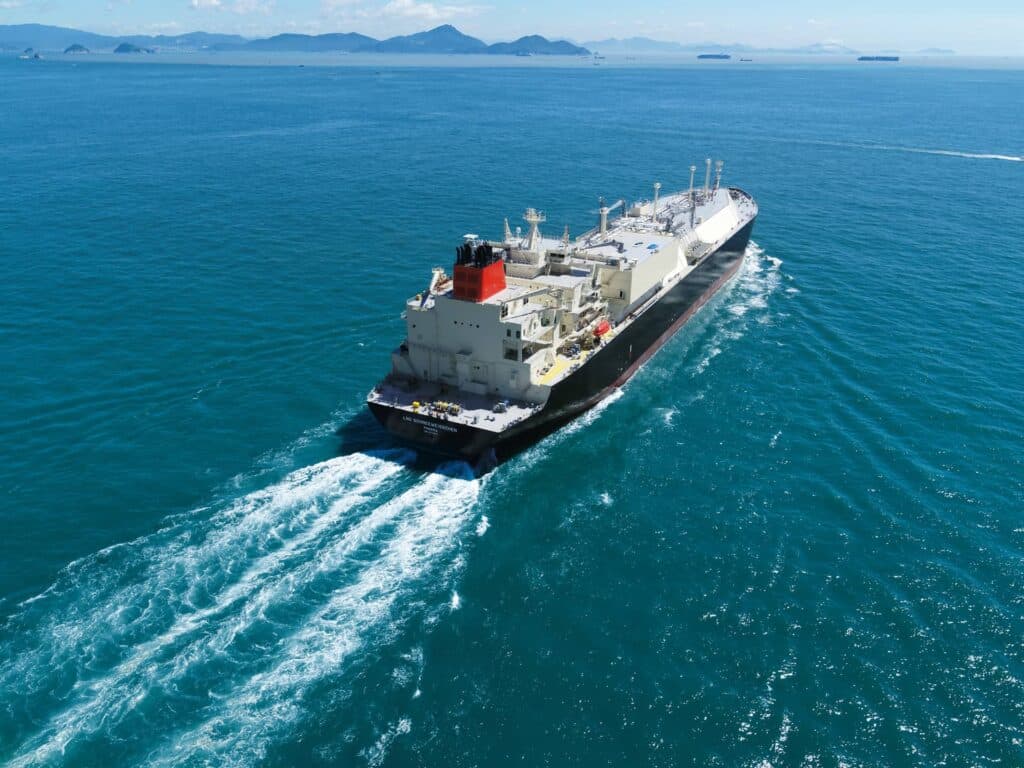
Given our policies, we cannot enter into a 20-year contract. And they cannot agree to a 10-year contract because of the huge investment needed to build the infrastructure. We cannot reach an agreement. So what happens is that we compete with Asia for ships at sea. But these are things that are difficult to change in Europe today. This is the situation we have to work with. And because of that, we have to be prepared for gas prices to be highly volatile.
In a recent commentary for hn.cz, you wrote that biomethane auctions are increasing Czechia’s ability to replace some imported natural gas with domestic sources. What share are we talking about, say, over the next ten years?
It will still be only a small share. If all the planned auctions go ahead and the gas volumes on offer are contracted, we will be talking about covering five to ten percent of domestic gas consumption.
Why so little?
The potential is limited by the fuel supply. A biogas plant that produces biomethane needs to be fed with something. And today, I do not think anyone wants to grow crops specifically to produce fuel.
So the share of domestically produced gas will not be large. Especially since gas consumption is expected to rise further as natural gas replaces coal in district heating plants. But let’s be frank: every cubic metre of gas produced in Czechia reduces dependence on imports and eases market jitters. There are countries in Europe where biomethane already covers consumption by tens of percent. But given its location, the Czech Republic cannot really aspire to reach those levels.
Why not?
Because it gets quite cold here and we need a lot of heating. We are in the part of Europe where the heating season starts in September and ends in May. We cannot do without heating.
So, to sum up: in the future, we need to be prepared for prices to be higher every winter, for us to compete for LNG ships at sea, and then we’ll see.
We will see whether this is sustainable or whether Europe will take a different path. I think that, when it comes to long-term contracts, people may realise that decarbonisation does not have to proceed as quickly as planned. The price of emissions allowances remains an open question. If the current EU ETS 1 system is retained, which gradually reduces the number of allowances in circulation and therefore raises their price, the cost of heat and electricity produced from gas will be very high.
“We have just under one gigawatt of capacity”
When someone says cogeneration, what should I picture?
We are talking about engine-generator cogeneration units, one type of combined heat and power generation. There are also large turbines, but they are a little different.
Cogeneration units with an internal combustion engine and a generator are relatively simple devices. The smallest ones used to have car engines; today they use stationary engines. Medium-sized cogeneration units have engines that can also be used in trucks. And the largest units have large marine engines. In other words, these engines are used either in cogeneration units or in huge ships. Their capacity is then measured in megawatts.
How large is the domestic market for cogeneration units?
There are approximately 800 cogeneration units running on natural gas, with a total capacity of around 450 megawatts. There are around 600 biogas units, but their capacity is slightly higher, at about 500 MW. Together, we have just under one gigawatt of capacity.
Why do biogas cogeneration units have 50 megawatts more capacity?
This is due to the different support rules for natural gas and biogas cogeneration. The state set up operating support in the form of a so-called green bonus. The state pays operators a bonus for every megawatt-hour produced. It should be noted that this support scheme for natural gas ended in 2025. All cogeneration units built by the end of 2025 operate with this support.
Natural gas cogeneration units have to use all the heat they produce. That is why they were first installed at district heating plants and boiler houses in the middle of housing estates—in short, anywhere a plant supplies heat to an urban area while also generating electricity and feeding it into the grid. Businesses, large and small, came next, and the technology gradually spread to smaller facilities such as schools and swimming pools. Support is provided for approximately 3000 operating hours per year. This means that cogeneration units run at full capacity only in winter, when electricity is in short supply and heat also needs to be supplied.
And what do they do in summer?
They run only during certain hours, most often during the morning or evening peak, supplying heat for things such as water heating. In summer, district heating plants might run cogeneration units for two hours in the morning and another two in the evening. They use a storage tank: the area is supplied with hot water from it throughout the day, and in the evening it is heated again so that it lasts through the night. If a business does not need heat, its cogeneration unit runs only during the winter months and then sits idle for the next six months.
And how was biogas support designed? Is it not necessary to use the heat in that case?
Biogas support was designed to get the sector off the ground—to encourage farmers to make use of waste generated by agricultural production. There is no requirement to use the heat, and support is not limited by the number of operating hours. In short, the conditions for biogas were more flexible. Similar rules will now apply to natural gas and biogas under the capacity mechanism (i.e. support for flexible sources, for which the state will pay for capacity and readiness to supply the grid, ed.).
What do you mean?
There is no requirement to use the heat, and there is no limit on operating hours. So a lot of investors are now preparing projects for cogeneration units that do not use the heat. In that case, they will not really be cogeneration units at all; they will simply generate electricity using an engine-generator system.
“We need to store electricity produced in summer for winter”
How many megawatts of cogeneration capacity will be built in Czechia because of the capacity mechanism?
Those projects will add several hundred megawatts; capacity could easily increase by as much as the amount currently in operation. What has been built here over 15 years could now be added in just a few years through capacity mechanisms. And that is only because there will be no requirement to use the heat. This is not ideal from an environmental perspective, because the biggest advantage of cogeneration is precisely its greater energy efficiency. We can use 90 percent of the energy contained in the primary fuel.
At the last minute, ČEPS extended by two months the deadline for projects to apply for so-called preliminary assessment if they are interested in capacity payments. Did that surprise you?
It certainly surprised many participants. Just a week beforehand, we recorded a podcast with René Neděla, the senior director of the energy section at the Ministry of Industry and Trade. His comments made it clear that the deadline would stand. The capacity mechanism’s state aid notification said that the first plants were to start operating in 2030, four years from now. The auction had to be held in October because of the so-called gas year, which always begins on 1 November. The aim was to have power plants ready to operate from 1 November 2030. Postponing the auctions shifts this back by a whole year.
Won’t that be a problem?
It seems not, because high electricity prices mean coal-fired power plants will not close as quickly as expected. They will remain profitable even after emissions allowance costs are factored in. So capacity from the capacity mechanisms probably will not be needed in 2030, which means the delay is not disastrous. On the contrary, it creates an opportunity to prepare projects better and attract more of them.
Is the complete decarbonisation of cogeneration units realistic within 15 or 20 years? Could they run on hydrogen, for example?
In some parts of the year and during certain hours, renewable sources generate huge amounts of electricity. That is why people talk about storage. This can be handled with batteries, but they can store electricity for only a few hours, or at most a few days. We need seasonal storage—we need to store electricity produced in summer for winter. The only way I can see is some kind of gaseous fuel. It can be stored in storage facilities for months. This would reduce dependence on imports, reduce price volatility, and so on. The idea is to use electrolysis to produce hydrogen from surplus electricity.
But the problem is with the molecules…
Yes, hydrogen molecules are tiny and escape through ordinary steel. In most cases, 100 percent hydrogen is not transported today. Instead, it is a blend, where this is less of a problem. Tests on Czech cogeneration units have shown that a 20 percent hydrogen volume share is no problem. That means a standard cogeneration unit can burn a mixture of 80 percent natural gas and the rest hydrogen. But it will take decades to get beyond that 20 percent.
Why?
Economically, it would be complete suicide. The cost of electrolysers and the entire storage system is astronomical. Electricity and heat produced this way would be so expensive that consumers would not be willing to pay for them. Yes, it has a future, but only if there is technological development and a major breakthrough in cost that would make mass use possible. So we are talking about a horizon of 25 years or more.
Is there no other option for seasonal storage?
Other types of storage are mostly still speculative. There is a lot of talk about molten salts and sand batteries. But these are more likely to be used for shorter-term storage, on the scale of weeks. They are being tested in Finland and other Nordic countries, but the amount of sand needed to store energy is disproportionately large compared with what you get out of it. They heat a few hundred apartments with it. The quantity of sand that needs to be heated and stored is enormous. For example, heating 20 apartments requires 2000 tonnes of sand.
So once again, the problem is economic reality.
Europe’s economic position was, and still is, based on cheap fossil fuels. Any change to this system will mean a decline in living standards. Many companies in the renewables sector say that wind and solar power is cheap because the fuel is free. That is true, but building the necessary infrastructure, providing storage and flexibility, and transforming the entire system will all be expensive.
The more inflexible and unpredictable renewable sources we have, the more we will have to rely on flexibility or storage, or retain centralised fossil-fuel plants to cover periods of shortage. That is exactly what capacity mechanisms are about. European countries have realised: We cannot tell households that they can use electricity only when the wind is blowing or the sun is shining; we cannot tell them to turn off the heating and television. So we will build new flexible sources.
Lukáš Dobeš
*Chairman of the Cogen Czech association.
*CEO of the Tedom Esco group, which operates energy facilities.
*Has worked in the energy sector since 2002, focusing on decentralisation, cogeneration units and supply flexibility.
*Worked for the ČEZ Group for eleven years.