
23 October 2026, 14:38
Loading...
IEA: Power generation and industry drive global growth in gas consumption
Klára Čeperová
27 March 2025, 10:45
Global demand for natural gas reached a new all-time high. According to the International Energy Agency (IEA), more than three-quarters of the growth came from emerging market and developing economies.
After the supply shock in 2022 and 2023, natural gas markets gradually returned to balance, and in 2024 they returned to structural growth, as the International Energy Agency (IEA) had forecast.
According to IEA preliminary data, gas demand increased by 2.7% in 2024, or 115 billion cubic metres (bcm). Emerging market and developing economies in Asia accounted for around 40% of additional gas demand in 2024, driven by continued economic expansion.
India and China lead the way
Natural gas demand in emerging market and developing economies in Asia grew by around 6% in 2024, accounting for nearly 40% of the increase in global gas demand. China and India recorded the fastest growth, supported by low LNG prices in the first half of the year and extensive heatwaves in the second and third quarters of 2024. Demand also rose significantly in Russia.
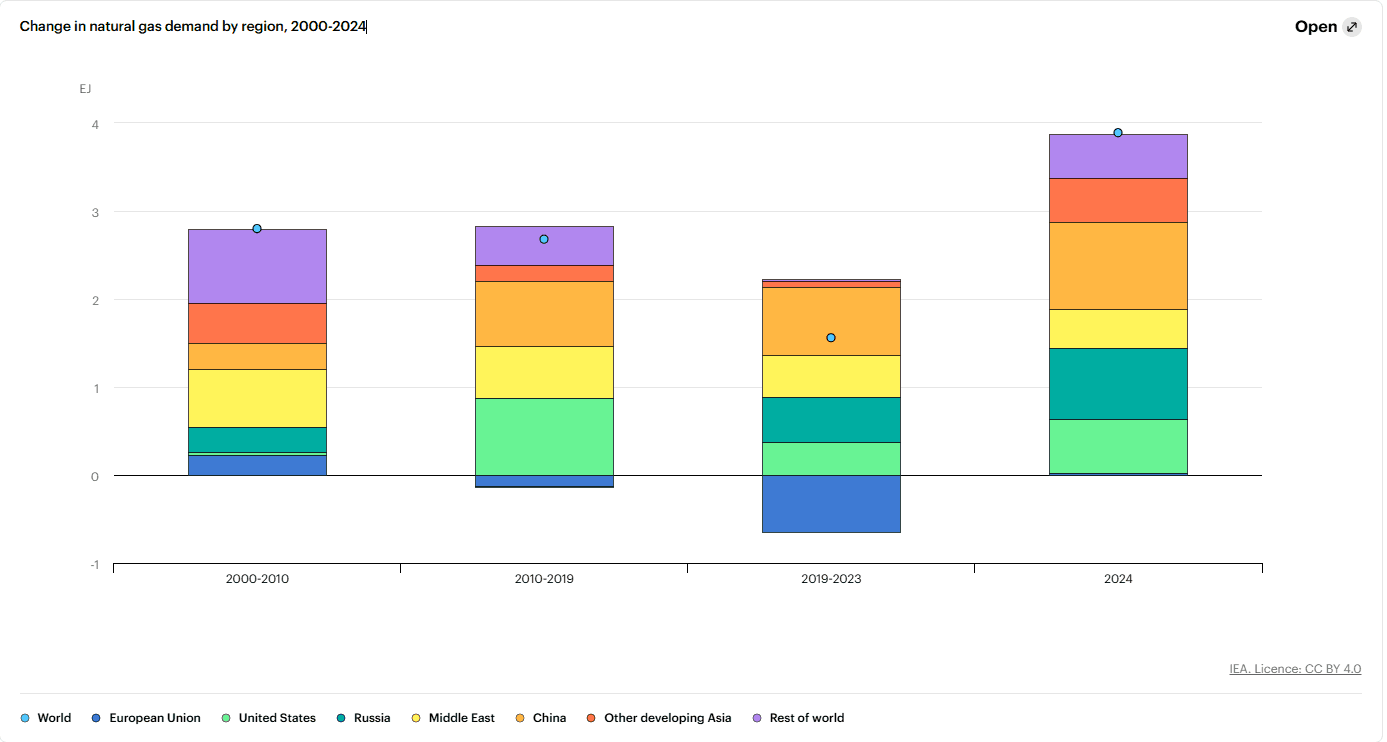
Source: IEA. Change in gas demand by region
Natural gas demand in China grew by more than 7%, although demand growth turned negative in the final two months of the year. In India, natural gas demand increased by 10%, supported by a favourable macroeconomic environment, the expansion of natural gas networks and greater need for gas-fired power generation due to high temperatures.
Natural gas consumption in the European Union increased by around 1% in 2024. Regional gas demand for power generation fell by around 5% in 2024, despite total electricity demand rising by around 1.5%. The sharp decline in gas-fired power generation was primarily driven by a significant increase in renewable power generation.
However, this puts the EU at odds with the global trend: worldwide, gas demand for power generation increased, and together with industry it accounted for 75% of the global increase in gas demand.
More electricity was generated from gas in North America, Asia and Latin America, particularly in Brazil and Colombia, which were affected by drought. This limited the availability of hydropower generation.
Other factors
The overall increase was also driven by continued economic expansion in fast-growing Asian markets, as well as some recovery in industrial gas demand in Europe, although it remained significantly below pre-crisis levels.
Extreme weather conditions, particularly heatwaves in China, India and the United States, contributed to greater gas-fired power generation in 2024.
Natural gas continued to displace oil and oil products across various sectors, supported by policies, regulations and market dynamics. The shift from oil to natural gas in the power sector continued in the Middle East in 2024.
In road transport, the rapid expansion of natural gas trucks in China—with record sales in 2024—contributed to lower diesel demand in the country. The use of LNG as a bunkering fuel is also expected to increase amid stricter emissions regulations for shipping.
Year-on-year demand for gas for power generation rose by nearly 2.8%, as strong growth in North America, fast-growing Asian markets and Eurasia was partly offset by lower gas-fired power generation in Europe. Extreme temperatures alone accounted for around one-fifth of the increase in global natural gas demand. Natural gas demand in the residential and commercial buildings sector rose by around 1% in 2024.
In Africa, lower extraction activity limited the growth in natural gas demand to less than 1%.
Translation disclaimer
This article is a machine translation of the Czech original and has not yet been fully reviewed. In case of any doubt, please refer to the Czech version.
Sdílejte článek prostřednictvím:
You might also like


23 October 2026, 11:01


23 October 2026, 06:34