
23 October 2026, 14:38
Loading...
A major milestone for the UAE: final unit at Barakah nuclear power plant officially enters commercial operation

Jiří Salavec
9 September 2024, 11:54
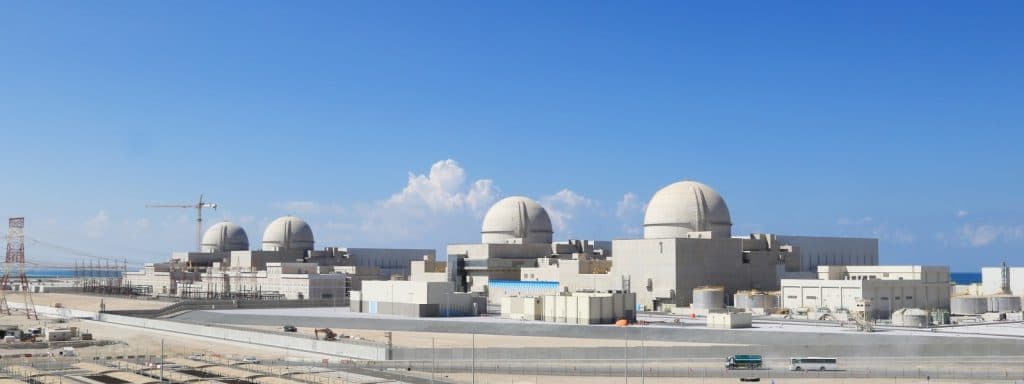
The United Arab Emirates has successfully completed construction of its first nuclear power plant, Barakah. The fourth unit has completed all tests and officially entered commercial operation. With a total capacity of 5,600 MW and South Korean APR-1400 units, the plant will now generate enough electricity to cover around a quarter of the country's consumption. The Emirates are already planning to complete two more units at the site as part of their climate goals.
Emirates Nuclear Energy Corporation (ENEC) announced the achievement of a major milestone. The fourth and final unit at Barakah, the Arab world's first nuclear power plant, has successfully entered commercial operation. Construction of the 1,400 MW APR-1400 nuclear unit took 9 years. In total, it took the country an impressive 12 years to build its first four-unit nuclear power plant, with a capacity of 5.6 GW.
“In 2008, the visionary leadership of the United Arab Emirates issued a comprehensive policy for the development of civil nuclear energy in the UAE, with the aim of transforming electricity generation. With Barakah Unit 4 entering commercial operation, that vision has been realized, with one in every four electrons on the UAE grid coming from the Barakah plant. This source of clean electricity will act as a magnet, attracting further investment in the UAE from sustainability-minded, energy-intensive industries around the world,” said His Excellency Khaldoon Khalifa Al Mubarak, Chairman of ENEC.
Once all four units are in operation, Barakah will generate 40 TWh of electricity annually. According to ENEC, that is almost equivalent to New Zealand's annual electricity consumption and around 25% of electricity in the UAE. The company says this amount of electricity would be enough to power 16 million electric vehicles a year. The estimated 22.4 million tonnes of CO2 emissions that Barakah will prevent account for around 24% of the country's decarbonization commitments through 2030.
“We are immensely proud of this monumental achievement for the United Arab Emirates. Over the past five years, the country has added more clean electricity per capita than any other nation, with 75% of this contribution coming from the Barakah plant. This clearly demonstrates that integrating nuclear energy into the UAE's energy mix and increasing the share of renewables was the right decision,” said His Excellency Mohamed Al Hammadi, Managing Director and Chief Executive Officer of ENEC.
More units on the horizon?
According to ENEC, the Barakah plant has brought a range of economic and environmental benefits. Despite rising electricity demand, natural gas consumption for power generation in Abu Dhabi is at a 13-year low. More than 2,000 highly skilled workers from the Emirates have contributed and continue to contribute to the plant's construction. Construction of the plant generated around $6.7 billion (over CZK 150 billion) for the local supply chain.
“The Barakah plant now generates a quarter of the UAE's electricity consumption in a way that will ensure a stable energy supply for the next 60 years. The reliable capacity and low price volatility it provides offer a strong foundation on which to build and grow,” said Nasser Al Nasseri, CEO of Barakah One Company.
ENEC expects electricity demand in the UAE to continue growing by an average of 3.4% in the coming years. Data centres and artificial intelligence are among the main drivers of increased consumption. UAE representatives have therefore already begun discussions with their South Korean counterparts about a possible expansion of the plant by two more units.
Translation disclaimer
This article is a machine translation of the Czech original and has not yet been fully reviewed. In case of any doubt, please refer to the Czech version.
Sdílejte článek prostřednictvím:
You might also like


23 October 2026, 11:01


23 October 2026, 06:34