Czech nuclear waste repository will have minimal impact on its surroundings, expert says

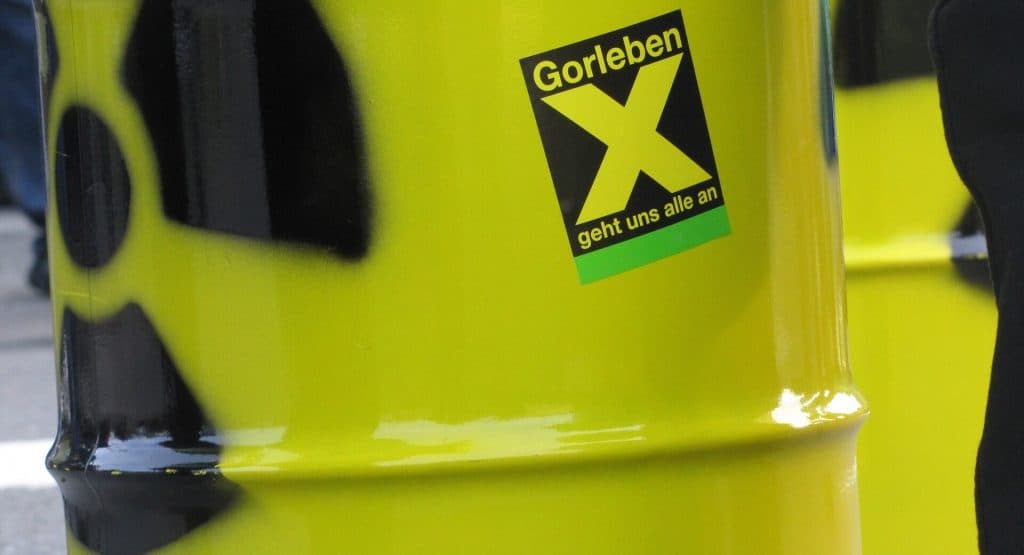
Nuclear waste repository should have minimal environmental impacts on the soil, and there are no better options for radioactive waste management in Europe, Jan Rohovec of the Institute of Geology of the Czech Academy of Sciences told CTK. The Radioactive Waste Repository Authority (SÚRAO) is currently assessing four sites in Czechia where a CZK 100 billion repository could be built. These are the Horka and Hrádek sites in the Vysočina region, Janoch near the South Bohemian nuclear power plant at Temelín, and Březový potok in the Klatovy area. Most of the affected municipalities have long opposed the construction.
„Repositories are designed so that even if containers holding radioactive material were to be damaged—a possibility that is largely theoretical—there would be enough insulating layers of different materials around them to stop any potential leak,“ Rohovec said.
According to him, routine environmental impacts would arise, for example, from transporting material to be stored.
„We expect the impact on the soil to be practically negligible. Repositories are built in bedrock hundreds of metres below the surface, in very compact and durable rock, outside soil horizons. At most, we would expect the usual effects of a mine on the landscape in its immediate surroundings. That means a small change in the water regime, which may not even be visible at the surface,“ Rohovec said.
He said residents’ concerns were unfounded.
„The area above the repository and the repository itself would be continuously monitored, far more than any other area. And if, purely theoretically, something were to happen, it would happen slowly and be detected immediately, allowing a response,“ Rohovec said.
According to him, the metallurgical, chemical and processing industries pose a far greater environmental burden.
The government will decide where to locate and build the deep geological repository for radioactive waste, after consulting the affected municipalities, for which the cabinet may set compensation. This is provided for in a law signed by President Petr Pavel on Thursday.
The repository was originally due to be built by 2065, but speeding up construction is being discussed because nuclear power has been temporarily classified as a green investment in the EU. The condition is that countries relying on nuclear power must have deep geological repositories by 2050.
„The biggest source of conflict between municipalities and the proposed construction is that municipalities have no say in decision-making with the state. If municipalities had a more equal footing, there would be a path to greater agreement and more equal negotiations. Some no longer want a repository under any circumstances, and that will be difficult to change,“ Edvard Sequens of the Platform Against Deep Geological Repositories told CTK.
Among other things, the platform points to how the area and residents’ lives would change, including the stigma that in some cases accompanies the danger of radioactive waste being stored near people’s homes, Sequens added. Thousands of tonnes of spent nuclear fuel from power plants are to be permanently stored in the repository half a kilometre underground.
„The Radioactive Waste Repository Authority has several projects underway that address environmental impacts. We have now completed what is known as a biological screening of the four shortlisted sites,“ Markéta Dohnálková, head of the radioactive waste repository preparation department at SÚRAO, told CTK.
„We also have local working groups at two sites that present municipal representatives with the results of projects and the process for selecting the final site. They did not want them in the Vysočina region, but a communication platform is held there once every six months. It works on the same principle, but is run by the region itself,“ Dohnálková added.
Translation disclaimer
This article is a machine translation of the Czech original and has not yet been fully reviewed. In case of any doubt, please refer to the Czech version.




